

 |
|
|
|
|
[+] Chemistry of Real Fuels[+] Biofuel Combustion Chemistry[+] Transport Properties of Fuel Molecules[-] Nanoparticle Formation in Combustion SystemsIn the combustion environment, nanoparticle formation is a fascinating multiscale
problem, both in length scale and in time scale. When the nanoparticles are able to reach a critical size, they begin to aggregate and the molecular science of the nanoparticles bridges with the statistical mechanics of nonequilibrium self-assembly and nucleation over two disparate length and time scales in a truly fascinating way. ¹ A. Violi Combustion and Flame 139: 279 (2004). 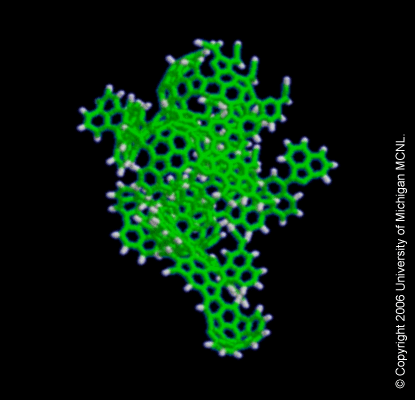 This work is supported by the National Science Foundation. Publications related to this project: 35. S. H. Chung, A. Violi “Insights on the Nanoparticle Formation Process in Counterflow Diffusion Flames”, CARBON 45(12): 2400-2410 (2007). [Download .PDF] 20. A. Violi “Modeling of Soot Particle Inception in Aromatic and Aliphatic Premixed Flames” Combustion and Flame 139: 279-287 (2004). [+] Coarse-Graining Simulations of Nanosystems |
See Also: |
|||