SCIENCE
EXPERIMENTS AND THE RELATIONSHIP TO
LEARNING
STYLES
CARL
F. BERGER
Background
Work relating problem
solving, learning, and teaching styles was first reported by David A. Kolb and
his colleagues, Irwin Rubin and John McIntyre (1979). This work came from
Kolb's earlier work (1976) on learning styles. Gathering data from thousands of
adults in varying occupations, Kolb found that people could be categorized into
four styles representing two dimensions (see Fig. 1).
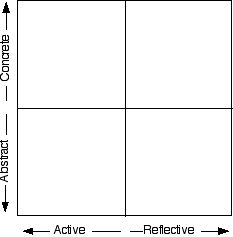
Figure
1 Learning Style Type Grid
(Adapted
from Kolb, 1976)
Across one dimension was a
pattern in learning style of active to reflective; across a different dimension
was a pattern from concrete to abstract. These dimensions sound familiar to
those of us acquainted with Piagetian psychology. Concrete operations and
formal or abstract operations are two of Piaget's developmental states.
Further, we are all familiar with students who learn actively or reflectively
or, as Kolb puts it, the "doers and the watchers."
Using the very simple
and straight forward "Learning Style Inventory," which takes about 5
to 10 minutes to complete, Kolb (1976) found striking differences in the
learning styles of adults in different occupations. He also found marked
differences related to the basic personalities of the people tested. Striking
as these differences may be, they fit remarkably well into reasonable theories of
personality and occupation selection. For example, in a large sample of MIT
seniors, business majors were highly active and concrete, whereas physics,
chemistry, and mathematics majors were highly abstract and somewhat reflective.
Political science and history majors on the other hand, were highly reflective
and concrete. Engineering students were active and abstract. In studies
identifying elementary and secondary teachers, colleagues of Kolb found that
elementary teachers were highly concrete, and secondary school teachers were
more abstract; both were equally active (see Fig. 2).
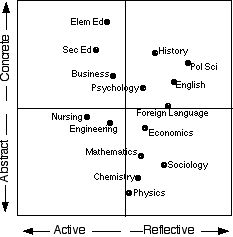
Figure 2. Student majors
grouped on the Learning Style Grid
Kolb, Rubin, and McIntyre
extended these learning style investigations into the field of problem solving.
In their book, Organizational Psychology: An Experimental Approach (1979),
the authors noted problem‑solving steps that they identified with
locations on the learning style chart. Starting from the 3 o'clock position and
proceeding clockwise, as shown in Fig. 3, they defined a series of two steps in
each quadrant that could be thought of as steps of a problem‑solving
process.
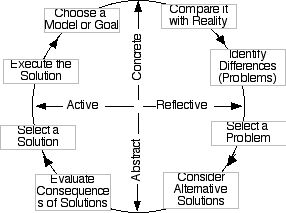
Figure
3 Problem Solving Cycle from Kolb, Rubin and McIntyre (1979)
These steps are:
1) Select a problem
2) Consider alternative
solutions
3) Evaluate the
consequence of solutions
4) Select a solution
5) Execute a solution
6) Chose a model or goal
7) Compare it with reality
8) Identify differences (problems).
Study
David Keller of the Akron
Public Schools and I noted that these steps were similar to steps in a
scientific method (neither of us believe there is THE scientific method). We
generated another similar series of steps that might be more recognizable to
science teachers. They correspond to the above steps and are listed below:
1) Select a problem
related to a model
2) Develop hypotheses
3) Evaluate to find the
best hypothesis
4) Select and experiment
to test the hypothesis
5) Carry out the
experiment
6) Draw conclusions
7) Compare conclusions
with the model
8) Identify new problems
and/or models
These steps are very
similar to many scientific methods or problem solving models such as one
reported by Dorothy Cox (1980). Armed with this new information that could
relate to science teaching, David Keller and I wondered if science teachers had
a particular problem‑solving style.
Method
Study 1
We tested 76 teachers who
were working in a demonstration project for gifted students in the Akron Public
Schools. Using Kolb's Learning Style Inventory, .we first checked to see if we
could identify the same dimensions from our data as Kolb had from his. We were
quite pleased and not a little bit surprised to find that our results compared
very well with those of Kolb. We could independently produce the same
dimensions of "concrete‑abstract and active reflective" that
Kolb had found in his original data. We did this through a complex statistical
process known as principal component analysis. Not only could we reproduce the
dimensions, but also there appeared to be no single learning style or problem‑solving
style that clearly dominated our population of teachers (see Fig. 4).
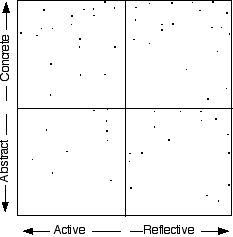
Figure 4 Scores of 76
teachers on a Learning Style Grid.
Thus, it is no small
wonder that any single curriculum will not be appropriate for all teachers, and
perhaps this is the source of the expression, "But it doesn't work for me.
" It appears from Fig. 4 that these 76 teachers fit, and each may be comfortable
with, varying parts of a scientific method. Some might emphasize more the
hypothesis portion of science, others the experimentation segment, still others
the application part, and some the model generation portion. For fun we could
place Mildred Fetisque, Walter Smedly, Alma Curlew, and Oswald Minicule on the
chart, not by their learning style, but by their teaching style. Kolb's
research on teaching styles indicates that there is a close match between
learning and teaching styles (1976).
Study 2
Are teaching and learning
styles so closely related to our personalities and occupations that they are
set and immutable? The research on this question is not clear, so David Keller
and I tried an experiment. We attempted to find out if the problem‑solving
style of teachers could be modified by the kind of activity the teachers were
involved in during a workshop. We generated three simple experimental
activities that involved different parts of a problem‑solving or
scientific method process. Each of these experiments, we hoped, would require
the use of a problem‑solving segment found more in one quadrant of the
model than in another. We could then determine if the teachers modified their
problem‑solving style by shifting toward a particular quadrant depending
upon the kind of experiment. Our first experiment was designed to be both in
the active and abstract quadrant. In this experiment, teachers had to support a
book 5 cm above the table using only a file card. We thought that this activity
would encourage teachers to reason abstractly and then actively build a
structure with the file card to support the book. Experiment number two was
designed to be in the reflective and more abstract quadrant. In this activity,
teachers, working in groups, had to generate a food web, remove one or two
links from that web and infer changes that would occur in the food web. Next,
they were to compare the changes with a similar activity done with an energy
web. Our third experiment was designed to be in the active and concrete
quadrant. It involved the use of a simple drop reaction timer to measure
reaction time; teachers were to modify their reaction time through a series of
experiments. We hoped that the data from the Learning Style Inventory
administered just after each activity and reflecting on the problem solving
during the activity, would show shifts toward the quadrants emphasized in the
particular experiment. The results of our work with these 76 teachers exceeded
our expectations. As shown in Fig. 5, in each activity the means of the group
fell in the appropriate quadrant.
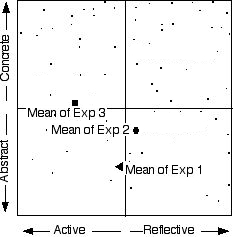
Figure 5. Means of Three
Experiments on a Learning Style Grid.
Further, there were strong
significant differences among all three means, well beyond the traditional
expected levels of statistical significance. Again, the teachers covered the
entire spectrum of quadrants, and while the overall mean of each group did
shift in the expected direction, strong individual differences were still
apparent.
Conclusion
While teachers maintain a
strong individual problem‑solving style, that style can be modified,
depending upon the particular activity involved. We hope to do further research
to determine if teaching styles also change in given activities. My own work in
the late 60's and early 70's shows marked evidence of the relation between
teaching behavior and teaching style perception, and that differing activities
encourage wider ranges of teaching styles (Berger, 1977)
Resources
Berger, Carl F.
"Investigation of Teacher Behavior: Interaction with New Curriculum Materials."
In M. Piper, and K. Moore (Eds.), Attitudes Toward Science investigations. Columbus,
Ohio: ERIC/SMEAC, The Ohio State University, 1977.
Cox, Dorothy A. Early
Adolescent Use of Selected Problem‑Solving Skills Using Microcomputers. Unpublished
doctoral dissertation, University of Michigan, 1980
Crowfoot, James A.
Personal communication, 1979.
Gephart, W., D. Strother,
and W. Duckett. "On Mixing and Matching of Teaching and Learning
Styles." Practical Applications of Research. Bloomington, IN: Phi Delta
Kappa, 3(2):1‑4, 1980.
Karplus, R., A. Lawson, W.
Wollman, M. Appel, R. Bernoff, A. Howe, J. Rusch, and F. Sullivan. Science
Teaching and the Development of Reasoning. Berkeley: Lawrence Hall of
Science, University of California at Berkeley, 1977.
Kolb, David A. Learning
Style Inventory Technical Manual. Boston: McBer and Co., 1976.
Kolb, D.A., I. Rubin, and
J. McIntyre. "Learning and Problem Solving.� Chapter 2 in Kolb et.al. Organizational
Psychology: An Experimental Approach (3rd ed). Englewood Cliffs, N.J.:
Prentice Hall., 1979.Tyler,. R. Basic Principles in Curriculum and
instruction. Chicago: University of Chicago Press, 1949.