Stationary
Mechanism
Click Here for the Animated Mechanism
Reaction Mechanism for Conversion of 102 to 116
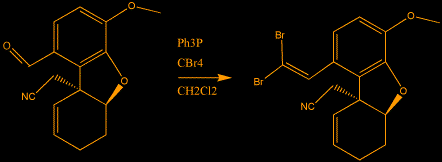
This is the overall reaction, converting compound 102 to compound 116. For simplification, an R group is used in the explanation.
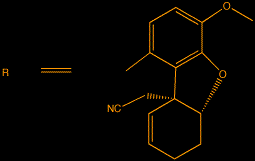
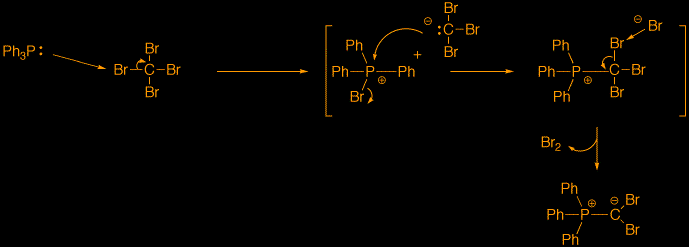
The phosphorus attacks the bromine because the carbon atom is too crowded. The carbanion comes back and attacks the phosphorus, with the bromine atom acting as a leaving group. The bromide ion comes back and attacks a bromine from the carbon and bubbles off as bromine gas.

The resonance form uses 3d (from the phosphorus) and 2p (from the carbon) orbitals. Since phosphorus has 3d orbitals, having five bonds is allowed. The resonance form undergoes a cycloaddition with compound 102 to form the intermediate.
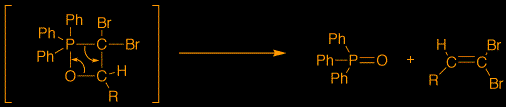
The transition state undergoes a cyclo-reversion to form POPh3 and compound 116. POPh3 is a very stable compound due to a high bond energy of P=O.

Reaction Mechanism for Conversion of 116 to 114
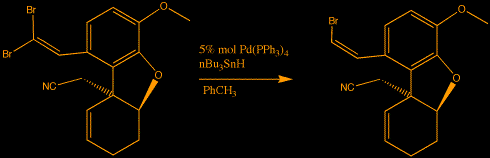
This is the overall reaction, converting compound 116 to compound 114. For simplification, an R group is used in the explanation.
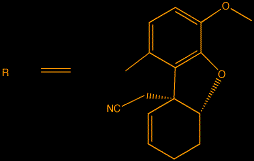
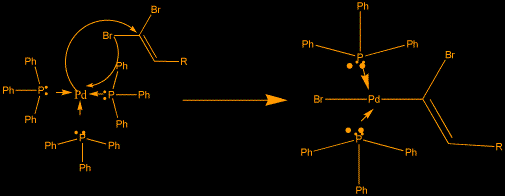
The Pd/PPh3 interactions form ligands, which are indicated by arrows. They easily attach and and detach from each other and one is removed from the first step for clarity. Through oxidative insertion, Pd(PPh3)4 interacts with compound 116, creating the intermediate.
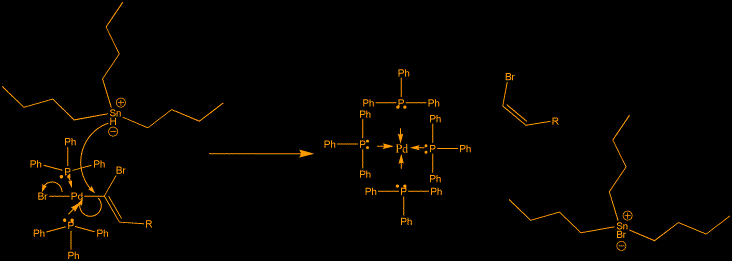
The nucleophilic hydride from nBu3SnH attacks the sp2 carbon, creating a C-H bond, while breaking the Pd-C bond. The bromine acts as a leaving group, yielding Pd(PPh3)4, Bu3SnBr, and compound 116 as products.