MechanismHNMR CorrelationExperimental ProcedureLeading Questions
References
About Us


Experimental

To a solution of sceptrin•2TFA (100 mg, 0.118 mmol) in H2O/CH3CN (1:1, 20 ml) was added peracetic acid solution (In dilute AcOH, 0.024 mmol) and the resulting solution was heated at 50°C. The reaction mixture was monitored by HPLC and additional 5 μL portions of peracetic acid solution added as necessary until ~50% of sceptrin was converted to the dihydroxylated products.  The reaction was then stopped. The four isomers of 50 were visible by analytical HPLC. As all four isomers participated in further reactions, they were isolated together by preparative HPLC to give 52 mg of 50 as a white solid (50 % yield) along with 35 mg of recovered sceptrin (35%).


Dihydroxylated sceptrin
50 (15 mg, 0.017 mmol) was dissolved in H2O (3 mL) and 0.2 mL of glacial acetic acid was added. The resulting solution was heated at 140 °C for 1 hour under reflux.  The resulting mixture was purified by preparative reverse phase HPLC. Oxysceptrin (13) was obtained as a white solid. (9.5 mg, 65 % yield)

IR (film) νmax 3500-3100, 1735, 1676, 1203, 1139 cm-1; 1H-NMR (600 MHz, CD3OD) δ6.94 (S, 2H), 6.82 (d, 1H), 6.73 (d, 1H), 6.54 (s, 1H), 4.43 (d, 1H), 3.42-3.49 (m, 4H), 3.01 (t, 1H), 2.66 (dt, 1H), 2.25 (m, 2H); 13C-NMR (600 MHz, CD3OD) δ123.0, 97.6, 113.8, 127.3, 127.0, 163.1, 163.0, 43.2, 42.6, 42.1, 41.8, 45.8, 40.0, 43.9, 35.1, 32.9, 61.7, 61.0, 129.1, 128.7, 160.5, 160.4, 148.7, 174.1, 110.6, 110.5; ESI-MS  m/z  635, 637, 639 [M+H]+, HRMS (ESI-TOF) calcd. For C22H25Br2N10O3 [M+H+] 635.0472, found 635.0461.

Glossary

Peracetic Acid:
Peracetic Acids elong to the organic peroxide family; is a bright, colorless liquid with a characteristic acrid acetic acid type odor; has a strong oxidizing potential and is highly corrosive.
Peracetic Acid

Dihydroxylated Sceptrin: 
Dihydroxylated Sceptrin was formed from the epoxidation of sceptrin as an intermediate.
Dihydroxylated Sceptrin

Glacial Acetic Acid:

Acetic Acid

Glacial acetic acid is anhydrous acetic acid.

Reflux:

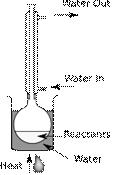
Reflux is a technique used in laboratory distillations to apply energy to reactions over a long period of time.  This increases the reaction rate by adding more energy, allowing a reaction which may not occur at normal conditions to occur more quickly.  With this idea, the reaction can go on for a long period of time without having to add more solvent to the system, because the condenser which is cool, due to water flowing through it, to condense the solvent back into the system.
Reflux.png

HPLC:

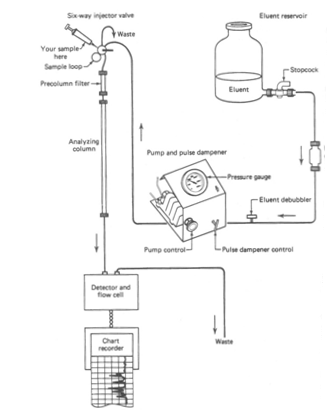
High performance liquid chromatography (HPLC) is a form of column chromatography used to separate compounds with varied polarity.

Reversed-phase HPLC is a generic name for any HPLC method that uses a non-polar stationary phase. Polar compounds are eluted first while non-polar compounds are retained-hence termed “reversed phase”.

Preparative HPLC refers to the process of isolation and purification of compounds. Important is the degree of solute purity and the throughput, which is the amount of compound produced per unit time. This differs from analytical HPLC, where the focus is to obtain information about the sample compound. The information that can be obtained includes identification, quantification, and resolution of a compound.

HPLC.jpg                       


Return to SSG 3 Main Page
Lauren Leader, Sharon Wei, and Tony Grillo. Chem 215 HH W'08
SSG 3.5 Home Page SSG 3.5 Home