|
1HNMR Correlation
1, Sceptrin
Reasoning
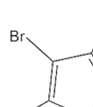
a: The first peak at 7.00 ppm corresponds to the hydrogen adjacent to the Bromine and amide. There are two equivalent hydrogen atoms, and they have one vicinal neighbor. It is the most deshielded because of the inductive effect from the Bromine and the amide and being at a sp2 center with the alkene carbon.
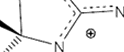
b: The second peak at 6.56 ppm corresponds to the hydrogen attached to the sp2 and part of the disubstituted heterocyclic pentane ring. It couples with hydrogen from the nitrogen. It is deshielded because of the inductive effect of the adjacent amide.
c: The third peak at 6.53 ppm corresponds to the hydrogen adjacent to the bromine. It has no vicinal neighbors, and therefore shows up as a singlet. It is deshielded because of the inductive effect from the bromine and bonding with the sp2 carbon.
d: The fourth peak between 3.40-3.52 ppm corresponds to the four hydrogen atoms on the acyclic β-carbon of the cyclobutane.
e: The fifth peak at 2.98 ppm corresponds to the two hydrogen atoms on the cyclobutane attached to a cyclic ring. The hydrogen atoms couple with the cis hydrogen, and the corresponding trans hydrogen, making it a doublet of doublets with the coupling constant of 9.6 Hz. corresponding to the trans hydrogen, and the 2.4 Hz. corresponding to the cis hydrogen. It is shielded by the large constituent groups bonded with it.
f: The sixth peak at 2.46-2.48 ppm corresponds to the remaining two hydrogen atoms on the cyclobutane. These are in a multiplet because they have many vicinal non-equivalent neighbors. |
13, Oxysceptrin
Reasoning
a: The first peak at 6.94 ppm corresponds to the two hydrogen atoms which are adjacent to the bromine, but not the the amide. These show up as a singlet because they have no vicinal neighbors, and they are highly deshielded because of the inductive effect from the bromine.
b: The second peak at 6.82 ppm corresponds to the hydrogen adjacent to the bromine. This is deshielded because of the inductive effect of the bromine and the amide. It is in the shielded part of the aromatic ring however.
c: The third peak at 6.73 ppm corresponds to the second hydrogen adjacent to the bromine. It is deshielded for the same reason, and it is a doublet because of its one vicinal neighbor.
d: The fourth peak at 6.54 ppm corresponds to the hydrogen of the aromatic cyclic ring with two nitrogen substituents. It only has one vicinal neighbor, but it is loosely held on because it can be easily deprotonated, so the coupling does not show up.
e: The fifth peak at 4.43 corresponds to the α-hydrogen to the carbonyl. It has one vicinal neighbor, making it a doublet.
f: The sixth peak at 3.42-3.49 ppm corresponds to the four hydrogen atoms which are attached to the carbon attached to the cyclobutane, part of the acyclic chain.
g: The seventh peak at 3.01 ppm corresponds to the hydrogen of the cyclobutane attached to the cyclic ring with the ketone.
h: The eighth peak at 2.66 ppm corresponds to the hydrogen attached to the cyclobutane with the other cyclic ring. It is closer to the nitrogen atom, which makes it slightly more shielded.
i: The ninth peak at 2.25 ppm corresponds to the two hydrogen atoms attached to the cyclobutane. It is bonded to a tertiary carbon, which shields it. It has many couplings with non-equivalent hydrogen atoms. |
Return to SSG 3 Main Page |