1. The rate lawT F(a.) is a differential equation
(b.) relates reaction rate and concentration of reacting species T F
(c.) is only valid in the U.S. T F
(d.) is a function of temperature; T F
2. The rate of formation of species A is per unit volume is
(a.) rA
T F
(c.) the generation of species A per unit volume rate T F
(f.) not used in Canada T F
3.
At a particular time t, the rate of formation of B in the reaction, rB, is 10 mole/dm3*min.
Which of the following are true?

Solution
Solutions
1 (a.) FALSE
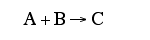
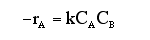
F. The rate law is an algebraic equation relating the rate of reaction with the concentration of the reacting species. Example, for the elementary reaction
Return to Problem 1


1 (b.) TRUE
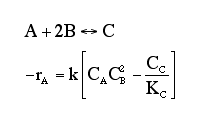
-rA = function (temperature and reacting species concentration), e.g.

1 (c.) FALSE It's also valid in Canada and the northern Provinces Return to Problem 1
1 (d.) TRUE (Page 5 of Text) Return to Problem 1
2 (a.) TRUE (Page 8 of Text)
rA=moles of A formed, per unit time, per unit volume
[rA]~[mol/dm3 s]
2 (b.) FALSE (Pages 3 and 5 of Text)
-rA is the rate of dissappearance of A, [mol/dm3 s]
2 (c.) TRUE
rate of formation=rate of generation
2 (d.) FALSE (Page 6 of Text)
r'A is the rate per mass of catalyst, i.e. grams of catalyst [mol/kg cat s]
2 (e.) FALSE (a & c are true) Return to Problem 2
2 (f.) TRUE
The Toronto Maple Leafs Hockey Team has little use for rate of formation of species A.