Project Group Poem
Engr477 VRML Project Report
"On the Curve"
December 5, 2003
Faculty Advisor: Thylias Moss
Project Members: Philip Williams, Chen Hong Leo
File Locations:
Initial Project Proposal: http://www-personal.engin.umich.edu/~chleo/otc.doc
Project Model: http://www.umich.edu/~chleo/otc.WRL
This Report: http://www.umich.edu/~chleo/report.html
Prototypes: http://www.umich.edu/~chleo/prototypes
3D Studio model of final release: http://www.engin.umich.edu/~chleo/otcfinal/otcbeta.max
3D Studio meshes used: http://www.engin.umich.edu/~chleo/meshes/
Concept Presentation Slides: http://www.engin.umich.edu/~chleo/concept.ppt
Entire VRML Model with textures and audio: http://www.engin.umich.edu/~chleo/vrml.tar.gz
Please note: Due to the massive size of this project, files will be removed by Jan 6, 2004.
Conceptual Development
Essentially:
(1)
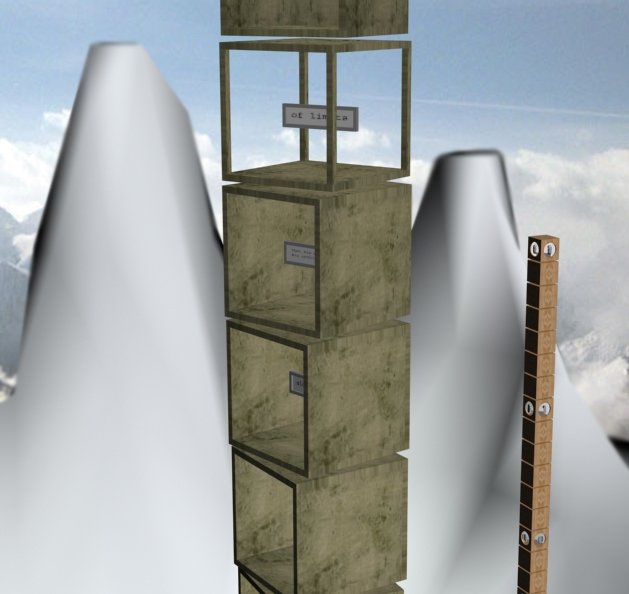
We translated the columns of text into literal towers
(2)
We allowed the links to become as dynamic as originally intended
(3)
We turned the reader into a user by fashioning the poem as an individual
experience
(4)
We augmented the experience by including thematically related objects
and music
For a number of weeks, we have sought to visualize Thylias
Moss's "On the Curve," three-dimensionally. Using
a hard copy of the poem as a blueprint, we developed an architectural setting
which would allow the narrative to unfold in the manner originally intended by
the author: at the discretion of the reader. Apart
from merely matching the structure the poem, we sought to visualize its form
according to the underlying theme.
The poem was devised to be read in many ways; there is no
single, linear course that leads to a single end. It
consists of parallel narratives contained in adjacent columns. At
certain points, the reader is allowed to choose amongst the alternative paths
by "links," or arrows that direct from one position to another. These
links compose a web of shortcuts that allow for virtually unlimited
navigational possibilities. Meaning
was to be discovered by individual exploration and inference, but the dynamic
movement implied by this web of interconnectivity could not be honored on the
2D page.
By literally translating these columns into towers, we sought
to present a more convincing form of the space Moss had originally envisioned. Each
verse became a room, or a place where one could enter, inhabit and study an
isolated phrase. The words
themselves became literal vehicles: selecting them now whisks you to
corresponding phrases and new perspectives, often subverting expectation. The
reader's position within the poem becomes evident by his position within an
architectural structure. It is
actual visual exploration that allows for the discovery of meaning.
In short, the reader now becomes a user.
The purpose of the surrounding environment was now to augment
this experience. A thematically
related musical score transforms as the user moves through the environment. Objects,
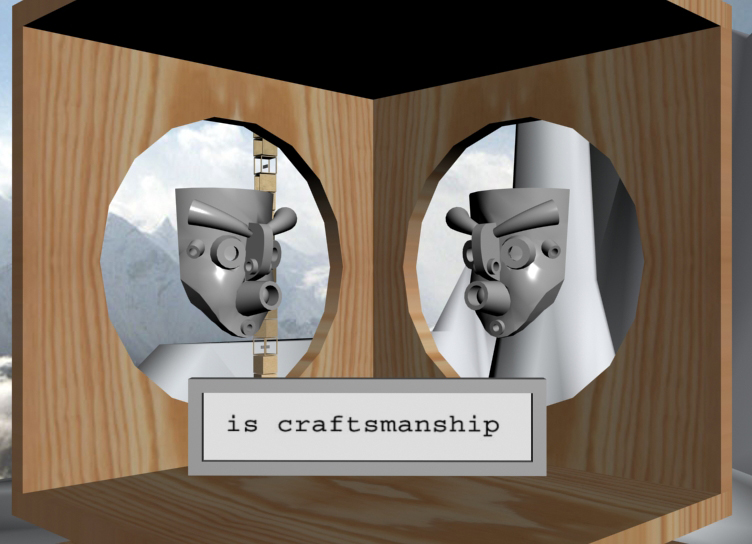
like masks, occupy some of the rooms in addition to the words.
Real-life surface textures present a world that invites curiosity. Enhancing
the effect already intended, and further facilitating exploration, these lesser
components serve the larger function of the three-dimensional poem.
The VRML representation of "On the Curve" is intended as a
prototype, a first attempt to genuinely anticipate the type of reader/user
Professor Moss addresses in her work.
Technical Implementation
Geometry
Apart from design issues, space / performance was our major technical goal
(comfortable and fast broadband download speeds). This was a poem we want the
world to see. Much like a poem typed out in an email, and sent easily to many
people world wide, we want this VR world to be lightweight and portable so that
it can be easily distributed over the internet. Because of that, 90% of the
objects we used in this project are VRML primitives, mainly "Boxes". These
boxes were shaped to make the compartments you see, the text frames and the
pedestal the towers rest on.
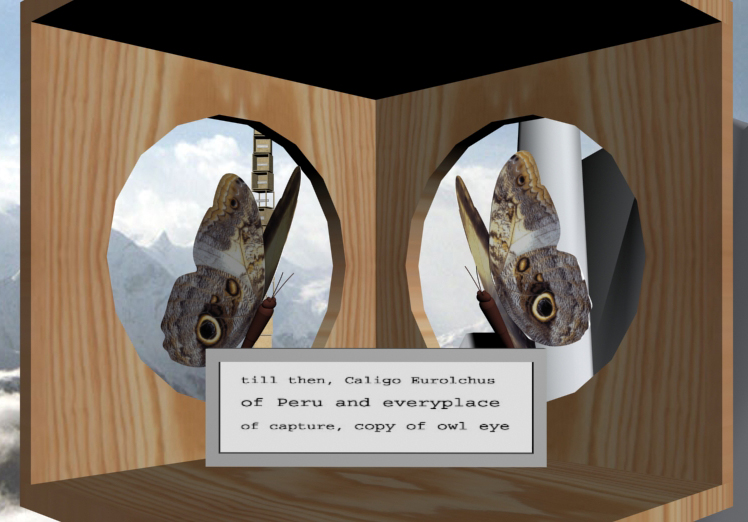
The only complex geometry left are the masks and the butterfly.
The landscape, although complex has its complexity reduced by tweaking various
3D Studio Max options. This results in a complex looking terrain which is not
high in polygon count / big in size.
Hence this vrml file is very small to begin with, yet it could be shrunk even
further when the masks are removed for even wider distribution (comfortable and
fast dial-up download speeds).
The complex masks were created via boolean operations of basic 3D studio
primitives. These boolean objects had their complexity furthered reduced by
converting them into pure meshes and then simplified further.
All geometry are original inspiration and were created from scratch in 3D
Studio Max, no geomertry were ever taken from any other libaries.
Animation
There are plenty of viewpoint animations in the poem, in excess of 200.
Everything else is pretty much static, as is the nature of any poem. It is a
discovery process for the reader, the poem is not supposed to shout at the
reader. In Thylias poem, there are links between her columns of text. Some are
very faint, and if you do not look carefully, you will miss it. We believe we
have captured the spirit of her poem by designing inter-text links to be
non-descript. If one does not look carefully, one will miss it in the VRML
model too. Ultimately this poem and VR-world where it resides in is fully
navigable. You can go anywhere you want, and for links you have discovered, it
will fly in a swooping animation across the various landscapes to reach its
destination.
Animations are done in 3D Studio Max with the help of the Anchor node, and a
knowledge of how VRML works. Links will have anchors which will transport you
to another viewpoint. We are not worried about bad path navigation because of
the way our NavigationInfo node is set up. It is set to "EXAMINE" type which
will avoid obstacles along the way and the VRML browser itself will find the
best route to naviagte within the two points.
Textures
The pine and stone textures were found from the Engin 477 texture libary,
http://www.engin.umich.edu/class/eng477/fall2003/docs/Laboratory/Textures/Wood/
The wood texture for tower one was from a site about ginkgo trees, provided by
our faculty advisor about ginkgo trees. The texture can be found here:
http://www.xs4all.nl/~kwanten/wood.htm
The butterfly texture was from the website of the Pacific Science Center and
can befound here:
http://www.exhibits.pacsci.org/insects/caligo.html
The textures from tower 1 were further edited to make it look like a
progression from wood to stone. This was done in Adobe Photoshop 7.0. 27
transition samples were extracted for the transition effect.
Functionality / How to use
The user is expected to navigate around the model on his own. This is supposed
to be an exploratory process. The only visual cue of interaction is from the
cursor, whose hand will change from the browser virtual reality navigation
metaphor into an interaction icon. Other navigation cues exist, such as the
presense of spatialized audio. The nearer the focus of a poem one navigates to,
the stronger the audio clip is heard. Apart from that, the last navigational
cue is the perception of height and location. Which of the 3 towers you are at
tells you where you are in the poem. The higher you go up a tower, tells you
the nearer you are, reaching the final culmination and conclusion of the poem.
Software and Hardware Used
The software used to develop the basic model for production output and the
various conceptual prototypes was Discreet's 3D Studio Max 5. 3D Studio Max was
also used to create basic interactivity because of the availability of its VRML
helper nodes.
Textures were entirely done and modified in Adobe Photoshop 7.0, and finally,
Parrallel Graphic's VRMLPad was used to touch up / fix loose ends that 3D
Studio Max's VRML generator could not generate.
A Korg Triton Workstation was used to generate and compose the original music
score, while MOTU's digital perfomer was used to sequence the audio track, and
generate the WAV audio files.
Development Hardware used was a Dell Precision 650 Workstation found in the
Media Union 3D lab. The computer was fast in calculations and generating VRML
models from 3D Studio Max, and we found the dual screen display setup helpful.
Unfortunately the graphics display was not configured well enough for our
demonstration needs, and the sound card and speaker system was of a subpar,
generic brand. Hence, we resulted in using a newer Dell Precision 360
Workstation for our demonstration purpose. It has a bright 19" LCD screen,
animations run smoothly and the driver configuration is very stable. Not
only that, since our VRML-3D Virtual Environment project takes advantage of
spatialized sound, the Precision 360 setup has stereo speakers mounted on the
LCD display and audio output is taken care by a dedicated soundcard, which
gives a very nice and high quality spatalized sound effect.
Why is this a userful application?
This project, POEM, has taken the first step into the world of kinetic poetry.
Where poetry is represented as fractals (the landscape) and archimidian solids.
Poetry does not have a fixed form and is open for interpretation by any one.
This project allows the reader of the implemented poem to start reading
anywhere he wants and to explore the poem upside down if he wishes. Its all up
to the reader and his imagination. The ability of such flexibility is the
hallmark of a good poem. Our faculty advisor Thylias Moss has experimented with
writing poem on different kind of geometries before. Such as a cube, or a
multi-facted ball. But this project releases the boundary of the writer's
imagination. The scale is huge. The model is greater than 10 KM Wide x
10KM Broad x 2.5 KM High. It gives the writer the ability to fly through
high mountains and up incredible heights to have her poem represented. There is
no other way to do this except in virtual reality. The cost would simply be
prohibitive.
And this application is useful, because of the very fact that it allows its
user to express their imagination in a huge scale, unlimited by the contraints
of physics, and able to represent their ideas in abstract space, yet
materialized in reality - virtual reality.
Not only that, this application was built in a modular fashion: Sound effects
can be changed, by simply swapping out the necessary audio files. The entire
text of the poem can be replaced with another. But there is a limit to how
modular the system maybe. A full-fledge tool would have to be designed for
more, but in an attempt
Problems encountered
The most critical issue encountered has to do with texture mapping in the VRML
model, and the quality of rendering of the VRML browser. It may be tolerable
for textures on abstract object to be rendered poorly, but we faced a different
issue. The text of the poem we are trying to represent is actually mapped,
image by image on to the "picture frames" in the VR model. Unfortunately, Cosmo
player is having trouble rendering high quality versions of the image. Some
renderings are so poor that the words are unintelligible. This was initially
thought to be attributed to poor scaling of the object where the text's texture
is assigned to. Upon further experimentation, we realized that this is a
renderer / performance issue. High quality rendering requires too much
computation power, and animations become choppy. Smooth animations resulted in
unreadable text. Our solution was to identify the trouble "text". (The text
texture mapping issue was not wide spread, and was limited to certain "picture
frames" only). Having identified the trouble "text", a higher resolution
version with a slightly bigger and bolder font was used to recreate the image
of the text of the poem. This was remapped to the model and solved 90% of our
problems.
In building the model, another issue found had to do with the placement and
alignment of objects. Our first tower was supposed to revolve 360 degress from
the foot to the top, and all the compartments have a different direction. Our
modelling / authoring program 3D Studio could only align items in 3 axis'es,
and we faced trouble aligining multiple text-plates to their frames which were
rotated and have different axis orientation. The only solution we found was to
manually change 80 instances of the alignment by hand.
The first try was not enough. Due to the massive size of the model, coplanar
polygons occured only when the viewpoint was very far away. Close up views did
not have any coplanar polygons. We had to change another 80 instances of the
text-plate / picture frame alignment again to resolve this issue.
Towards the end of the project, when we added lighting into our model, we had
trouble placing our light sources adequately. This is due in part to the fact
that Cosmo player can accept about 6 light sources. Any more and we will have
degraded performance. Unfortunately these 6 light sources are not enough to
cover all 80 light compartments to our satisfaction. There is no solution for
this issue
3D Studio Max has a bug in their VRML export plug-in. I have encountered this
problem before, in 3D Studio Max Release 3. It could have been present since
the pre-max, IPAS days. When meshes get complicated, exporting anything
in anything (Ngons, Quads, Visible Faces) other than triangles, would be
exported badly. Normals will not be exported and meshes will not be complete.
Our team have been using Ngons all along because N-gon Indexface set VRML files
are smaller than their Triangle Indexface Set counter-parts. Everything was
working fine until several complicated meshes were introduced into the model
and messed up the Cosmo browser. It must be noted that 3D Studio Max's VRML
exporter is more Cortona friendly. I hope the recently released 3D Studio Max 6
has fixed this issue.
Remaning shortcomings and recommendations for further improvements
Apart from the problems mentioned above, there are no other issues left in this
project. However we do have some recommendations to make. POEM is a concept
prototype to demonstrate the feasability of abstracting poems in virtual
reality. Hence it is not very extensible. Since VRML is an interpreted
language, we believe an authoring tool can be built for it to allow poets to
create their own abstract structures in three dimension. Tools like 3D Studio
Max is too complicated, something simpler maybe a web-based interface could be
used.
It was mentioned in class that it would be good if the tool could track the
reader's path through the poem. This could be implemented in future attempts.
There was also the issue of time / resource constraint. Many ideas and concepts
simply could not be implemented because we wanted to assure quality of the base
model-poem. Future attempts on this poem could include multiple ways of
interpreting the poem instead of the current literal represntation.