
Video Recorder(VCR)
The Video Recorder operates on two-head helical scan system with inclined track recording. By implementing this system, video signals are laid down diagonally in relation to the direction of tape travel. The the head drum consists of the two-headed helical. The two heads are arranged opposite each other. The magnetic tape is placed in a clasp around the drum, using a complicated system. The drum is arranged obliquely to the plane of the tape. Then, the video head applies its magnetic track to the tape at an oblique angle. Recording the video signals occurs on the lower edge of the tape and runs obliquely upwards. The two heads take turn recording the signals. While one is beginning the other one is finishing recording transmitted video signals. The alteration between video heads maintains continuing recording. In addition, the VCR is not the only video recorder that implemented this technology, but the Video Tape Recorder (VTR)and the BetaMax Recorder. In the late 1990's, new technology was released for capturing and playing back video and audio signals. This new technology is Digital Video Disk, which is currently being sold along the VCRs. However, DVD is more expensive than VCRs. Also, DVD provides high-quality pictures and sound on a disk by capturing video and audio signals onto laser disks. Lasers and plastic disks give a sharper picture and sound than the VCR.
Sources:
--Lanzendorf, Peter.The Video Taping Handbook.Harmony Books.1983
--Sony
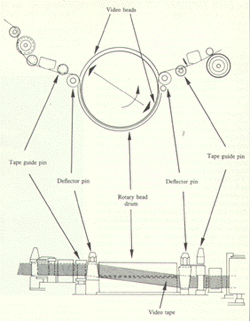
The video tape is fed past the head drum at an inclined angle.
