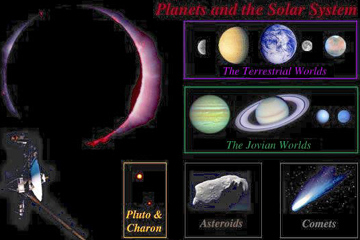
Our Sun's Planets
|
|
|
|
|
|
|
|
|
|
|
|
 been
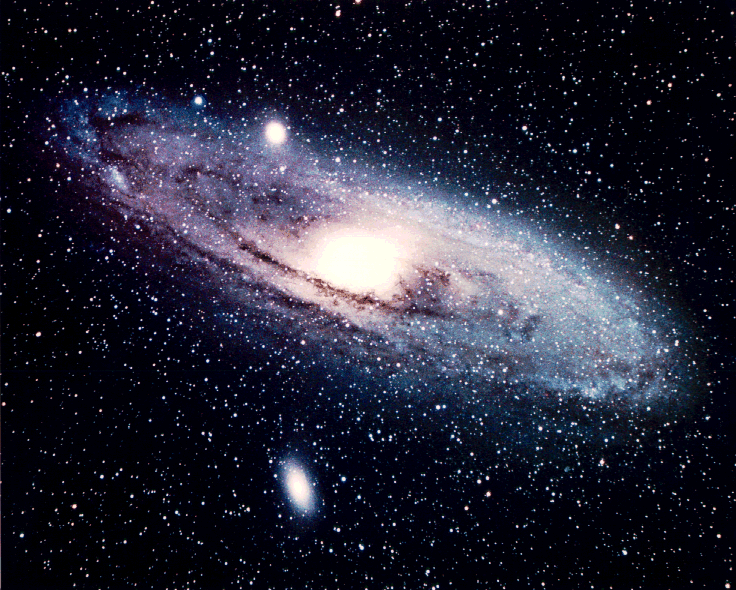
motivating factors to learn about our place in the universe. In order to
understand the solar system and the objects within it, we must first take
a look at its formation through time. In this chapter, we will take you
on a journey from when our solar system was first created up to the present
time. Along the way, we will describe some important differences between
the planets and how they are categorized. Our primary emphasis will be
on how the sun plays a role in regulating our solar system, and also to
compare and contrast the inner and outer planets. Hopefully by the time
you finish reading this chapter, you will have gained a better understanding
of our sun and its nine planets.
been
motivating factors to learn about our place in the universe. In order to
understand the solar system and the objects within it, we must first take
a look at its formation through time. In this chapter, we will take you
on a journey from when our solar system was first created up to the present
time. Along the way, we will describe some important differences between
the planets and how they are categorized. Our primary emphasis will be
on how the sun plays a role in regulating our solar system, and also to
compare and contrast the inner and outer planets. Hopefully by the time
you finish reading this chapter, you will have gained a better understanding
of our sun and its nine planets.  Next
Previous
Table
of Contents
Next
Previous
Table
of Contents
|
|
|
|
|
|
|
|
|
|
|
|
|
|
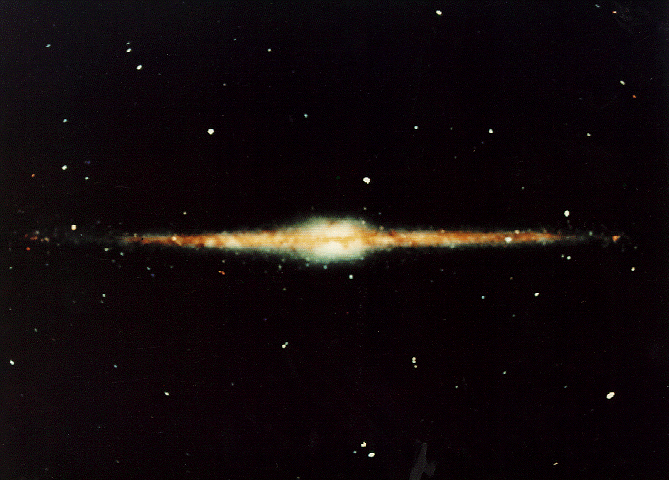 nebula,
which had a mass three times that of our sun. Matter in this cloud was
composed of gas and small grains of ice and dust. Initially, the solar
nebula is cold with temperatures less than 50K. At these temperatures most
gases freeze into ice particles. However these temperatures are not cold
enough to solidify hydrogen and helium, which remain as gases.
nebula,
which had a mass three times that of our sun. Matter in this cloud was
composed of gas and small grains of ice and dust. Initially, the solar
nebula is cold with temperatures less than 50K. At these temperatures most
gases freeze into ice particles. However these temperatures are not cold
enough to solidify hydrogen and helium, which remain as gases. The gravitational pull of the particles and gases causes them to
collect toward the center of the solar nebula. As the concentration of
matter in the center increase, density and pressure rose in magnitude.
The high pressure and density caused molecules to collide and thus the
temperature deep in the nebula increased. The high temperatures and enormous
amount of matter characterized the early stages of our sun, called the
protosun. After a few million years, temperatures in the protosun reached
millions of Kelvin, igniting thermonuclear reactions; from which our sun
was born.
Next
Previous
Table
of Contents
|
|
|
|
|
|
|
|
|
|
|
|
|
|
Above the core resides the photosphere, which is the actual surface
of the sun. 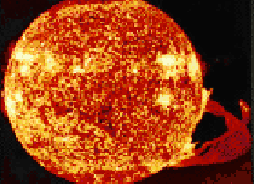 Since
temperatures and pressures here are not as high as found in the core, hydrogen
fusion does not occur. Here we can find such things as sunspots which are
very large dark spots which seem to be scattered on the suns surface. It
is thought that they represent relatively cool regions of the sun (3800
C compared with surrounding temperatures of 5800 K). This phenomenon is
not well understood since logic would suggest the cool regions would be
quickly heated thus eliminating the sunspots. However, sunspots can be
visible for days, and it has been suggested that the strong magnetic field
of the sun somehow prevents warming of the dark spots. These magnetic fields
are important to us because they produce flares of hot gas which are accelerated
to over 900 km/hr. The particles that are emitted by these flares which
interrupt radio communications and cause the northern lights on Earth,
and need to effect radio-controlled devices.
Since
temperatures and pressures here are not as high as found in the core, hydrogen
fusion does not occur. Here we can find such things as sunspots which are
very large dark spots which seem to be scattered on the suns surface. It
is thought that they represent relatively cool regions of the sun (3800
C compared with surrounding temperatures of 5800 K). This phenomenon is
not well understood since logic would suggest the cool regions would be
quickly heated thus eliminating the sunspots. However, sunspots can be
visible for days, and it has been suggested that the strong magnetic field
of the sun somehow prevents warming of the dark spots. These magnetic fields
are important to us because they produce flares of hot gas which are accelerated
to over 900 km/hr. The particles that are emitted by these flares which
interrupt radio communications and cause the northern lights on Earth,
and need to effect radio-controlled devices.
Above the photosphere lies the chromosphere, which is just a gaseous
layer 2500 km thick. Above this layer is the corona that has the remarkable
feature of temperatures as high as 2,000,000 C. How can a relatively cool
photosphere (6000 C) give rise to such a hot corona? The answer lies once
again in the magnetic fields of the sun. Twisted magnetic fields carry
energy from the core to the corona where the energy causes particles to
move extremely fast, thus resulting in high temperatures. Such high temperatures
strip electrons from their nuclei leaving behind nuclei floating in a sea
of electrons. These electrons and protons are steadily discharged and travel
through space at 450 km/sec. This is known as the solar wind which has
important effects as we will later see.
Next
Previous
Table
of Contents
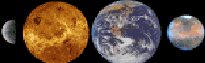 aluminum,
calcium, and nickel. Due to the violent impacts of large objects, such
as asteroids, with the protoplanets, a great deal of heat was released.
This, along with the energy from radioactive decay, produced enough heat
to melt the rocky protoplanets . The heavy elements (iron, nickel, and
lead) then sank to the center of the protoplanets, while the lighter elements
(calcium and graphite) rose to the surface. The elements which were gases
were burned off by the heat of the impact and the combination of the planet's
close proximity to the sun. After time, the protoplanets cooled leaving
behind dense iron cores with rocky surface formations.
aluminum,
calcium, and nickel. Due to the violent impacts of large objects, such
as asteroids, with the protoplanets, a great deal of heat was released.
This, along with the energy from radioactive decay, produced enough heat
to melt the rocky protoplanets . The heavy elements (iron, nickel, and
lead) then sank to the center of the protoplanets, while the lighter elements
(calcium and graphite) rose to the surface. The elements which were gases
were burned off by the heat of the impact and the combination of the planet's
close proximity to the sun. After time, the protoplanets cooled leaving
behind dense iron cores with rocky surface formations. Scientists are able to deduce when the core of the earth was formed by looking at the distribution of radioactive material on its surface. After long periods of time, uranium decays into 206Pb and 207Pb. Originally lead could only be found in the core of the Earth, but then radiogenic lead was found near the Earths surface. By measuring the lead to uranium ratio scientist could determine that the iron core of the Earth was formed 50-100 million years after the formation of the planet.
The effects of solar radiation have boiled off many of the lighter
elements such as hydrogen and helium, from the inner protoplanets. These
planets consist therefore primarily of solid material and thus have been
termed terrestrial planets.
Next
Previous
Table
of Contents
|
|
|
|
|
|
|
|
|
|
|
|
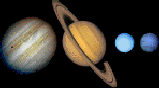 5~The
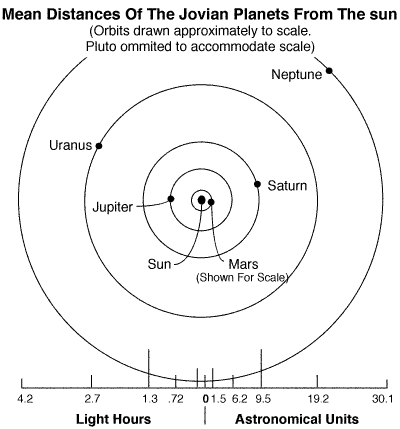
outer planets of our solar system, Jupiter, Saturn, Uranus, Neptune, and
Pluto, began their formation in a similar fashion to the inner planets.
Their rocky cores also incorporated gases which were present in the environment,
but unlike the inner planets, due to the effects of solar radiation and
their far distance from the sun (Figure 1b), the
outer planets did not lose their acquired gases. These gases, mainly the
lighter elements of hydrogen and helium, were not boiled off and thus increased
the surface area of the planets leading to an increase in volume. The term
Jovian (Jupiter like) has been given to Jupiter, Saturn, Uranus, and Neptune
since these four planets exhibit similarities. Even though Pluto is considered
an outer planet, it is an exception in that it does not contain a dense
gaseous atmosphere. Next
Previous
Table
of Contents
5~The
outer planets of our solar system, Jupiter, Saturn, Uranus, Neptune, and
Pluto, began their formation in a similar fashion to the inner planets.
Their rocky cores also incorporated gases which were present in the environment,
but unlike the inner planets, due to the effects of solar radiation and
their far distance from the sun (Figure 1b), the
outer planets did not lose their acquired gases. These gases, mainly the
lighter elements of hydrogen and helium, were not boiled off and thus increased
the surface area of the planets leading to an increase in volume. The term
Jovian (Jupiter like) has been given to Jupiter, Saturn, Uranus, and Neptune
since these four planets exhibit similarities. Even though Pluto is considered
an outer planet, it is an exception in that it does not contain a dense
gaseous atmosphere. Next
Previous
Table
of Contents
|
|
|
|
|
|
|
|
|
|
|
|
|
|
|
|
|
|
All of the planets except Venus and Uranus rotate on their axes in this same direction. The entire system is remarkably flat. Some of the planets are distinct in their revolutions. For example, Mercury exhibits a 3 to 2 spin-orbit coupling. This means that for every two complete orbits around the sun, the planet makes three complete rotations about its axis. Planets also vary in the shape of their orbits. For example, Pluto's orbit is so elliptical that it is sometimes closer than Neptune to the Sun. Thus, it is the farthest planet from the sun only part of the time.
Next
Previous
Table
of Contents
|
|
|
|
|
|
|
|
|
|
|
|
|
|
As we travel away from the sun, the temperature rapidly drops. Pluto,
the farthest planet, is so cold that it exhibits the temperature conditions
of the original solar nebula. These vast temperature differences have contributed
greatly to the unique characteristics of planets. For example, Mercury
has no atmosphere because it would be burned up by the intense heat of
the sun. Pluto however has no atmosphere because the gases are frozen and
consequently fall to the ground. However, when Pluto comes closest to the
sun, its atmosphere resumes a gaseous state similar to that of the outer
planets. The atmospheres of the outer planets are very prominent compared
with those of the inner planets. 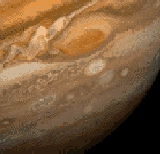 For
example, Jupiter exhibits differential rotation due to the immense volume
of its atmosphere. That is, the core rotates at one speed, but the surrounding
gases move at a different speed. Scientists were able to deduce that Jupiter
is composed of a large quantity of gases by observing that Jupiters equator
and poles move at two different speeds. Such observances are key to inferencing
facts about other planets.
For
example, Jupiter exhibits differential rotation due to the immense volume
of its atmosphere. That is, the core rotates at one speed, but the surrounding
gases move at a different speed. Scientists were able to deduce that Jupiter
is composed of a large quantity of gases by observing that Jupiters equator
and poles move at two different speeds. Such observances are key to inferencing
facts about other planets.
Next
Previous
Table
of Contents
|
|
|
|
|
|
|
|
|
|
|
|
|
|
Venus has been referred to as Earths sister planet. The reason for this is its size, density, and distance from the sun resembles that of Earth Table 1. Therefore, it was once thought that the environment on Venus would be similar to that of Earth (especially since they formed from about the same position in the solar nebula). Since Venus is closer to the Sun than the Earth, three things led to the formation of a dense atmosphere on Venus:
|
|
|
|
|
|
||
|
|
Thus, the atmosphere of Venus became hot, acidic and full of carbon dioxide. Both water and carbon dioxide absorb radiation and prevented it from escaping. This is known as the greenhouse effect. Due to the large amount of water and carbon dioxide in Venus atmosphere, heat is trapped on the surface thus causing temperatures to rise beyond that of even Mercury. The effect is so strong that Venus is regarded as having a runaway greenhouse effect.
Since Earth and Venus are "sister" planets, people on Earth should realize the dangers associated with greenhouse gases. If we continue to add greenhouse gases to our atmosphere on Earth, it will cause the temperature to rise (like it did on Venus). This, in turn, will cause more reactions to occur and more gases to be realesed. Eventually, just like Venus, Earth will have a runaway greenhouse effect. By preventing the builup of these problematic gases in our atmosphere, we can save Earth from a fate similar to that of its sister planet.
Next
Previous
Table
of Contents
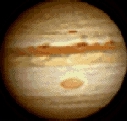 Just
as there are similarities between the terrestrial planets, the Jovian planets
also share similar characteristics. For example, violent storms are very
prominent on Jupiter, Saturn, and Neptune. These storms are so intense
that observers on Earth can see them. On Jupiter, there is an area located
near its equator known as the Great Red Spot which is a giant hurricane
like storm with winds gusting up to over 500 km per hour. The size of the
Great Red Spot is as big as the entire surface area of the Earth. On Neptune,
even stronger wind forces (up to 1100km per hour) are observed near the
equator. Ironically, this area has been termed the Great Dark Spot (in
contrast to Juptiers Great Red Spot).
Just
as there are similarities between the terrestrial planets, the Jovian planets
also share similar characteristics. For example, violent storms are very
prominent on Jupiter, Saturn, and Neptune. These storms are so intense
that observers on Earth can see them. On Jupiter, there is an area located
near its equator known as the Great Red Spot which is a giant hurricane
like storm with winds gusting up to over 500 km per hour. The size of the
Great Red Spot is as big as the entire surface area of the Earth. On Neptune,
even stronger wind forces (up to 1100km per hour) are observed near the
equator. Ironically, this area has been termed the Great Dark Spot (in
contrast to Juptiers Great Red Spot).
The formations of the storms on Jupiter's Great Red Spot and Neptune's Great Dark Spot differ. The initial understanding of storm formations on The Great Red Spot was first understood after many flybys of spacecrafts which were sent past Jupiter. The first spacecraft to fly past Jupiter was Pioneer 10 in December of 1973. It sent back many colorful photographs of Jupiter which were seen for the very first time. Within a four year time period three more flybys of spacecrafts were sent past Jupiter. The photographs reveal many dynamic changes occured near the area of the Great Red Spot. Photographs from earlier space satellites show a broad white zone dominated the area of the Great Red Spot while later photographs show a dark band begining to form. Through careful examination of cloud and wind motions it was discovered that north of the spot the winds blew to the west while south of the spot winds blew to the east. This opposing wind pattern created a counterclockwise circulation of wind around the Great Red Spot which in turn led to the creation of the violent storms. Recent flybys past Neptune showed pictures of the Great Dark Spot for the first time in August of 1989 when Voyager 2 flew past Neptune. The photographs also revealed a counterclockwise motion around the region of the Great Dark Spot however, the violent storms of Neptune were formed in a different manner. It is believed that methane decomposes near the core into carbon and hydrogen. The carbon crystallizes into diamond releasing great amounts of heat energy that is carried to the surface, which is what fuels the power of the wind and forms these extremely violent storms on the Great Dark Spot.
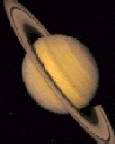 Another
interesting feature of the Jovian planets is the presence of rings which
encircle the planets. The rings are composed of tiny ice particles, dust
and rock. The most prominent rings are found around Saturn. It is believed
that these rings may be fragments of moons that never formed or perhaps
moons that were pulled in and destroyed by the intense gravitational field
of the planets. The latter of these theories was deduced by observations
of how moons interact with planets. For example, the moon causes tides
on the Earth, and the Earth causes seismic rumbling on the moon. Similarly,
a planet with the magnitude as large as Jupiter can have profound interactions
with its moons. Its interactive forces are strong enough to melt the rock
of its closest moon Io.
Another
interesting feature of the Jovian planets is the presence of rings which
encircle the planets. The rings are composed of tiny ice particles, dust
and rock. The most prominent rings are found around Saturn. It is believed
that these rings may be fragments of moons that never formed or perhaps
moons that were pulled in and destroyed by the intense gravitational field
of the planets. The latter of these theories was deduced by observations
of how moons interact with planets. For example, the moon causes tides
on the Earth, and the Earth causes seismic rumbling on the moon. Similarly,
a planet with the magnitude as large as Jupiter can have profound interactions
with its moons. Its interactive forces are strong enough to melt the rock
of its closest moon Io.
Next
Previous
Table
of Contents
|
|
|
|
|
|
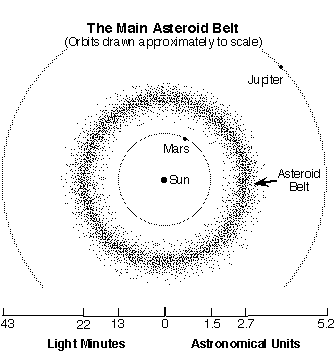
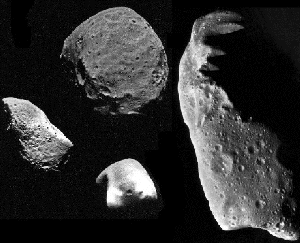 nebula
that never coalesced into a planet. Since these objects represent what
the early solar system was made from, they are of great interest to astronomers.
By analyzing asteroids, we can get a better idea of the composition of
our solar system early in time.
nebula
that never coalesced into a planet. Since these objects represent what
the early solar system was made from, they are of great interest to astronomers.
By analyzing asteroids, we can get a better idea of the composition of
our solar system early in time. The orbit of asteroids is variable. If one comes too close to a planet, the force of that planets gravity could cause the asteroid to fall and hit the planet's surface. As an asteroid falls toward the surface of a planet, it heats up by friction with the atmosphere and begins to glow; this is termed a meteor. Most meteors burn before hitting the surface but a few actually reach it. The impact of meteors can cause craters on the surface to form which, as we learned, is what gave the terrestrial planets different terrains and shapes.
Next
Previous
Table
of Contents
|
|
|
|
|
|
|
|
|
|
|
|
|
|
|
|
1. The "capture" theory states that accidentally floating asteroids traveling through space were caught by the Earth's gravitational field and began to orbit the Earth. |
| 2. The "spinning" theory states that due to the Earth's rapid rotation around its axis portions of the Earth began to break off and formed the moon. | |
| 3. The "collision" theory says that enormous asteroid hit the Earth causing a portion of the Earth to split off and take orbit around the planet. |
Of the three theories that were created about moon formation the
most accepted is the "collision" theory. The reason for its popular
acceptance is that the other two theories have proof against them. For
example, the fact that, other than iron, most of the elements in the moon
and Earth are present in similar amounts would disprove the capture theory.
If the moon was captured by the Earth, the chances of it having similar
composition is too low. As far as the spinning theory, it is improbable
that the Earth could have rotated so fast. For this theory to be valid,
calculations have shown that the Earht must have spun so fast that the
length of a day would be only two hours! For these reasons it is 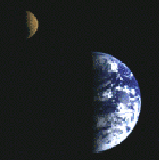 believed
that gigantic asteroids collided with the surface of the Earth and a portion
of the Earth broke off and thus formed the moon. It has been suggested
that this collision is the same one which resulted in the formation of
the Earth's core as the collisional energy was sufficient to melt the planet.
It has even been speculated that at one point Pluto was a moon. Pluto's
close resemblance with many of the moons of Neptune have led researchers
to believe that Pluto may been an escaped moon that was once a part of
Neptune. This would explain the many exceptions for Pluto in regards to
the outer and inner planets charecteristics.
believed
that gigantic asteroids collided with the surface of the Earth and a portion
of the Earth broke off and thus formed the moon. It has been suggested
that this collision is the same one which resulted in the formation of
the Earth's core as the collisional energy was sufficient to melt the planet.
It has even been speculated that at one point Pluto was a moon. Pluto's
close resemblance with many of the moons of Neptune have led researchers
to believe that Pluto may been an escaped moon that was once a part of
Neptune. This would explain the many exceptions for Pluto in regards to
the outer and inner planets charecteristics.
Next
Previous
Table
of Contents
|
|
|
|
|
|
|
|
|
|
|
|
|
|
There are so many theories behind the formation of the solar system that perhaps one day we will physically be able to venture out to other planets to gain a better understanding about them instead of having to read about them. With the successful journey to our moon, scientists are trying to endeavor further. Plans are already underway to send a manned shuttle to Mars. The mystery behind our solar system will not be solved for a long time, but with the advent of new technology and an increased understanding of scientific knowledge, we continue to get closer to understanding our Sun and its nine planets.
Next
Previous
Table
of Contents
|
|
|
|
|
|
|
|
|
|
|
|
|
|
Next
Previous
Table
of Contents
|
|
1. Broecker, Wallace. How to Build a Habitable Planet. Eldigio Press. New York. Copyright 1985. |
| 2. Chapman, Clark R. Planets of rock and ice : from Mercury to the moons of Saturn. Scribner Publishing. New York. Copyright 1982. | |
| 3. Kaufmann, William J. Universe. Freeman Press. New York. Copyright 1991. | |
| 4. Morrison, David. The Planetary System. Addison-Wesley, Mass. Copyright 1988. |
Web Sources:
Next
Previous
Table
of Contents
|
|
|
|
|
|
|
|
|
|
|
|
|
|
Comparison
Between Inner and Outer Planets Similarities
Within the Terrestrial Planets
Next
Previous
Table
of Contents
|
|
|
|
|
|
|
|
|
|
|
|
|
|
 Formation
of the Inner Planets
Next
Previous
Table
of Contents
Formation
of the Inner Planets
Next
Previous
Table
of Contents
|
|
|
|
|
|
|
|
|
|
|
|
|
|
 Formation
of the Outer Planets
Next
Previous
Table
of Contents
Formation
of the Outer Planets
Next
Previous
Table
of Contents
|
|
|
|
|
|
|
|
|
|
|
|
|
|
 Asteroids
Next
Previous
Table
of Contents
Asteroids
Next
Previous
Table
of Contents
|
|
|
|
|
|
|
|
|
|
|
|
|
|
chromosphere: name given to the region of the sun which is located
core: The innermost region of the core in which fusion occurs.
corona: Characterized by its low density and high temperature, this is
crater: Indentations on the surface of planets which may be caused by the
density: Term which gives the ratio of mass to volume.
flare: A sudden eruption of energy where large amounts of radiation and
fusion: The process of two nuclei joining together to make a different element.
greenhouse effect: Term given to the effect of heating caused by blocking
ice: Name given to solid forms of water, methane, and ammonia.
Kelvin (K): Temperature scale used to give information. Absolute zero is
photosphere: Surface of the sun. This is where sunspots are found.
protoplanet: The name given to a planet while it is being formed.
protosun: Name given to the early sun while it was still being developed.
solar nebula: The gas cloud from which the solar system originated.
solar wind: A continuous flow of energetic particles and gas which are
sunspot: Dark areas of the photosphere which are due to relatively low
Previous
Table
of Contents