Return to Files List    


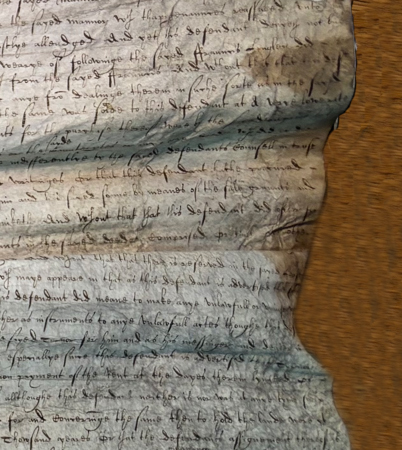
All four parts of the lawsuit are here: the Bill of Complaint, the Answer, the Replication, and the Rejoinder. At issue is the complicated arrangement whereby the manor of Paris Garden was sold by the late Francis Langley to Hugh Browker (an arrangement that the complainant, widow Jane Langley, protests was unfair), and the existence of four leases, exempted from the sale, and put in trust to John Turner, to which Jane claims she is entitled. Text has been modernised, but surnames retain their original spelling. In places the scrivener, having written some text, scraped it away and replaced it with strings of xx, as in lines 33 and 34 of the Bill. Ellipses indicate missing or unreadable text; words enclosed in {curly braces} are questionable readings. For unfamiliar terms see the Glossary.
    • The Bill of Complaint of Jane Langley
    • The Answer of Hugh Browker
    • The Replication of Jane Langley
    • The Rejoinder of Hugh Browker

The Bill of Complaint of Jane Langley

Tercio Februarii 1602
Wilkinson
To the Right Honourable Sir Thomas Egerton knight, Lord Keeper of the Great Seal of England

[1] Humbly complaining sheweth unto your good Lordship your daily oratrix Jane Langley the widow and administratrix of Francis Langley deceased, that whereas the said Francis her late husband [2] was in his lifetime during the intermarriage between them, lawfully seised & inherited of certain lands & tenements in the Goldsmiths' Row in Cheapside within the City of London, of the [3] yearly value of two hundred pounds or thereabouts, by reason whereof your said oratrix by the common laws of this realm should now, after the death of her said husband, be justly and [4] rightfully entitled (as she is informed) to a third part thereof in the name & lieu of her dower. And whereas also your said oratrix was afterwards, during the said intermarriage, joined [5] purchaser with her said husband of the manor of Old Paris Garden in the county of Surrey, being of the like yearly value of two hundred pounds at the least, whereby she should now, by the [6] survivor, be interessed in the whole manor & enjoy the whole rents & profits thereof for term of her life, if she would make choice to relinquish her said title of dower in the said lands and [7] tenements lying in Cheapside. Yet so it is (may it please your good Lordship) that your said oratrix, tendering the credit & reputation of her said husband, being persuaded that it was for his good, was induced by him without [8] the consent or advice of her own kindred & friends, to join with him in acknowledging a deed of bargain & sale enrolled within the said City of London, according to the custom of the said City, whereby (as [9] she is given to understand) she is barred of her title of dower & all other demand of the said lands & tenements in Cheapside being often promised by her said husband, in regard thereof that she should wholly [10] & quietly enjoy the said manor of Paris Garden if she happened to survive him, discharged of his debts & all other encumbrances; yet was afterwards urged & finally by the clamorous importunities of [11] some pretending themselves to be his creditors, enforced without being permitted to take any advice of friends as aforesaid, to acknowledge a fine of the said manor, being her jointure as aforesaid, to Hugh [12] Browker, Esquire, who had formerly contracted with her said husband for the same (having long before affected the compassing & obtaining of the said manor), by means whereof she is utterly defeated & excluded, as well of her jointure in the said manor as of her dower [13] of the said lands & tenements in Cheapside, which otherwise (as she in informed) she should have enjoyed & held cleared & discharged of all his encumbrances, both in law and conscience. And your said oratrix was the easier & sooner [14] won & wrought to levy the said fine of her jointure, by reason that she was promised assuredly both by her said husband & the said Hugh Browker, that certain leases should be made in recompense thereof, to the [15] benefit of her & her children, of the manor house & other tenements & parcels of ground adjoining thereunto, upon the sale of the said manor. And the said Hugh Browker likewise faithfully protested, promised, [16] & assumed that as well her said husband as herself or any friend of hers should have the said manor with the appurtenances reassured unto him or them upon repayment of the money to be disbursed then by him [17] upon the purchase thereof, in such manner & at such days of payment as he took for the same, in consideration of which promises & protestations made by the said Hugh Browker, who had by a very indirect [18] pretense pretending a former title thereunto, which he would set on foot if any other should buy it (though indeed he had none of any strength or validity in conscience or law), discouraged & terrified others from [19] offering the true value thereof, & by threatening that he would have it, whosoever should buy it, disheartened them finally from dealing therein, her said husband was persuaded, or rather by such practice means [20] compelled, to sell the said manor unto him at a very low rate & very easy days of payment for the said manor, being better worth than two hundred pounds by the year as aforesaid was sold [21] unto him for little more than twelve years' purchase, namely for the sum of five & twenty hundred pounds, payable by two hundred pounds every term next ensuing the sale thereof. But [22] because it is (if it please your good lordship) that yet the said Hugh Browker having so easily obtained the said manor, which lay very conveniently for him through the great trust & confidence which the said [23] Francis Langley and your said oratrix reposed in him, hath by undue and indirect means gotten into his hands not only the deeds & evidences concerning the said manor and such deeds as were sealed, by the indirect means hath obtained your oratrix's husband unto him belonging by reason of his said purchase but also the counterpart of all such indentures & other writings [24] as were sealed or agreed on to be sealed by himself & others at his appointment to the use of the said Francis Langley upon the sale of the said manor & divers other writings & deeds which do properly belong to your said oratrix & to the heirs [25] of the said Francis deceased by a cunning course causing the said Francis to give consent to leave them as he did some of his in the hands of the counsel learned of the said Hugh Browker to be by him kept indifferently in trust till the intended [26] conveyances were perfected between them and all the moneys for the purchase should be to the said duly paid the said Francis Langley having no other assurance for his said money, & afterwards procuring them into his own custody, contrary to many promises made by the said learned counsel & the confidence reposed in them, refusing [27] to deliver the same to your said oratrix or any demanding them on her behalf affirming doubtfully that it may be there were no such counterparts sealed by himself whereby he seeketh to obscure the [28] certainty of the intent & true meaning of the said purchase & of the covenants in the said deeds comprised. And whereas certain good & indefeasible leases were promised & should have been made by the [29] said Hugh Browker or such others as should have lawful interest to make the same to some such as the said Francis should nominate for the benefit of himself his wife & children at some [30] easy rent thereon to be reserved the said Hugh Browker hath made four several leases of the said manor house & such other parcels as were agreed to be by him demised to one John Turnor at the [31] appointment & nomination of the said Francis with colorable show of performance of his promise but hath reserved on the said leases a great rent of fifty & three pounds by the year being near [32] the uttermost value of the said parcels by the said leases so demised & the deeds of the said four leases being left in the hands of the said Hugh Browker after the ensealing & delivery of them & remaining [33] in his custody at the time of the decease of the said Francis Langley on special confidence & many promises to deliver them to his wife your said oratrix or to any other at her request yet the [34] said Hugh Browker after many dilatory answers & devices finding himself urged with several promises made in that behalf did finally refuse to deliver them pretending to prefer the satisfaction of the [35] said John Turnor whose testimony he meant to make much use of in discharge of his account of the said moneys, though it ought to be but of little validity, as being his the said Turner's especial instrument whom if this device failed he might [36] haply work to surrender or forfeit the said leases, being a person only named in trust & not otherwise interessed in them, before the performance of a due & just promise made by him the said Browker to the said deceased being [37] often afterwards iterated as well to your oratrix as divers of her friends after his decease for the ready delivery of the said leases. But his pretense therein being frustrated by reason that the deeds of the said leases were [38] happily gotten out of his hands without suit of law, contrary to the good liking of the said Browker, he hath sithence as well to your oratrix as to others discovered that his purpose in detaining the deeds of the said leases was that they should have been forfeited [39] unto him for non-payment of rent at the days therein limited which could not certainly have been known to your said oratrix if the said deeds & leases had been still by him detained which if it had succeeded [40] according to his expectation either your oratrix should have had no leases at all or at least must have been contented to have taken others at his hands under such new covenants & conditions as he would [41] have vouchsafed her. And moreover whereas before his purchase of the said manor to the end he might get it at the lower price & have longer days of payment he promised that he would at any time within seven [42] years be ready to reassure the same for the like sum of money as he had disbursed & to give like days of payment he still pretendeth a willingness to perform his promise therein but manifesteth by his proceeding [43] that he intendeth nothing less for when any such offer is made him he craveth present performance of the whole sum at one entire payment which is neither easy nor usual for any man in a purchase of that quality; [44] or else insisteth on demand of such security as is very extraordinary in that behalf where he himself gave none at all. And for a further manifestation that his fairest shows are but colorable herein he settled [45] the inheritance at the time of his purchase in himself & his young son who is under age intending thereby that it should not hastily be removed whereby he hath disabled himself towards any such performance which it [46] appeareth he never intended & hath taken an assignment of a fraudulent fraudulent lease of a thousand years or for some such long term of the said manor which he keepeth still on foot in the names of two other men who are [47] not known to your said oratrix with purpose that he or his son shall molest trouble & encumber her therewith hereafter when they shall espy their opportunity. By means whereof the said Francis Langley reposing himself [48] wholly in the said Hugh Browker & his counsel learned for his assurance of the said leases & the provisos or conditions & covenants to be inserted as was requisite according to good meaning for the redemption of [49] the inheritance at the days & sums agreed which should have been set down in the conveyance hath conveyed the said manor (as they have devised) for so small a sum of money & such easy payments absolutely out [50] of him & yet had his leases made from the said Hugh Browker alone being but jointly seised of the reversion & a long fraudulent lease being before & by him kept still in being. And further the said Hugh [51] Browker against his own hand & seal giveth out to divers that the keeping of the Court Leet views of frankpledge felons' goods & other royalties within the said manor demised in the said leases for one & forty [52] years do appertain unto him & not unto your said oratrix & pretendeth that the said Courts should be kept in his name which indeed are & ought to be kept in the name of your said oratrix by reason of the said leases & [53] hindereth & impeacheth her in receiving the rents of her tenants & letting & setting of such tenements & parcels of ground as she hath to let & set & otherwise to raise & make her commodity of them contrary to the true extent of the said leases by disparaging [54] & by doubtful speeches calling in question her title in them hoping that thereby she will wax weary to pay the rents reserved on the said leases seeing she maketh so little profit or benefit of them whereby [55] they may be forfeited into his hands or for some slight consideration surrendered unto him. And moreover whereas the said Francis Langley towards the payment of his debts & settling of his estate [56] assigned divers sums of money due & coming of the sale of the said manor unto divers of his creditors to be received of the said Hugh Browker he being unfurnished & driven to take up the money at [57] interest took bond as well of the said Francis as of such his creditors for the repayment thereof & for the said interest as if it were money lent by him or borrowed of others to pleasure them & not [58] due by himself & payable for the said purchase so that at an account lately offered by him before certain commissioners it appeared & was confessed by him that many bonds of the said [59] Francis Langley & his said creditors were yet remaining in his hands which ought all to have been redelivered & sundry judgments for several sums against the said Francis Langley & others [60] of his friends remained undischarged which ought all by the said Hugh Browker to have been cleared. And divers other bonds of the said Francis Langley were then brought in by him for discharge of his [61] account without showing any appointment authority or direction from the said Francis Langley that his money should be that way employed & that the debts due on them or some part thereof was not formerly [62] satisfied having formerly [.....] differing one from the other. And moreover, to fill up his accounts that there might be no overplus & arrearage to come to your said oratrix, he hath been contented in the said account to demand three hundred pounds [63] to be detained by him for a yearly rent of forty pounds with which the said manor standeth charged for some few years yet to come to one Edward Harvest notwithstanding that he had notice of the said [64] rent so going out of the said manor before his purchase thereof & hath notwithstanding demanded allowance also for payment of the said rent by ten pounds quarterly upon his account. And [65] whereas also the said Francis Langley out of his confidence before mentioned did take certain conveyances leases bonds & other deeds in the name of the said Hugh Browker expecting that he [66] would have suffered him the said Francis to have taken the benefit thereof as duly belonging to him & to his heirs executors or administrators after him the said Hugh Browker as if no such trust or [67] confidence had been, pretendeth that the said deeds were taken in his name to his own use & for his security of certain debts as if he had paid all the money due for the said purchase & that the said [68] Francis Langley were yet in arrearage unto him which are very hard courses as your said oratrix doth verily believe & contrary to equity & good conscience. In tender consideration whereof [69] & in regard that your said oratrix is a poor desolate widow charged with six children, who brought a competent portion & came without any charge to her said husband, for whose good she hath [70] been contented to relinquish both her dower & jointure which should have been discharged of all her said husband's debts as aforesaid, and the rather for that the said manor of Paris Garden was purchased by her husband with money procured by your oratrix best [...] for her good, yet by which means she now standeth subject to all his [71] encumbrance & is daily troubled with the importunities of his creditors his debts being not all discharged as they should have been by the sale of the said manor lands & tenements & for that the said [72] leases taken of the said Hugh Browker & the moneys yet resting in his hands are the chiefest stay of her poor estate as also because she knoweth not the certainty of such deeds evidences [73] writings & counterparts as as are belonging unto her & her son & remaining in the custody of the said Hugh Browker nor what covenants or conditions are therein to be performed on her part or by the heirs [74] of her said husband nor wherein they are contained nor what moneys are justly & certainly due unto her from him nor how to demand the same by the course of the common laws of this [75] realm nor yet how to maintain the validity of her leases hereafter against the son of the said Hugh Browker & against those that have the said long lease of a thousand years conveyed unto [76] them nor what deeds have been taken in trust by her said husband in the name of the said Hugh Browker nor hath any means by the course of the common laws to compel him to execute [77] the said trust in him reposed The premises duly considered may it please your good Lordship out of your wonted compassion & consideration in such cases accustomed to grant unto [78] your said oratrix her majesty's most gracious writ of subpoena with a ducens tecum to be directed to the said Hugh Browker who is one of the prothonotaries of the Court of Common Pleas [79] & is ordinarily abiding in & about the City of London commanding him thereby on a pain therein to be limited presently on the sight thereof to make his personal appearance in her majesty's high [80] Court of Chancery & to bring with him all such deeds evidences & writings as he or any other to his use hath in his or their custody belonging or appertaining to your said oratrix then & there [81] to answer to all & every of the premises & to abide such further order & direction therein as to your Lordship shall seem agreeable with equity & good conscience. And your said oratrix shall be [82] thereby farther bounden to pray for your lordship's preservation.


The Answer of Hugh Browker
The right edge of this document is torn in two places; the ends of several lines are lost (see image). Additionally, the left and right edges of the document are both badly worn, and much text is rubbed out, making readings difficult. These places are marked by ellipses. In places the scrivener, having written some text, scraped it away and replaced it with strings of xx, as in lines 16 or 21 or 30.

Juratus 13 Maii Mat: Carden
The Answer of Hugh Browker esquire one of the Prothonotaries of his majesty's most honorable Court of Common Pleas defendant to the Bill of Complaint of Jane Langley widow complainant
[1] The said defendant by protestation not confessing or acknowledging the said Bill of Complaint or any thing therein contained material to charge this defendant to be true, saith that he this defendant thinketh the said Bill of Complaint to be uncertain and [...]
[2] for this defendant to answer unto, and that the same is devised and exhibited into this most honorable Court against this defendant of malice and evil will, to trouble vex and molest this defendant in and by wrongful expenses rather than upon any good grounds or sufficient cause where the com[...]
[3] do nevertheless all advantages of exception in and to the uncertainty and insufficiency of the said Bill of Complaint, and to the jurisdiction of this most honorable Court, concerning the same to this defendant now and at all times hereafter saved, he this defendant did tr[...]
[4] of this defendant's knowledge of such of the matters in the said Bill alleged, as this defendant thinketh material for him to answer unto, saith that Thomas Cure esquire, deceased father to the wife of this defendant, did contract for the manor of Paris Garden in the [...]
[5] the late right honorable Henry lord Hunsdon, Robert Newdigate, and Arthur Fountayne esquires, the which or some or one of them then had the freehold and inheritance thereof, as this defendant verily believeth, who before the conveyance of the freehold and inheritance of the same leased divers parts thereof for [...]
[6] and amongst others made a lease of part thereof to the said Thomas Cure esquire for one thousand years, and after conveyed the freehold and inheritance thereof in fee simple unto Thomas Cure the younger being a younger son of the said Thomas Cure esquire, and the said Thomas [...]
[7] being possessed of the said term of one thousand years, did make his last will and testament in writing and thereof made one Ann, then his wife, and one George Cure his eldest son, and this defendant his executors, and thereby declared that his will was that his goods should be divided into three [...]
[8] the one third part to his wife, another to his two sons, and reserved the other part out of which he did give sundry legacies, and left the rest unto his said executors, and died possessed of the said term, as this defendant verily believeth. After whose decease this defendant did take upon him [...]
[9] executors, and for good causes him moving, whereof amongst other one was for that the said Ann did possess herself of the most part of the goods and did not so effectually endeavor to perform the said legacies, as this defendant thought she should have done, and doubting that she [...]
[10] unpaid as she hath done, whereby this defendant hath been urged and charged to pay divers of the said legacies, amounting to the value of more than all the debts or movable goods late of the said Thomas Cure, which came to this defendant's hands as executor be worth did conv[...]
[11] said term of one thousand years unto one Michael Smalpage, which term also by good and lawful means did come again unto this defendant. That is to say, as the executor of the last will and testament of Thomas Smalpage, executor of the last will and testament of the said [...]
[12] the assignment so made by this defendant, the said Francis Langley did without the privity of this defendant, for less money than one thousand pounds, obtain a bargain and covenants from the said Thomas Cure the younger for the conveyance of the said manor to the said [...]
[13] person as he should nominate for that purpose, and caused the said Thomas Cure the younger to levy a fine to the said Francis Langley, Jane his wife, the now complainant, and one James Pemberton, now one of the sheriffs of the City of London, of the freehold and inheritance of th[...]
[14] them three and the heirs of the said Francis Langley. And after the said Francis Langley obtained from the said Ann Cure a deed in writing purporting that she did convey the said term of one thousand years unto the said Hannibal Gammon in the said Bill mentioned [...]
[15] thereof the said Francis Langley did take the issues and profits of the most part of the said manor without interruption by this defendant, which this defendant did forbear to intermeddle with, for the love he did bear to the said Thomas Cure the younger, this defendant's wife's brother [...]
[16] unprovidently was wrapped into very hard covenants and great bonds to the said Francis Langley, without this defendant's privity, wherewith he might have been indamaged if this defendant had entered x x x x x as this defendant thinketh. And yet it may be this defendant did, as he conceived he lawfully might, utter some speeches of or concerning the insufficiency of the right, when as [...]
[17] Francis Langley did take the profits and use the possession of the capital house and other things part of the said manor but this defendant doth not remember that he did use either any such speeches to any that was about to buy the premises of the said Francis Langley, or any other like
[18] speeches of or for any such intent or purpose, as in the said Bill of Complaint is mentioned, to hinder any sale thereof attempted by the said Francis Langley, though he this defendant was credibly informed that the said Francis Langley was greatly indebted, and therefore in this defendant's opinion was
[19] not likely to keep the same long, having no other means, to this defendant's understanding, to make satisfaction of his debts. And he this defendant was likewise persuaded that the said Francis Langley had not any friends that would disburse any great sum of money for the good of the said Francis
[20] Langley and the complainant. And as this defendant hath been credibly informed, the said Francis Langley did borrow and take up that money which he paid for the said purchase upon interest and hard bonds and great sureties. And this defendant saith that in or about Michaelmas Term was two
[21] years there was a x x x x x bargain had & made between the said Francis Langley and this defendant for the said lease of a thousand years, which the said Francis Langley pretended to have procured the said [...] to assign unto the said Gammon upon especial trust and confidence to the use of the said Francis Langley, and for the freehold and inheritance of the said manor of Paris Garden, for which this defendant was by the said bargain to pay to the said Francis Langley the sum of two thousand and five hundred pounds of lawful
[22] money of England in form following That is to say in that Michaelmas Term four hundred pounds and in the then next Hilary Term three hundred pounds and every term after until the whole sum were paid two hundred pounds And the said Francis Langley at the time of the said
[23] bargain did pretend that the premises which this defendant then was to purchase and pay that money for were and should be worth to this defendant two hundred pounds by the year And that this defendant should receive of and for the rents thereof at Christmas then next following fifty pounds and
[24] quarterly from thenceforth fifty pounds every quarter without any encumbrance or let by the said Francis Langley or any other by his means And the said Francis Langley after that bargain made desired to have in lease part of the premises But when this defendant went to his counsel to get his assurances
[25] drawn that were any lets and hindrances thereof, by means of the said Francis Langley and his dealings, so that this defendant could not get such good conveyance and assurance of the said manor and bargained premises according to the said bargain as was fit until about the month of January was
[26] [.....]neath of the said bargain made. And yet in the meantime this defendant did pay, in the said Michaelmas term, the sum of three hundred and fifty pounds, part of the said sum of four hundred pounds, and after that Michaelmas term and since that time that this defendant hath paid out
[27] [...]ffred by the [...] agreement of the said Francis Langley, divers other sums of money at several times, and by several portions, which do amount together in the whole to the sum of two thousand and two hundred pounds, as by an account made before certain commissioners in a cause wherein the
[28] complainant [...] and which account is certified into this honorable court, whereunto this defendant referreth himself, it doth and may most plainly appear, and which said account this defendant offered [...] the said commissioners, and yet is willing to make proof the said complainant
[29] [...] pay oth[.....] object against the same any true or just matter, a great part of which money was paid and satisfied by this defendant before he this defendant had any assurance to him made of the said manor from the said Francis Langley. And in the meantime the said defendant did
[30] [......] Francis Langley and his friends for much of the money which he disbursed before the said assurance made. And after this defendant had made the bargain x x x x x and long before this defendant could get any assurance from the said Francis Langley
[31] [......] by the said Hannibal Gammon that if the said Hannibal, at the request and desire of the said Francis Langley, had conveyed his interest under the said lease unto one Edward Harvest, and had taken an assignment back again, by which the interest of the lease was tied for
[32] [......] the year by Francis Langley during the term of one and twenty years unto one Robert Allison, deceased, whose executor the said Harvest is, or to the like effect to this defendant's remembrance, whereof as this defendant thinketh there be about sixteen years yet to
[33] come for which the said Francis Langley, as this defendant understood, had three hundred pounds, whereupon he this defendant did confer with the said Francis Langley concerning a discharge of that yearly payment from the said Harvest, who after some speeches had, did agree that he this
[34] defendant [.....] three hundred pounds, parcel of the said five and twenty hundred pounds therewith, and that in consideration thereof, this defendant should take the care for the said term or interest to discharge or [...] the said yearly payment, so that this defendant [...]
[35] [...] the said [...] of the said two thousand and five hundred pounds at the time of his decease. And this defendant further saith that he this defendant oftentimes, before any assurance passed from Langley to this defendant of the said manor, did require of him that
[36] he should take surety of this defendant for the money that was then to be paid unto the said Langley for the said lease by assuring him that he should have such reasonable security for the payment thereof as he would reasonably require. But he still deferred to accept any. Neither could this
[37] defendant at any time during the life of the said Langley procure him to come to make a full and perfect account with this defendant for the money which this defendant [......]
[38] [...] further require him so taken. And this defendant, for the further declaration of the true estate of the leases by him made unto the said John Turnor, saith that the same were by him this defendant >made [......]
[39] the said Francis Langley did appoint, and were made by this defendant only, out of the said term of one thousand years before the sealing or passing of the freehold or inheritance of the premises unto this defendant and his said son, he this defendant having [......]
[40] [...] and consent of the said Francis Langley, an assignment from the said Hannibal Gammon of his interest of the said term of one thousand years, and granted the whole interest of that term, which he had either by his own conveyance to Smalpage as is aforesaid mentioned
[41] of the said Ann and Hannibal Gammon unto one William Howpell and Thomas Harvye of Lyon's Inn, gentlemen, and did take from them one lease for one hundred years of the premises, to be accounted from the one and twentieth day of July in the three and fortieth [year of her majesty's reign (=1601)] [......]
[42] [...] without any condition or reservation in that lease mentioned, which were all done in the said chief mansion house of the said manor in the presence of the said Francis Langley. And this defendant having the said lease and interest of one hundred years in the [....]
[43] the said leases to the said John Turnor, in such sort as the said Francis Langley did appoint. In one of which there was inserted one tenement with the appurtenances, late in the tenure of one Thomas Bradshawe, without the privity of this defendant, and more than the said Francis Langley [...]
[44] at the first desire, to this defendant's remembrance, which this defendant heeded not at the time of the sealing of the lease thereof. And therefore did, since his death, make some speech thereof, and yet suffereth the same to be enjoyed according to the said lease without any interruption by this [...]
[45] which this defendant thinketh is that which, in the said Bill of Complaint, is said to be meant to be the tenement which she allegeth that the defendant did interrupt her from enjoying, for which nor for any so leased by him he meant no other interruption but that he said he thought she had [...]
[46] leased that tenement And touching the counterpane of the sale of the inheritance of the said manor made to this defendant the same was ever [never?] sealed by this defendant for that the said Francis Langley did never require the same to be sealed But if it had been offered unto him this defendant
[47] to be sealed he this defendant would very willingly have sealed it And touching any conveyances or bonds made to this defendant in trust for the said Francis Langley this defendant knoweth not of any other than one obligation made to this defendant by one Oliver W[oodliffe]
[48] for the sum of eight pounds or thereabouts, and one indenture purporting that the said Francis Langley did demise unto the said Woodliffe certain romeths [=ample spaces (OED)] part of a messuage called the Boar's Head in Whitechapel parish for the term of certain years [......]
[49] delivered by the said Woodliffe to this defendant's custody, to be kept to the use of the said Francis Langley in consideration of twelve pounds paid by this defendant to the said Woodliffe, by the appointment of the said Francis Langley, for the redemption of the said [....]
[50] one other indenture enrolled in this honorable court whereby the said Francis Langley and others sold to this defendant and to Thomas Emerson, gentleman, two tenements and certain lands [...] in Enfield in the county of Middlesex. And certain writings [...]
[51] [...] or some part thereof, as this defendant thinketh, which the said John Turnor delivered to this defendant, by appointment and direction given by the said Francis Langley in his lifetime, as the said Turnor informed this defendant, and which the said Turnor did fetch from Mr Robert Asheley brother to the complainant and [...]
[52] Turnor likewise enfra[...] this defendant. And this defendant saith that after the date of the said indenture of sale of the premises in Enfield enrolled in this most honorable court, the said Francis Langley entreated this defendant to be bound with and for him [...]
[53] and five pounds unto one Mr Smithe, promising that there should be made of the sale of the said tenements and lands in Enfield, or part thereof, the same sum of one hundred and five pounds which should be made ready and employed to the payment of that debt which [...]
[54] and in default thereof this defendant hath been driven to pay the said sum of one hundred and five pounds with his own money. And the said Francis Langley agreed that this defendant should detain the same tenements and lands, or some part thereof, and the estate therein [...]
[55] one hundred and five pounds, were satisfied and recompensed to this defendant, which is not yet done, whereof this defendant hath advertised the complainant and is willing to deliver the same upon reasonable satisfaction for the said one hundred and five pounds and [...]
[56] thereby sustained. And the other obligation made by Woodliffe, and indenture to Woodliffe, he is and always hath been ready to deliver to the said complainant Without that that to this defendant's knowledge the said Francis Langley did promise that the said complainant [...]
[57] wholly and quietly enjoy the said manor of Paris Garden if she happened to survive him, or that the same should be discharged of his debt and all other encumbrances, or that it is material to this defendant whether he made any such promise or not. Or that the said [...]
[58] to this defendant's knowledge, was so urged or importuned, or not permitted to take advice of her friends, or did for or upon any such cause acknowledge the said fine of the said manor, as in the said bill is suggested, but as this defendant did think she did it with good advice and [...]
[59] for her doing whereof this defendant did promise unto her one hundred pounds at her request and to her use, as this defendant conceived, did become bound to one Anthony Leighe, by her appointed for the payment of the said sum of one hundred pounds at a day now past, which this defendant hath sithence paid. And without that [...]
[60] defendant did promise the said complainant to make any lease, to the benefit of the complainant or her children, of the said manor or premises, or any part thereof, other than such as were made before the said indenture of sale of the said manor was sealed to this defendant [...]
[61] the fine was by the complainant acknowledged. Or that this defendant did ever to his remembrance protest, promise, or assume that as well the said Francis Langley as the complainant, or any friends of his, should have the said manor with the appurtenances reassured unto
[62] them upon repayment of the money to be disbursed then, by this defendant, upon the purchase thereof in such manner and at such days of payment as he took for the same, as in the said Bill of Complaint is very unjustly alleged. And yet this defendant denyeth not but
[63] that after this defendant had disbursed much money upon and for the said manor, and could not have his assurance as he hoped, and found the premises far more encumbered than he did think of, this defendant being weary of following the said Francis Langley did
[64] voluntarily then wish him to get any other to repay the defendant his money and damages, and to take the premises from the said Francis, which he did not. And then afterwards this defendant procured assurances thereof from the said Francis. And without that, that this defendant,
[65] to his knowledge and remembrance, did discourage or terrify any from offering any value of or for the same manor. Or that he this defendant did threaten that he would have it, whosoever should buy it, or disheartened any from dealing therein in such sort as in the said
[66] Bill is pretended. Or that the said complainant's husband was to this defendant's knowledge, or by his means, persuaded or by any such means as in the Bill is mentioned, compelled to sell the said manor to this defendant. Or that the same was sold to this defendant at a very low rate
[67] or very easy days of payment, as in the said Bill of Complaint is untruly furnished. And without that, that the said manor is or hath been better worth to this defendant than two hundred pounds by the year. Or that the payments for the purchase thereof were by the said bargain [...]
[68] made by two hundred pounds every term next ensuing the sale thereof, as in the said Bill is alleged. Or that this defendant hath by any undue or indirect means gotten into his hands the said deeds or evidences or the said [......]
[69] belong to the said complainant, or to the heirs of the said complainant's husband, or did cause the said Francis Langley so to give consent to leave them in the hands of this defendant's use. Or that the same were to be kept indifferently by the said defendant's counsel in trust
[70] till the conveyances were perfected between them and all the money for the purchase duly paid. Or that the said Francis Langley had no other assurance for his money other than the indifferent keeping of the said writings. Or that this defendant hath procured
[71] into his own custody any deeds, evidences, or counterparts of writings which do belong to the complainant, but such as he hath concerning the said manor and the safety thereof, and of right as he thinketh belong to him and his said son by means of the sale, grant, and
[72] deliveries of the said Francis Langley, Hannibal Gammon, and others by his appointment, to be by this defendant and his son kept as their or one of their own, which he justifieth the detaining of as lawful is for him to do as he thinketh. And without that, that this defendant did often for
[73] any fraud or deceit doubtfully affirm that there were no such counterparts sealed by himself or [....] of the intent or true meaning of the said purchase or of the covenants in the said deed as comprised. Or that any other
[74] leases other than such as were made [* many words lost in fold *] true meaning of the said purchase or of the covenants in the said deed as comprised. Or [...]
[75] made by this defendant any greater {kente} than the said Francis Langley did request and desire to have set down and reserved therein. Or that the same rents are near the uttermost value of the said parcels by the said leases so demised, which may appear in that as this defendant is advertised [...]
[76] leases made by this defendant be {prorated}, affirmed, or appraised by the complainant's friends to be worth four hundred pounds. And without that, that the deeds of the said four leases are remaining in this defendant's custody, Or that this defendant did mean to make any unlawful or [...]
[77] testimony of the said John Turnor as the complainant, in the said Bill most slanderously suggesteth. Or that the said Turnor is this defendant's especial instrument. Or that he this defendant meaneth to use the said Turnor or any other as instruments to any unlawful acts, though this defendant,
[78] by the means of the complainant's troubles and suits, is driven to use the said Turnor to declare the truth of the dealings between this defendant and the said Francis Langley, for that the said Langley did use and employ the said Turnor for him and as his messenger, and delivered [...]
[79] of his causes concerning the matter in the Bill mentioned. And without that, that this defendant did or doth intend to work the said Turnor to surrender or forfeit the said leases, as in th said Bill is slanderously surmised, especially since this defendant is advertised that Turnor [...]
[80] assigned those terms to others by the appointment of the complainant or her friends. And without that, that this defendant did purpose, in detaining the deeds of the said leases, that they should have been forfeited unto him for non-payment of the rent at the days therein limited. Or [...]
[81] that this defendant, to his remembrance, did promise at any time within seven years to reassure the said manor for the like sum of money as he had disbursed, or to give like days of payment, or still pretendeth a willingness to perform any such promise although this defendant neither is nor was at any time so
[82] desirous or liking of the bargain after he had intelligence of the said Langley his encumbrance, but that he would be more glad to have his money again, and reasonable consideration for the trouble, costs, and damages by him sustained for and concerning the same, than to hold the land, were it
[83] not to ease his said brother in law and his assigns of other lands of the said bonds, wherewith he was wrapped and tied by the said Francis Langley his procurements. And without that, that the said assignment of the lease for a thousand years. Or that the defendant's assignment thereof is
[84] fraudulent by any mispractice of this defendant, or that this defendant hath any purpose that he or his son shall molest, trouble, or encumber the complainant or any interested in the said leases made by this defendant covering the same, contrary to the true meaning thereof. Or that the said
[85] Francis Langley reposed himself wholly in this defendant or his counsel for assurance of the said leases made to the said Turnor, or of the said provisos, conditions, or covenants in the same leases mentioned, or any of them, for this defendant's counsel in the said purchase never did see those leases till they were engrossed. Or that
[86] any provisos, conditions, or covenants, to or concerning the redemption of the said manor were at any time meant or intended to have been inserted into the said conveyances made to this defendant & his son, or any of them. Or that the said leases made to the said Turnor to the [...]
[87] understanding be anything the worse because they were made by this defendant alone, although he be but jointly seised of the freehold and inheritance in reversion thereof, inasmuch as this defendant was solely interested and possessed of the lands and tenements so leased to Turnor [...]
[88] of the said lease for one hundred years before mentioned. Or that to this defendant's knowledge any fraudulent or other lease was before by this defendant made or by him still kept in being, as by the Bill is pretended. Or that this defendant, against his own hand or seal, gaveth out that the keeping of
[89] the Court Leet, views of frankpledge, [felons' goods}, and other royalties within the said manor demised to the said Turnor do appertain unto this defendant and not unto the said complainant, as in the said Bill of Complaint is untruly alleged. But this defendant saith that he this
[90] defendant's understanding that the complainant did cause the Court to be kept in her own name after she had procured the leases thereof to be by the said Turnor assigned to others, as this defendant was credibly informed, did find fault with her keeping the Court in her name
[91] as he thinketh he [... ...] may and might do. And without that, that the said Courts to his knowledge ought to be kept in the name of the said complainant. Or that this defendant any way hindereth or impeacheth the complainant in receiving the rents of her tenants or telling
[92] or setting any such rents on parcels of ground she hath to let or set or otherwise reasonably to raise or make her commodity of them. Or that this defendant hoped that the complainant will wax weary to pay the rents reserved upon the said leases. Or that this defendant
[93] doth detain any bonds of the said Francis Langley or his creditors which are remaining in this defendant's hands and ought to be re-delivered otherwise than to the intent thereby to make clear his account of the moneys by him disbursed and which bonds be mentioned in the
[94] [...] been satisfied. Or that any judgment [...] ought to be cleared by this defendant remain undischarged. Or that this defendant [* many words lost in fold *] in any great material points. Or that this defendant
[95] [....] [....] [....] from the said Francis Langley that the money by him [...]
[96] [....] [....] [....] points. Or that this defendant, to fill up his account that there might come me
[97] [....] [....] [....] rent or payment of forty pounds otherwise than he lawfully might by the agreement of the said Francis Langley as is
[98] [....] [....] [....] made of the said purchase had notice of the said yearly rent or payment of forty pounds. Or that the said manor was so encumbered for the same as it after appeared to be. Or that this defendant by
[99] [....] [....] [....] of the said rent by ten pounds quarterly, as in the said Bill is alleged. And without that, that the said Francis Langley, to this defendant's knowledge, did take any conveyance [...]
[100] [....] [....] [....] this defendant's knowledge, which this defendant doth detain or seek to convert to his own use in any other manner than such as the said Francis Langley in his lifetime did give unto]
[101] [....] [....] [....] complainant is truly alleged. And without that, that any other matter, cause, or thing in the said Bill of Complaint contained material or effectual for this defendant to answer unto and not here [...]
[102] [....] [....] [....] unto [...] to this defendant's knowledge. All which matters this defendant is and will be at all hands ready to aver and prove as this most honorable court shall award. And prayeth to be dismissed out of and from the [...]
[103] [....] [....] [....] therein in this behalf most wrongfully sustained.


The Replication of Jane Langley


The Replication of Jane Langley widow complainant to the Answer of Hugh Browker defendant
[1] The complainant all advantage of exception to the uncertainty and insufficiency of the said Answer now and all times saved not acknowledging any thing therein contained material to be replied unto to be true saith as in her [2] Bill she hath already said, and is ready to aver and prove the same and every article, clause, and thing herein contained to be true in such sort, manner, and form as in the same they are alleged, and for Replication further saith that [3] she verily believeth that the said defendant was neither in law nor conscience any ways duly entitled to any such lease of the said manor of Paris Garden, as in his said Answer he pretendeth, before that she by such undue means, as in [4] her said Bill is alleged, was procured to acknowledge a fine thereof to him and others by his appointment, which she is the rather induced to believe, for that she hath credibly heard that the said long lease of a thousand years [5] was disposed of by the said Thomas Cure esquire, in the said Answer mentioned, in his lifetime to his son Thomas Cure the younger, or by his last will unto him devised, unto whom he had formerly purchased the inheritance thereof [6] whereby or by some other lawful ways or means the said Thomas Cure the younger was sufficiently enabled to convey as well the possession as the inheritance thereof to her husband and her on good consideration; for proof [7] whereof they entered thereinto and took the profits thereof without let or interruption either of the defendant or the said Ann Cure in the said Answer mentioned, or any other for divers years before the assignment of the said [8] term of a thousand years procured by her said husband for some small consideration from the said Ann Cure to the said Hannibal Gamon in the said Bill and Answer mentioned. Neither did the defendant forbear to make title thereunto [9] (as this complainant thinketh) in the favor of the said Thomas Cure the younger, who might have been damnified by his breth breach of covenant, but principally for want of good ground and just consideration of any such title, or demand, and partly for [10] fear that some other land, which the defendant had bought of the said Thomas Cure the younger, might be encumbered by a statute acknowledged by the said Thomas Cure the younger to her said husband, if his possession of the said manor [11] of Paris Garden should by him have been interrupted. And touching the account of the said defendant mentioned in the said Answer to be made before commissioners, the complainant hath many just causes of exception (as she verily thinketh) [12] thereunto, namely in that several accounts have been offered each differing from the other in very material points, and sums of good value no authority nor appointment showed from her said husband, for most of the money which should [13] have been paid unto himself or to his executors, administrators, or other sufficient assigns but only so many bonds brought in without any agreement on his behalf that his money should be so employed, seeing other debts of higher nature [14] are left unsatisfied. Neither doth it appear thereby whether the principal only, or the interest for the forbearance were by his warrant, and for how long time to have been satisfied, and how long, and from what time the payment for the [15] forbearance was by the defendant himself to have been discharged, in so much that on some bonds he hath reckoned the uttermost of the penalty to be allowed him, as shall be duly proved. Others to be twice allowed, as namely the money payable to one [16] Robert Smyth, in the said Answer mentioned, which he reckoneth as parcel of the moneys paid for the purchase of the manor of Paris Garden, and yet retaineth still the conveyance of Enfield for it: and hath also demanded ten pounds [17] quarterly for discharge of the annuity in the said Bill and Answer mentioned, and yet justifieth the detaining of £300 in regard of it with divers other unjust demands not to be allowed unto him, as upon the hearing of the cause in this honorable [18] court the complainant intendeth to manifest more at large. And the complainant also saith that she thinketh there was or ought to be in all good meaning a counterpart sealed by the said defendant of the conveyance of the inheritance of [19] the said manor, whereby both herself and the heirs of her said husband may know what they are bound unto by the said conveyance, as also what conditions or covenants are to be expected from the defendant to be performed [20] towards them. And this complainant saith that as well the writings concerning the lands and tenements in Enfield, as the counterparts before mentioned, and the rest in the said Answer confessed do appertain to her, as she verily [21] believeth, because the names of the defendant and Thomas Emmerson, in the said Answer mentioned, were used only of trust therein to the use of her said husband and his assigns, and no cause being why they should remain with the [22] defendant for his security of money borrowed, seeing the hundred and five pounds mentioned in the said Answer to be payable to the said Robert Smyth is inserted and reckoned in his said Answer as parcel of the sum paid for the manor of Paris [23] Garden. And that therefore the said defendant and the said Thomas Emmerson ought to yield her the whole parcel and benefits made or to be made of the said lands, tenements, and hereditaments in Enfield, the writings whereof mentioned in the said [24] Answer were not by any direction or appointment of her said husband in his lifetime delivered to the said defendant, as in the said Answer is supposed, but by undue practice and by a false and counterfeit message of the said Turnor in the [25] name of this complainant's husband, in his extremity of sickness when he thought him past recovery, which he afterwards much misliked and disallowed, were gotten and set by the said Turnor from the brother of the said complainant thereby to gratify howsoever [26] indirectly the defendant, who had formerly pleasured him with money as given or lent by himself which he hath been sithence content to insert into his said account as parcel of the price of the said purchase to be allowed by the said complainant. [27] Without that, that Francis Langley purchased the said manor of Paris Garden for less than £1000, as in the said Answer is alleged, for the said complainant saith she can make due proof that by compounding with others who were then in [28] possession of the said manor, and had a lease thereof for divers years then in being, as also with Mr Gardiner for a lease made to Mr Danby, the said manor stood her husband in a far greater sum of money, though it were then [29] of no such value as it is at this present, having been much improved in buildings and otherwise by her husband's great charge, and to the benefit of the defendant. And without that, that any other clause, matter, or allegation in the [30] said Answer contained material by this complainant to be replied unto is true in manner and form as in the aid Answer is alleged. All which matters this complainant is ready to aver & prove as this honorable court shall award, and prayeth [31] as before she hath prayed.


The Rejoinder of Hugh Browker


The Rejoinder of Hugh Browker esquire defendant to the Replication of Jane Langley widow complainant

[1] The advantage of exception to the insufficiency of the said Replication to this defendant now and at all times hereafter saved, The said defendant for Rejoinder doth say in all and every matter and thing as he in his Answer hath said and doth and will aver maintain [2] and prove his said Answer and all and every matter and thing therein contained to be true certain and sufficient in the law to be replied unto. And this defendant further saith that he this defendant was and is in law and conscience lawfully and duly entitled to the [3] said lease of the said manor of Paris Garden, as in his said Answer is truly declared, and was and is by lawful conveyance in the law and in equity to enjoy the same. And this defendant further saith that he this defendant being informed that the interest [4] of the said lease was tied for the yearly payment of forty pounds by the said Francis Langley during the space of one and twenty years unto the said Robert Allison, deceased, whose executor the said Harvest is of which said one and twenty years [5] there are about sixteen years yet to come, for which the said Francis Langley received and had three hundred pounds, whereupon this defendant did confer with the said Francis Langley concerning a discharge of that yearly payment from the said [6] Harvest, who after some speeches did agree that the defendant should defalk and retain in his own hands three hundred pounds parcel of the said five and twenty hundred pounds. And in consideration thereof, this defendant should from thenceforth take care during [7] all the residue of the said term of one and twenty years to discharge or satisfy the said yearly payment of forty pounds. And this defendant denyeth that this defendant in his account mentioned in his Answer to be certified into this honorable [8] court did demand any allowance for any part of the said yearly payment of forty pounds. And the said defendant further saith that all the demands of the said defendant mentioned in the said account certified into this honorable court are just and true [9] and ought to be allowed unto this defendant. And that in the said conveyance of the inheritance of the premises to the said defendant there is not any condition or covenant to be performed by the said defendant towards the said complainant or her husband or any his [10] heirs. And that there is sufficient and good cause wherefore the said counterparts should remain with the said defendant. And that the writings in the said defendant's Answer mentioned were by the direction and appointment of the complainant's said husband in his lifetime delivered [11] to the said defendant as in the said Answer is declared. And that the said complainant's husband purchased the said manor of Paris Garden for less than a thousand pounds as in the said Answer is most truly declared and set forth. And this defendant [12] denyeth that the said lease of a thousand years was disposed of by the said Thomas Cure esquire in his life to Thomas Cure the younger or by his last will to him devised. Or that the said Thomas Cure the younger was enabled to convey as well the possession as the inheritance [13] thereof to the said complainant and her husband. Or that the said complainant and her husband took the profits thereof for divers years before the assignment of the said term of a thousand years was made by the said Ann Cure. And this defendant [14] denyeth that he did forbear to make title to the premises for any the causes in the said Replication supposed, but did forbear only for the cause in this defendant's said Answer expressed. And this defendant denyeth that the complainant was by undue means procured [15] to acknowledge a fine, as in the said Replication is untruly alleged. Or that the said complainant hath any just cause of exception touching the said defendant's account before the said commissioners. Or that several accounts have been offered each differing from the other [16] in any material point or sum of money as in the said Replication is surmised. And this defendant saith that there was showed further to the said commissioners' good matter to prove that the said money was paid for the said purchase to the said Francis Langley [17] and by his appointment. And this defendant denyeth that he was at his own charge to satisfy any interest for any of the said money, but that the same should be accounted as part of the said money which the defendant was to pay for the said purchase. And this [defendant] [18] denyeth that he hath reckoned the penalty of any bonds to be allowed to him unless this defendant did pay the penalty by the appointment of the complainant's husband. And this defendant denyeth that he hath demanded any money to be twice allowed or hath had any money twice [19] allowed him, as in the said Replication is supposed. Or that any default shall or can be justly proved in this defendant's said account, as in the said Replication is untruly declared. Or that any sum of money is twice allowed in the said account. Or that the said defendant [20] reckoneth all the money payable to the said Robert Smith as parcel of the moneys paid for the purchase of the said manor of Paris Garden. Or that the said defendant retaineth still the conveyance of Enfield for any sum of money which is to him allowed. And this defendant [21] saith that the demands of the said defendant are just and true and are both in law and equity to be allowed unto him. And that the said complainant cannot manifest any such matter against this defendant as in her Replication she pretendeth and untruly surmiseth. And this defendant [22] denyeth that the writings concerning the lands and tenements in Enfield and the counterparts before mentioned and the rest of the writings in the said Answer confessed or any of them other than those which this defendant hath been always ready to [23] deliver, as in this defendant's said Answer is declared, do appertain to the said complainant. With that, that there is good cause why the same should remain with the said defendant, as in his said Answer is mentioned. And this defendant denyeth that the hundred [24] and five pounds mentioned in the said defendant's Answer to be payable to the said Robert Smithe is inserted or reckoned in this defendant's account certified into this honorable court as parcel of the sum paid for the said manor of Paris Garden. [25] Or that the said defendant or the said Thomas Emerson ought to yield to the said complainant the whole profit and benefit made or to be made of the said lands, tenements, and hereditaments in Enfield aforesaid. Or that the said writings [26] or any of them were delivered to this defendant by any undue practice or by a false or counterfeit message of the said Turnor in the name of the said complainant's husband in his extremity of sickness, as in the said Replication is supposed. Or that [27] the said complainant's husband afterwards much misliked or disallowed that the same were gotten or set by the said Turnor from the brother of the said complainant. Or that the same was done indirectly to gratify the said defendant. Or that [28] the said defendant had formerly pleasured the said Turnor with money as given or lent by himself which this defendant hath sithence inserted into his said account as parcel of the said purchase to be allowed to the said defendant, as the complainant [29] in her said Replication most untruly hath surmised. Or that the said complainant can make any due proof that either by any compounding with others who were then in possession of the said manor and had a lease thereof for divers years then in being [30] with Mr Gardyner for a lease made to Mr Danby the said manor of Paris Garden stood the said complainant's husband in a far greater sum of money than in the said Answer is mentioned. Or that the same hath been much improved in buildings [31] or otherwise to the said complainant's husband's great charge and to the benefit of the said defendant, as in the said Replication is most untruly alleged. And the said defendant further saith that at the time of the decease of the said Francis Langley [32] there was due to be paid to this defendant by the said Francis Langley one hundred and fifty pounds for rents which the said Francis received of the said manor after the said bargain by him made to this defendant and for which he promised to be accountable [33] to the said defendant. And further saith x x x x x That there was then likewise due to this defendant by the said Francis Langley thirteen pounds and five shillings for one quarter's rent payable at the Feast of the Annunciation of the Blessed Virgin Mary next [34] before the death of the said Francis upon x x x x the said leases which were made unto the said Turnor by the appointment of the said Francis Langley upon trust and confidence to the use of the said Francis Langley which two several sums do yet [35] remain unpaid unto this defendant. And without that, that any other matter, cause, or thing in the said Replication contained material or effectual to be rejoined unto and herein not sufficiently answered unto, confessed and avoided, traversed or denied, is true, all which [36] matters this defendant is ready to aver and prove as this most honorable court shall award, and prayeth as before in his said Answer he hath prayed.