 |
|
| Return to Files List |
|
The document consists of two parchment sheets, the first containing the Bill, the second the Answer.
The right edge of the Answer is worn in places (see image), but generally legible except for the final half dozen lines.
The complainant is Thomas Mallard, a 'poor waterman'.
The defendants are John Rye and Dennis Sheringham.
At issue are unnamed properties in Paris Garden once held by John Palmer, who at his death bequeathed them to his wife Ann, who then died intestate.
The Bill rehearses the plaintiff's distress due to the lack of clarity about who has right to which properties, and urges resolution in his favor.
The defendants provide complex answers to these concerns.
In places the scrivener, having written some text, scraped it away and replaced it with strings of xx, as in lines 60 or 71 of the Answer.
• Though the document's shelfmark is C3/319/27, internal penciled notation suggests it was intended to be C3/319/28. Text has been modernised, but surnames retain their original spelling. Ellipses indicate missing or unreadable text; words enclosed in {curly braces} are questionable readings. For unfamiliar terms see the Glossary. | 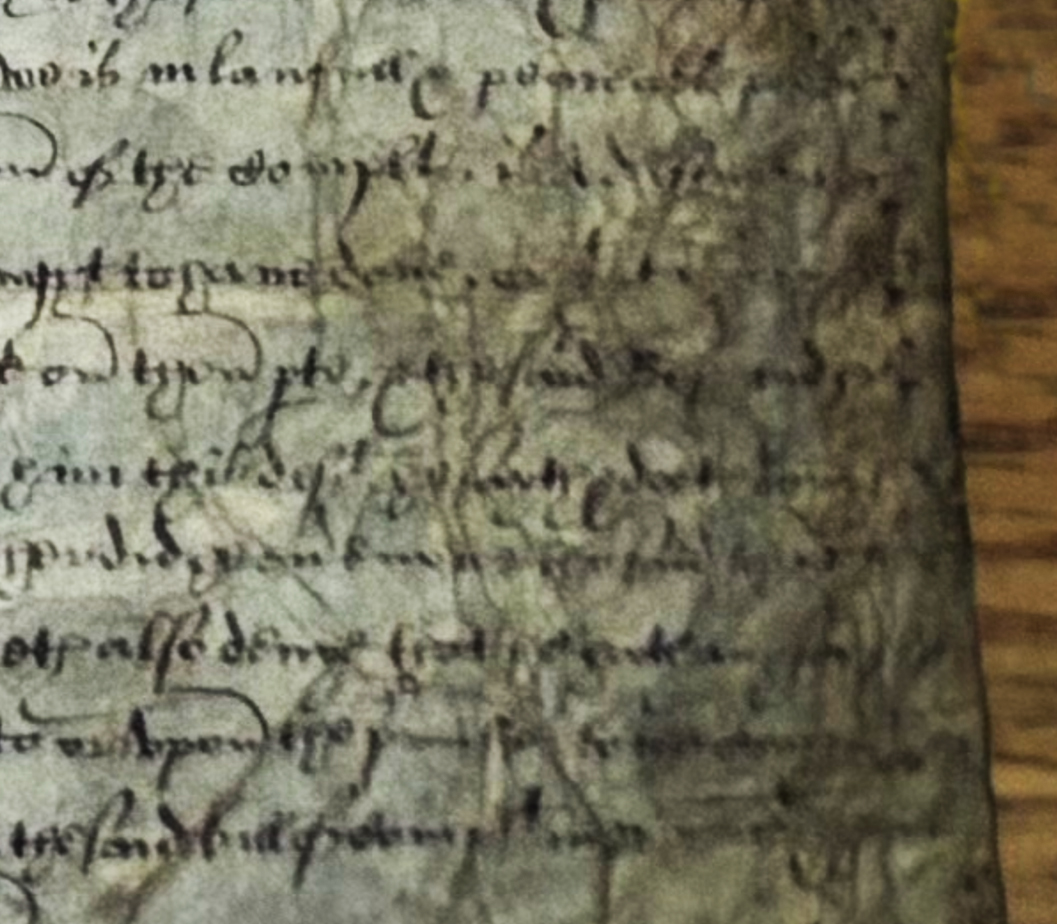 |
|
• The Bill of Complaint of Thomas Mallard
• The Answer of John Rye and Dennis Sheringham |
The Bill of Complaint of Thomas Mallard
5 July 1620
To the Right Honorable Sir Francis Lord Verulam Lord Chancellor of England
[1] Humbly complaining sheweth unto your honorable lordship your daily orator Thomas Mallard, a poor waterman. That whereas one John Palmer, deceased, was in his lifetime [2] lawfully possessed for divers years then & yet to come of & in divers gardens & garden plots, messuages & tenements with the appurtenances lying & being in the liberty of old [3] Paris Garden in the parish of St Saviour & in the county of Surrey; And being so thereof possessed, in or about the month of September in the year of our lord 1599 did [4] make & declare his last will & testament in writing & did thereby give & bequeath unto Ann then his wife the said premises, whereof he so stood possessed, with the leases [5] rents & reversions thereof any way to him of right belonging. And of his said will he made the said Ann his wife sole executrix. And afterwards by his indenture [6] bearing date the sixteenth day of July in the fourth year of the king's majesty's reign of England now being [=1606], he the said John Palmer did demise & to farm let [7] unto your said orator & Isabel his wife parcel of the said premises so bequeathed, that is to say, all those two little garden plots with the appurtenances, upon one of which a [8] house was then built wherein your said orator then inhabited in the liberty & parish aforesaid for the term of forty years being a less term than the said [9] Palmer held the same for as aforesaid, at the yearly rent of five & fifty shillings, with a clause of re-entry for non-payment of the said rent according to the [10] condition & provisos in the said indenture of lease expressed, as by the said indenture of lease amongst divers other covenants, grants, articles, & agreements whereunto [11] your said orator for more certainty referreth himself, doth & may appear. By virtue whereof your said orator into & upon the said demised premises with the appurtenances did [12] enter & was thereof lawfully possessed. And afterwards in or about the month of February in the year of our lord 1608 the said John Palmer, possessed of the reversion [13] expectant upon the said demise or lease made to your said orator, died. After whose decease the said Ann his wife (as your said orator is informed) made her election & [14] did enter upon the premises to her bequeathed by virtue of the said bequest, & not as executrix. And after that the said Ann took to husband one Francis Best cabinet [15] maker, and afterwards in or about the several months of July & August in the ninth year of his majesty's said reign of England [=1611] your said orator did make two several [16] demises & leases of parcel of the said demised premises unto Walter Consett & James Haynes for several terms of years yet enduring & not exceeding the term [17] to your said orator granted as aforesaid, at several yearly rents payable by the said Consett & as in & by the said several demises & leases to them made as [18] aforesaid may appear. And since then your said orator & the said Consett & Haynes, hoping to enjoy their said several estates & interests without any manner of eviction [19] or disturbance, have very much improved the said demised premises so to your said orator by the said Palmer demised as aforesaid, and every of them upon their several [20] parcels hereof respectively have bestowed great costs, charges, & expenses both in repairing the same & in new building & erecting divers new tenements & cottages thereupon. [21] But now so it is, if it may please your honorable lordship, that the said Ann Best died, & the said Francis Best her husband her did survive, & claiming in the right of his [22] said wife to be rightfully interessed & possessed of the reversion & rent of the said demised premises late before in the possession of the said Ann his wife did take & receive [23] of your said orator to his own use, the said rent reserved upon your said orator's lease & made acquittance for the same as true owner in reversion, without the claim [24] or interruption of any other person or persons. And your said orator, conceiving that the said Francis Best was the true owner thereof in reversion, & having no knowledge [25] any other that had better right thereunto, & being in danger to forfeit his said lease upon the condition of non-payment of rent if he should not pay the same being demanded [26] did therefore continue payment of his said rent unto the said Francis Best & his assigns until one John Rye the elder, a troublesome fellow & some kindred to the said [27] John Palmer deceased, being stirred & set on by one Dennis Sheringham, sometime an attorney in his majesty's Court of Common Pleas, did begin to quarrel the title of [28] the said Best. And to that end & purpose, they the said Rye & Sheringham have plotted, practised, & combined themselves together, and by such their plot, practice, & [29] combination to defraud the brother, children, & others the kindred of the said John Palmer, the said Rye procured unto himself letters of administration out of the [30] Prerogative Court of Canterbury of the goods of the aforesaid John Palmer unadministered. And by pretense & color of the said letters of administration & without any [31] other just cause or title, the said Rye thereupon did enter into & upon aswell the said premises to your said orator demised as aforesaid as also all other the goods & chattels [32] & leases which sometime were of the said John Palmer, pretending the same to be unadministered & of right to him the said Rye belonging, by virtue of the said letters of [33] administration. And thereupon suits began & were commenced between the said Rye & the aforesaid Francis Best for touching & concerning the reversion both of the said [34] lease by the said Palmer made to your said orator & also of divers other leases by him made unto others. For appeasing of which suits, they the said Rye & Francis Best did [35] submit themselves to the arbitrament of Sir Edmund Bowyer & Sir Thomas Lowe knights, who thereupon did award that the said Best & his assigns should have & enjoy [36] the said lands & leases then in controversy, whereof the lands to your said orator demised are part. And that the said Best or his assigns should in respect thereof satisfy unto the [37] said Rye or his assigns the sum of one hundred marks, according to which arbitrament one Abel Browne, the assignee of the said Best to whom the said Best had [38] assigned aswell the said lands to your said orator demised, as also all other the lands then in controversy, did by & with the consent & good liking of the said Rye pay & [39] satisfy unto one John Blinckerne, the assignee in that behalf of the said Rye, the said hundred marks so awarded to be paid as aforesaid. And so the award was [40] on the part of the said Best & his assigns fully executed & performed, for which cause your said orator conceived that the said Abel Browne, the assignee of the said [41] Best ought to have & enjoy amongst other things the reversion of the premises to your said orator demised as aforesaid, & that he had good right & title thereunto, whereupon [42] your said orator did continue the payment of the said rent after that unto the said Abel Browne for a good space together without any contradiction of the said [43] Rye or any others for him or on his behalf, until the said Dennis Speringham did again move & stir up the said Rye to further quarrel & contention. And your [44] he the said Sheringham, having gotten from the said Rye a secret & fraudulent conveyance to himself or some others to his use, amongst other things of the [45] reversion of your said orator's lease & the lands thereby to him demised as aforesaid, did as a cause of the said quarrel & contention find fault with the said award as [46] insufficient & void in law. And so after the same award had been by the said Rye his own consent executed on the part of the said Best & his assigns, they the [47] said Rye & Sheringham went about & endeavored to avoid the execution thereof on the part of the said Rye contrary to all equity & good conscience. By occasion [48] whereof they the said Rye & Sheringham went about & endeavored to avoid the execution thereof on the part of the said Rye, contrary to all equity & good conscience. By occasion [49] made divers secret demands of the rent due & payable by your said orator as aforesaid, & have gone about to take the forfeiture of your said orator's lease [50] only for non-payment of rent grown due in the time of suits between the said Rye on the one part & the said Best & his assignee Browne on the other part, [51] when your said orator could have no knowledge which part had best right to receive the said rent or to whom your said orator might safely pay the same. And [52] hereupon (as it appeareth unto your said orator) contention and suit grew between the said Browne & Rye, and cross-Bills are now depending in this [53] honorable Court of Chancery between them concerning the right in reversion of the lands & leases of the said John Palmer deceased, whereof your said orator's lease is [54] parcel. In the proceeding of which said suits upon the motion of the said Rye upon his own Bill, it was the fifth of May in the sixteenth year of his majesty's [55] said reign [=1618] ordered against the said Rye that the possession should continue with the said Browne until the hearing of the cause or other order to the contrary, [56] at the time of the making of which order & before your said orator was tenant in possession of the said premises to him demised, as aforesaid, & the said Browne as [57] true owner of the reversion, expectant upon your said orator's lease, did from time to time receive the rent thereof at your said orator's hands as formerly [58] he had done, your said orator not knowing any other that had right thereunto. But the said Rye & Sheringham, notwithstanding the said order & in contempt of the [59] same attempted suit against your said orator at the common law, thereby to evict your said orator upon a supposed forfeiture of your said orator's lease for [60] non-payment of rent. And although your said orator, as tenant to the said Browne, & in maintenance of his possession, did serve the said Rye with a writ of examination [61] of the said order. Yet nevertheless afterwards, & before any hearing of the cause or other order to warrant the same, the said Rye & Sheringham by undue [62] courses & under color only of non-payment of his rent to the said Rye, have caused your said orator to be evicted & put out of his possession & dwelling, leaving [63] him utterly destitute of all place of habitation, to lie in the street, and so & therewithal they have disturbed the possession of the said Browne, & by that means [64] the possession doth not continue with him the said Browne, as according to the tenor of the said order it ought to have done. Which being manifestunto[65] contempt against this honorable Court of Chancery committed by them the said Rye & Sheringham of set purpose to dispossess your said orator & his under-tenants after [66] their great costs & charges bestowed as aforesaid, your said orator hopeth your honorable lordship will take special consideration thereof for relief of your said orator [67] punishment of the said offenders. In tender consideration of all which premises & for that if it shall appear to this court upon the hearing of the cause between the [68] said Browne & Rye (which is now in this honorable court depending) that the said Rye hath best right to the said reversion, it is nevertheless against all equity [69] & conscience that the said Rye, or the said Sheringham by any conveyance from the said Rye, should take advantage of the forfeiture for non-payment of rent (as the case [70] standeth) either against your said orator or his said undertenants, and your said orator hath no relief for the same by the strict proceedings of the common law [71] in case the title fall on the part of the said Rye. May it please your honorable lordship to grant unto your said orator his majesty's most gracious writ of subpoena to be [72] directed to the said John Rye & Dennis Sheringham, them & either of them, thereby commanding at a certain day & under a certain pain therein to be limited, to [73] be & personally to appear before your honorable lordship in his majesty's high Court of Chancery, then & there to answer the premises, & further to stand to & abide all such [74] order & direction therein as to your honorable lordship shall seem agreeable with equity & good conscience. And your said orator shall daily pray to God for your honor [75] in all health & happiness long to continue.
The Answer of John Rye and Dennis Sheringham
Jurati 20 Septembris 1620
The joint and several [answers] of John Rye and Dennis Sheringham, defendants, to the Bill of Complaint of Thomas Mallard complainant
[1] The said defendants now and at all times hereafter saving unto themselves all benefit & advantage of exception to the uncertainty & insufficiency of the said Bill of Complaint & of the matters therein contained, they & either of them for himself severally saith. And first the said John Rye to so much of the [2] said Bill of Complaint as doth any way concern him this defendant & material for him to answer unto, saith & confesseth it to be true that John Palmer, in the Bill of Complaint named, was in his lifetime lawfully possessed for divers years then & yet to come, of & in the gardens, garden plots, messuages & tenements in the said Bill of [3] Complaint mentioned. And further saith that he, being thereof so possessed, did make & declare his last will in writing, bearing date about the 14th day of September anno domini 1599, and thereby did give unto Ann then his wife all such leases, bonds, & other goods & chattels which he then had or of right ought to have, for the [4] bringing up of Nicholas his son, & made & appointed the said Ann sole executrix of his said last will & testament. And this defendant also thinketh it to be true that the said John Palmer did demise & to farm let unto the complainant & Isabel his wife in the Bill of Complaint named, the two little garden plots upon one of which a house [5] was then built, being parcel of the premises by the said John Palmer as aforesaid bequeathed for such term of years, & for such yearly rent, and under such or the like condition as in the said Bill of Complaint is mentioned. And further saith & confesseth that afterwards, that is to say about the 27th day of February anno [6] domini 1603, he the said John Palmer died, of the same premises so possessed as in the Bill of Complaint is expressed. And this defendant further saith that the said John Palmer at the time of his decease had leases, goods & chattels, debts & credits in several divers to the value of £200 or £300, and that the said Ann proved the said will, took [7] upon her the execution thereof, by virtue whereof she became possessed of all the premises in the same will mentioned, as executrix to the said John Palmer. And this defendant denyeth that the said Ann did make election & claim the said premises as a legacy only, but as executrix as aforesaid. And the said defendant Rye further [8] saith that about one year & a half after the decease of the said John Palmer, she the said Ann did intermarry with Francis Best, in the Bill of Complaint also named, and that afterwards, about the 7th of April anno domini 1611, the said Ann died intestate. After whose decease the defendant Rye, being the natural brother of the [9] said Ann & uncle & next of blood unto the foresaid Nicholas the son of the said John Palmer (the said Nicholas being then dead) about the 27th of April anno domini 1612 did sue forth letters of administration out of the Prerogative Court of Canterbury of all the goods, chattels, debts & credits of the said [10] John Palmer & unadministered by the said Ann, as by the said letters of administration under the seal of the said Prerogative Court of Canterbury ready to be shewed forth to this honorable court doth & may appear. By virtue whereof the interest & terms of years of him the said [11] John Palmer of, in, & to all the foresaid premises late the said Palmer's not administered by the said Ann, and the reversions expectant upon determination of leases of any part of the premises by him made doth belong unto this defendant Rye, as by his counsel he is advised. And this defendant also saith that it [12] may be true that the complainant about the several months of July & August in the ninth year of his majesty's reign of England [=1611] made two several leases of parcel of the premises (to him as aforesaid demised) unto Walter Consett & James Haynes for several terms of years as & at several yearly rents [13] and that since then the said complainant, Consett, Haynes have improved the said premises in repairing & building some small tenements & cottages thereupon, and might have also enjoyed the same without eviction or disturbance of this defendant, if he the said complainant had not willfully & & maliciously delayed [14] and made default of payment of the said yearly rent upon his own lease reserved. And this defendant further saith that soon after he had sued forth the foresaid letters of administration out of the Prerogative Court of Canterbury, he the said defendant caused the same to be openly published & made known aswell [15] to the complainant as to others the late tenants of the said John Palmer deceased, requiring & demanding them & every of them severally from thenceforth to pay their several rents upon their several leases reserved to him. This defendant, as administrator of the goods & chattels of the said John Palmer was [16] administered by Ann his late wife & executrix which they & every of them refused & utterly denied to do, but said & affirmed they would still continue the payments of their several rents unto the said Best & his assigns as formerly they & every of them had done. And this defendant saith that the said [17] Francis Best claimed & pretended to have interest in & to all the premises late the foresaid John Palmer's by & under color of a nuncupative will supposed to be made by the foresaid Ann, the late wife & executrix of the said Palmer, which supposed will nuncupative (as this defendant hath credibly heard) was [18] after the decease of the said Ann made, contrived, & parted by practice & confederacy between them the said Francis Best & the complainant & Isabel his wife, Walter Consett, James Haynes, & William Bundye or some of them, who purposely (as this defendant hath also credibly heard) combined [19] themselvestogetheragainst this defendant, hoping thereby to make void the said administration to him as aforesaid granted. After the probate of which supposed will, that is to say, about the 13th day of November anno domini 1612, the said defendant Rye entered his appeal in the Court of Arches, & there disproved the [20] the same surmised will, depending which appeal divers & sundry suits at law were risen & grown between this defendant Rye & the said Francis for & concerning the foresaid premises, late Palmer's, in the Bill of Complaint mentioned. For appeasing & undoing of all which suits then in controversy [21] between them, they the said Rye & Best did about the 30th day of May anno domini 1613 submit themselves to the arbitrament & final determination of Sir Edmund Bowyer & Sir Thomas Lowe, knights, in the Bill of Complaint named, who taking upon them the burden thereof did [22] afterwards about the 28th of June then next following, make their award between the said parties in writing by which there {wonde} no mention is made of the foresaid suit in the Court of Arches then depending between the said parties, neither was that suit deterring [...]d in [23] as by that same award albeit the said arbitrators before the award made had notice of the said suit in the said Court of Arches so depending, and therefore under favor of this honorable court that same award was & is merely void in law & ought not to be performed as this defendant hopeth will seem reasonable to this honorable court. And [24] this defendant also further saith that the aforesaid supposed nuncupative will (whereupon the foresaid award is grounded) was afterwards admitted & made void by a sentence given against the same in the foresaid Court of Arches, as by the exemplification thereof under the seal of that court ready to be shewed to this honorable court doth & may appoint [25] all which proceedings were still from time to time not fixed & made known to the said complainant & divers others the undertenants unto several {pieces} of the premises. And this defendant denyeth that the foresaid arbitrators did award that the said Best & his assigns should have & enjoy the lands & leases then in controversy, or that the said Best [26] as his assign did in respect thereof satisfy unto the said Rye or his assign the sum of one hundred marks or any part or parcel thereof, or that Abel Browne, in the said Bill of Complaint named (as assign of the said Best, & by & with the consent & good liking of this defendant) did satisfy unto John Blinkorne, in the said Bill of Complaint named, [27] pretended to be assign of the said Rye in that behalf, the said hundred marks or any part thereof, as in & by the said Bill of Complaint is most untruly surmised. And yet this defendant thinketh it to be true that after the said avoid award so made, the foresaid Abel Browne might obtain & take from the said Francis Best an assignment [28] of that his pretended title unto the premises in the Bill of Complaint mentioned, & that after that assignment so made, the said complainant did continue the payment of his said rent unto the said Abel Browne to this defendant's knowledge. But this defendant doth deny that the said Francis Best or the foresaid Abel Browne, by any such [29] assignment thereof to him made had or hath any lawful right or title of, in, or to the same premises, or that the said Browne, as assign of Best, ought ought to have & enjoy the reversion of the premises to the complainant demised, or that he had any good right or title thereunto, or to receive the rents of the same or of any part thereof. [30] And this defendant doth also deny that the said complainant did at any time after the foresaid administration to him this defendant granted, continue the payment of the said rent without any contradiction of the said defendant Rye, for this defendant knoweth it to be true, & is well able to prove that soon after that assignment to the said Browne so made, and before the [31] feast of St Michael the Archangel next ensuing, & divers & sundry times after the said feast, he the said defendant did forewarn and charge the said complainant & others not to pay any rent unto the said Abel Browne, but unto him this defendant, promising the said complainant & others undertenants of several parcels of the premises, that if he or [32] they would attorne tenants by payment of their several rents unto him this defendant, he the said defendant would become bound to save harmless the said complainant & others against the said Abel Browne, which to do or accept, the said complainant & others from time to time, so often as any such demand was made, did most obstinately & willfully refuse to. [33] Therefore the said complainant had no cause nor color to continue the payment of his said rent unto the said Browne, or to conceive that the said Browne ought to have & enjoy the reversion of the premises to him the said complainant demised. And this defendant doth deny that the other defendant Dennis Sheringham did move or stir up him the said [34] defendant Rye to quarrel the title of the said Best, or that they the said defendants have plotted, practised, & combined together to defraud the brother's children, or others the kindred of the said John Palmer (if any such be), and doth also deny that the said Sheringham hath got any secret or other conveyance from this defendant Rye [35] to himself or to his use of the premises or any part thereof, or that they the said defendants, or either of them, hath made any secret conveyance or entries of or in the premises to the complainant demised other than re-entries for non-payment of rent reserved, & such leases as the defendant Rye hath heretofore made unto Edmund [36] Fynche & unto John Rye junior severally of parcel of the premises for trial of this defendant's just title thereunto, which with the favor of this honorable court he hopeth he might lawfully do. And this defendant thinketh that the complainant hath purposely inserted the bane of the other defendant in the said Bill of Complaint to take away his {testimony} [37] in the behest of this defendant, which this defendant hopeth this honorable court will not think fit nor allow of. And also hopeth this court will think it reasonable & so order that notwithstanding he the said Sheringham is made defendant in this suit, this defendant Rye shall have the benefit of his testimony he the said Sheringham {might be a} [38] material witness in this cause. And the said defendant Rye doth also deny that the foresaid award was by his own consent executed on the part of the said Best & his assign; neither was there any execution at all of that award by him to be performed in regard that same award was & is void in [39] law. And further this defendant saith that the said complainant did exhibit his foresaid Bill of Complaint into this honorable court against this defendant upon the fifth day of July anno domini 1620, being the last day of Trinity term now last past, and further saith that long before the exhibiting of the [40] said Bill, that is to say, about the eighth of November anno domini 1614, the foresaid Abel Browne & John Blinkorne did exhibit a Bill of Complaint against the now defendant Rye, by which last said Bill of Complaint the said Browne did then pretend to be interessed unto two leases late Palmer's, being the premises [41] in the now Bill of Complaint mentioned, by & under color of the foresaid nuncupative will & award, by which said Bill the said Browne then endeavored to have the said award ratified & confirmed by the order & decree of this honorable court. Unto which said Bill the defendant Rye appeared & put in his Answer, upon oath in & by which said answer [42] this defendant denied the said title of the said Browne unto the premises & affirmed his own title unto the same premises by virtue of the foresaid letters of administration to him as aforesaid granted, which said Bill by Browne & Blinkorne so exhibited was afterwards, & before the complainant's now Bill exhibited, after many orders & reports in that cause [43] made, & counsel on both sides often times heard, absolutely dismissed with {xpoti marks cases} as by an order of this court in that cause made the 12th day of March anno 15 Jacobi regis [=1618] ready to be shewed forth appeareth, & it standeth still dismissed upon 6 several dismissions. And this defendant further saith that afterwards & before the exhibiting of the [44] complainant's now Bill of Complaint, scilicet in the term of Easter anno domini 1619, the said Abel Browne (as this defendant in further examination of the foresaid confederation & combination and the rather being (as this defendant verily believeth) instigated & set on by the complainant Mallard & others pretending themselves to be undertenants [45] unto several parcels of the premises (knowing that they & every of them for their several obstinate & willful refusals & non-payment of their several rents have forfeited their several estates & that two verdicts having also passed against the pretended title of the said Browne at the common law, and knowing the defendant Rye to be a very poor man & constrained to pay the several yearly rents upon the ground leases reserved, being £5.10s per annum paid by the defendant by the space of 3 years now last past, otherwise those leases had been forfeited. [46] And in these respects hoping to wear him out with continual suits in law. He the said Browne for these same respects (as this defendant takes it), rather than upon any just cause, did exhibit a new Bill of Complaint into this court against this defendant Rye for & upon the selfsame cause & title in his former bill mentioned, unto which last said Bill the said defendant Rye also appeared, & by way of answer [47] thereunto did again deny the title of the said Browne & maintain & set forth the same his just & true title to the premises to such effect as in his foresaid Answer to Browne's first Bill is specified. Which last said Bill, after some references & reports & counsel on both sides heard was also before the complainant's now Bill exhibited) absolutely [48] dismissed, as by the exemplification thereof under the great seal appeareth. Without that, that the said complainant had no knowledge which part had best right to receive the said rent or to whom he might safely pay the same, and without that, that at the time of the exhibiting of the complainant's now Bill there were cross Bills in this honorable court [49] depending between the said Browne & this defendant Rye concerning the right in reversion of the lands & leases of the said John Palmer deceased. And the defendant Rye doth further say & confess that there is a Bill in this honorable court depending between this defendant Rye therein complainant & the foresaid Abel Browne & others defendants concerning [50] the title of the premises, and that upon a motion made upon that same Bill it was on the fifth day of May in the 15th year of his majesty's reign [=1617] (amongst other things therein contained) ordered that the possession should continue with the said Browne until the hearing of the cause or other order to the contrary. [51] But this defendant doth deny that at the time of the making of that said order or for 6 months before, that the complainant was tenant in possession of the premises to him as aforesaid demised, for this defendant saith that before the said order made, that is to say, at the Assizes holden for the county of Surrey the 16th day of [52] July in the 15th year of his majesty's reign over England [=1617] upon an action of ejection firm formerly brought by one Edward Fynch, lessee of this defendant, in his majesty's court of King's Bench at Westminster against the now complainant for & concerning the title of the premises now questioned. A verdict was there given for the title of [53] this defendant against the title of the now complainant and for this very cause by reason of his obstinate & willful refusal & not payment of his foresaid rent to the now defendant as administrator of the goods of the foresaid John Palmer being upon the 16th day of July anno domini 1616 lawfully demanded & not paid and that in the term of St Michael then next following [54] after the foresaid Assizes and before the foresaid order so made, or the complainant's now Bill exhibited, judgment was thereupon given, & a writ of habere facias possessionem termini awarded to the then sheriff of the county of Surrey directed, by virtue whereof the said sheriff put the lessee of this defendant in lawful & quiet possession [55] of the premises so recovered, which possession the said lessee presently delivered up to this defendant which he did quietly & peaceably hold until the term of St Hilary in the foresaid 16th year of his majesty's said reign [=1618]. In or about which time the said complainant, by one Matthew Hodges his lessee, brought an action of ejection firm in his majesty's Court [56] of Common Pleas at Westminster against one Thomas Crewe then undertenant in possession of the premises formerly from the complainant as aforesaid recovered. Unto which said action the said Thomas Crewe without the privity & consent of this defendant appeared and fraudulently suffered a judgment by non sum informatus, which judgment was in the [57] same term & interest with a remit of the costs & a writ of examination was thereupon soon after taken forth to the then sheriff of the county of Surrey directed. By virtue of which said writ the said sheriff did again set the now complainant in possession of the said premises, by reason of which undue practice this defendant Rye was [58] again outed from his lawful possession of the premises by him as aforesaid lawfully recovered. Which this undue practice (as this defendant hath credibly heard & believeth to be true) was first demised & wrought by the sinister practice & combination of the complainant and one [blank] Tysdalle sometime an attorney at the {Common Pleas} [59] and of Robert Smyth a common noted solicitor, or by one of them, & of the foresaid Thomas Crewe. And this defendant also saith that afterwards, and before the complainant's now bill exhibited, scilicet in the term of St Trinity in the 16th year of his majesty's reign [1618], this defendant, for recovery again of his lawful possession of the premises (out of which by [60] the undue means aforesaid he had lately been outed), did by John Rye the younger, his son & lessee, bring an action of ejection firm in his majesty's court called the King's Bench at Westminster against the said complainant Thomas Mallard, Ann Ridge, & Mary Forde x x x x whereunto they the said Thomas Mallard & the other defendant {by action} [61] did in the term of St Michael then next following plead not guilty, which issue so joined was afterwards at the Assizes holden for the county of Surrey the first day of March in the 17th year of his majesty's reign [=1620], by a jury of that county tried, and after full hearing of the cause & full evidence on both sides [62] given, a verdict was by that jury given for the title of the now defendant Rye, and in the term of Easter then next following & now last past, judgment was thereupon given, and a writ of habere facias possessionem termini was awarded to the sheriff of the county of Surrey, by force & virtue whereof, the said sheriff did again [63] set the lessee of the defendant Rye in lawful & peaceable possession of the premises by him as aforesaid so lawfully recovered & now vainly questioned, as this defendant hopeth with the favor of this honorable court he might lawfully do, notwithstanding any order of this court in the Bill of Complaint mentioned, which is the same eviction & putting out [64] of possession & dwelling, leaving the complainant destitute of all place of habitation, & contempt in the foresaid Bill of Complaint mentioned, whereof this defendant humbly prayeth this honorable court to take due consideration, for that long before & at the time of the foresaid order made, this defendant was & now is in lawful & peaceable possession [65] of the premises by due course of law as aforesaid, & for which is now again questioned, and also for that this defendant, by the undue practice aforesaid was so wrongfully outed from his former lawful possession. Without that, that the foresaid recovery again of the defendant's former possession & eviction of the complainant, is a dif[...] [66] of the possession of the said Browne (the said Browne not being in possession thereof at the time of the said order made). And without that, that by that means, in the Bill mentioned, the possession doth not continue within the said Browne, according to the terms of the said order (as the said complainant pretends it ought to have done, or that it is [...] [67] contempt against this honorable court committed by them the said Rye & other {ingham} or a set purpose to dispossess the complainant & his undertenants at further great costs & charges bestowed, other than (under favor of this honorable court) is lawful for them to do. And without that, that in the time of suits between the defendant Rye on the one part & the said Best and his [68] assign Browne on the other part, the complainant could have no knowledge which party had best right to receive the rent or to whom the said complainant might safely pay the same. And the defendant Dennis Sheringham, for himself & for full answer to so much of the foresaid Bill of Complaint as any way concerning him, this defendant he saith & doth deny [69] to have at any time moved, stirred, or set on the other defendant Rye to quarrel the foresaid title of the foresaid Francis Best or his assign Browne, & doth also deny to have plotted, practised, or combined himself with the said Rye to deceive the brother's children or other kindred pf the foresaid John Palmer, neither did he ever [...] the said John Palmer [70] or ever knew or heard of any kindred that the said John Palmer had. And this defendant Sheringham doth also deny that (to his now remembrance) he gave advice for the procuring to the other defendant Rye the foresaid letters of administration out of the Prerogative Court of Canterbury. And this defendant doth also deny that he hath [...] [71] or any conveyance at all of the premises in the Bill of Complaint mentioned, or of any part thereof, but doth utterly deny that he hath any right. title, or interest of, in, or to the same premises or to any part or parcel of the same, and doth also deny that he hath made x x x x any secret entries into or upon the premises to the complainant [72] demised, or that he in his own right hath made any secret demand of rent due or payable by the complainant, or that he hath gone about to take the forfeiture of the complainant's lease for non-payment of rent as in the Bill of Complaint is most falsely surmised. And without that, that any other matter or thing in the said Bill of Complaint [...] [73] not sufficiently confessed & avoided, traversed or denied, is true, all which matters these defendants & either of them for his own part severally do & will be ready to aver, maintain, & prove, as this honorable court shall award, and they & either of them pray to be dismissed with good costs by reason of the complainant's unjust & wrongful vexation.