Return to Files List    


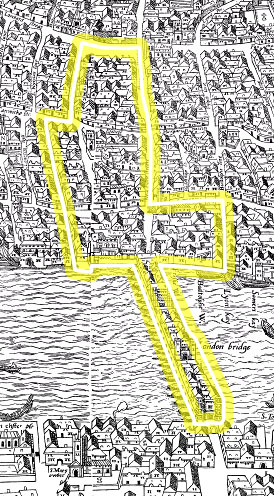
St Saviour parish was made up of manors. At the western end was the Manor of Paris Garden, and in the middle the bishop of Winchester’s Manor of Clink Liberty. At the eastern end of the parish, the part parishioners called Boroughside, the parish boundaries overlapped with three more manors, the Guildable Manor, the King’s Manor, and the Great Liberty Manor. These manors ran along and spread outward from the main thoroughfare of Borough High Street.

1. The Guildable Manor (The Northern Bridgehead) was the oldest, smallest, and most lucrative sliver of land. It consisted of the tight urban pocket directly at the foot of London Bridge. Acting as a critical collection point for royal taxes and shipping tolls, its territory straddled the north end of Borough High Street and extended down toward Borough Market and St Saviour’s Dock.

2. The King’s Manor (The Southwestern Quadrant) included the remainder of Borough High Street moving south, shifting toward Blackman Street and the open marshlands. It completely surrounded St George the Martyr Church and stretched west to include the open expanses of St George’s Fields.

3. The Great Liberty Manor (The Eastern Flank) controlled the eastern side of the borough. It extended away from the eastern edge of Borough High Street to encompass the lands of Snow’s Fields and ran down along the path of Old Kent Road.

In 1550, a comprehensive royal charter by king Edward VI enabled the City of London to purchase the King’s Manor and the Great Liberty Manor, uniting them with the Guildable Manor which the City already controlled. The purchase was intended primarily to stop fugitives and criminals from escaping justice across London Bridge.

The City organized all three manors into a single administrative unit known as Bridge Ward Without. This action fixed the collective footprint of the three manors as the official legal boundary of the ‘Town and Borough of Southwark’.

The easternmost part of St Saviour parish thus became part of the Borough of Southwark, while the remainder of the parish — the manors of Clink and Paris Garden — remained outside its jurisdiction.

The City managed Bridge Ward Without by appointing a dedicated alderman — often their most senior, longest-serving alderman — as alderman of the ward, while relying on the existing courts leet of its three Southwark manors, rather than elected common councilmen, to provide local representation. The ward (and the borough) thus elected no alderman or common councilmen of its own.

[In 1978 the Ward of Bridge Without was finally amalgamated with Bridge Ward Within (the area on and just north of the bridge) to create a single ward.]


The Ward of Bridge Within
(whose boundaries include the structures on London Bridge)