 |
|
| Return to Poor Petitions |
|
|
| Return to Poor Petitions |
|
Thomas Cure of St Saviour was a man of stature and substance.
He had been Master of the Company of Sadlers a remarkable five times, and was Sadler to king Edward VI, queen Mary, and queen Elizabeth.
By 1558 he had moved to St Saviour and was almost immediately elected a vestryman, a post he held till his death.
He was chosen churchwarden in 1558 and many times thereafter.
In that same year he presented to the churchwardens a large folio volume of empty pages for their use as a register (P92/SAV/3001).
On its first page is written 'A Register Book Given by Thomas Cure unto the parish church of St Saviour'.
In 1568 he was one of three vestrymen delegated to meet with the wardens of St Olave to discuss the matter of a grammar school.
From 1572 he was one of the Commissioners for Sewers in Surrey.
He acquired the title to many capital messuages in Southwark: the Red Lion, the Cross Keys, the Estridge Feather, the King’s Head, the Vernacle,
the Pewter Pot in the Hoop, and others.
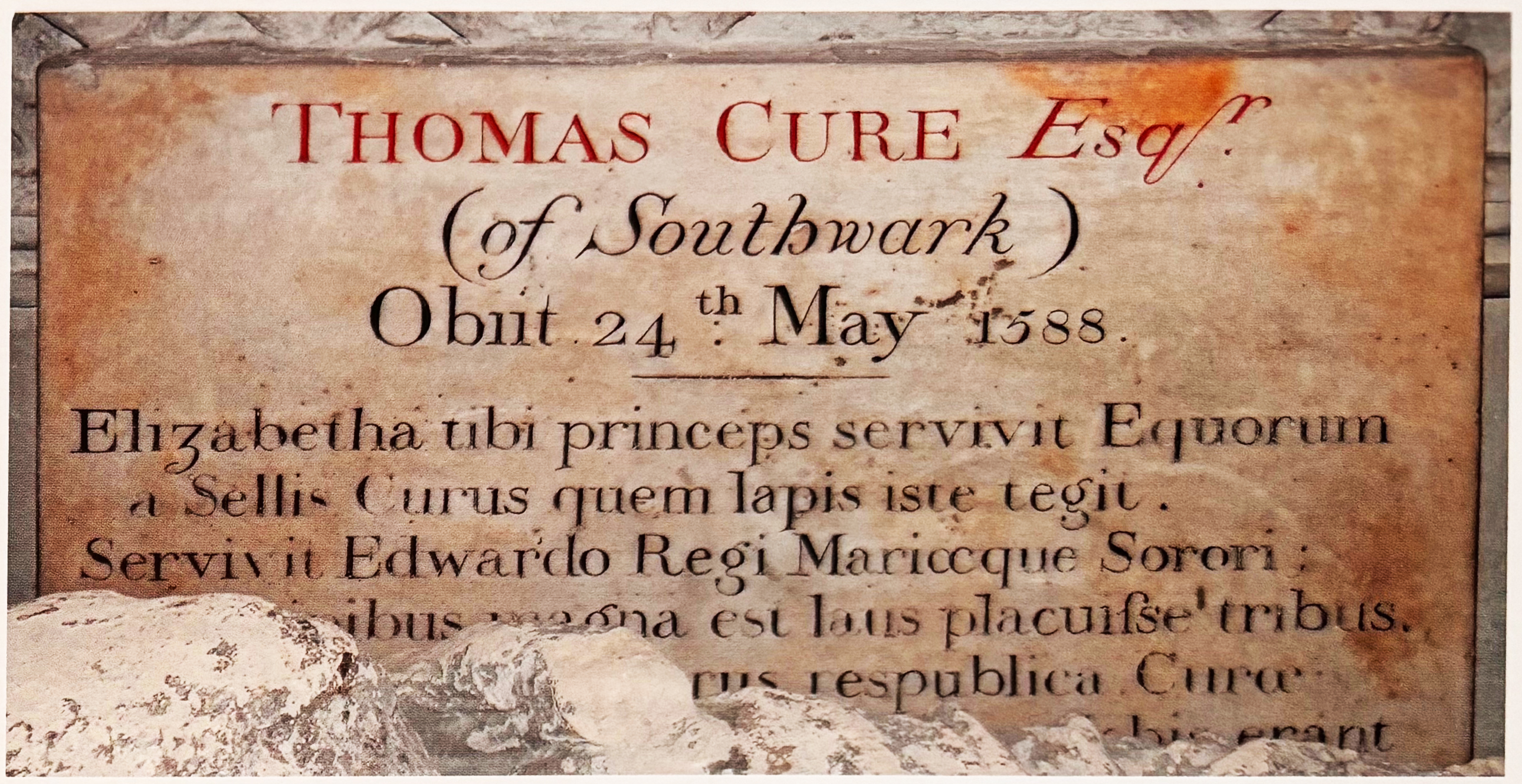
In 1579 he purchased Waverley House and adjoining land from Viscount Montague, and in 1584 he secured letters patent for the erection of a college on the site for poor people in the parish. In that same year, the St Saviour vestry decided that Cure should be partially reimbursed for 'those lands, given to the College for the Poor,' which were 'purchased of my Lord Montague.' The proposed institution was designated a 'College or Hospital for the Poor', and consisted of sixteen almshouses to support sixteen impoverished parishioners. Each petitioner for admission had to be sponsored, affirmed by the vestry, and catechized on the Christian faith. Admission brought with it a weekly pension of twenty pence. The original site of the College and its burial ground was off Dead Man’s Place, later Park Street, on Waverley House property earlier intended as a churchyard, which then became known as College Yard. Along with the new almshouses built there, the College also occupied some of the older Waverley House buildings. The sixteen residents of the College were selected based on need and moral standing, qualities that would mark them as deserving of the parish's benevolence. There were, of course, more than sixteen poor people in the parish. Those not eligible for admission to the College were usually supported by gifts from the vestry of small amounts of money. Wealthy parishioners often left bequests specifically for the poor; the vestry minutes are filled with acknowledgments of such gifts. Thomas Cure died four years after the founding of his College, and was buried at St Saviour, in the church, on 10 May 1588. Above his effigy, a 19th-century plaque has replaced the original bronze plaque, unfortunately stolen. In his will, proved on 22 June, he left £100 towards the purchase of land for a St Saviour grammar school. He left 'his lands, messuages, and tenements in Southwark', including the manor of Paris Garden, to his younger son Thomas, while making his elder son George responsible for annual payments to the use of the poor in the almshouses of his newly erected College. A half century later, at a meeting December 1621, the vestry belatedly ordered an 'inscription' to be made 'over the new gate leading into the College churchyard where the almshouses are'. The inscription was to honor 'Thomas Cure the elder Esquire deceased' for having been 'a good benefactor in founding and building the said College and almshouses.' For further information on this topic, including useful maps, see Living and Dying in Southwark, 1587-1831: Excavations at Cure’s College Burying Ground, Park Street, a book filled with useful information. |
 |