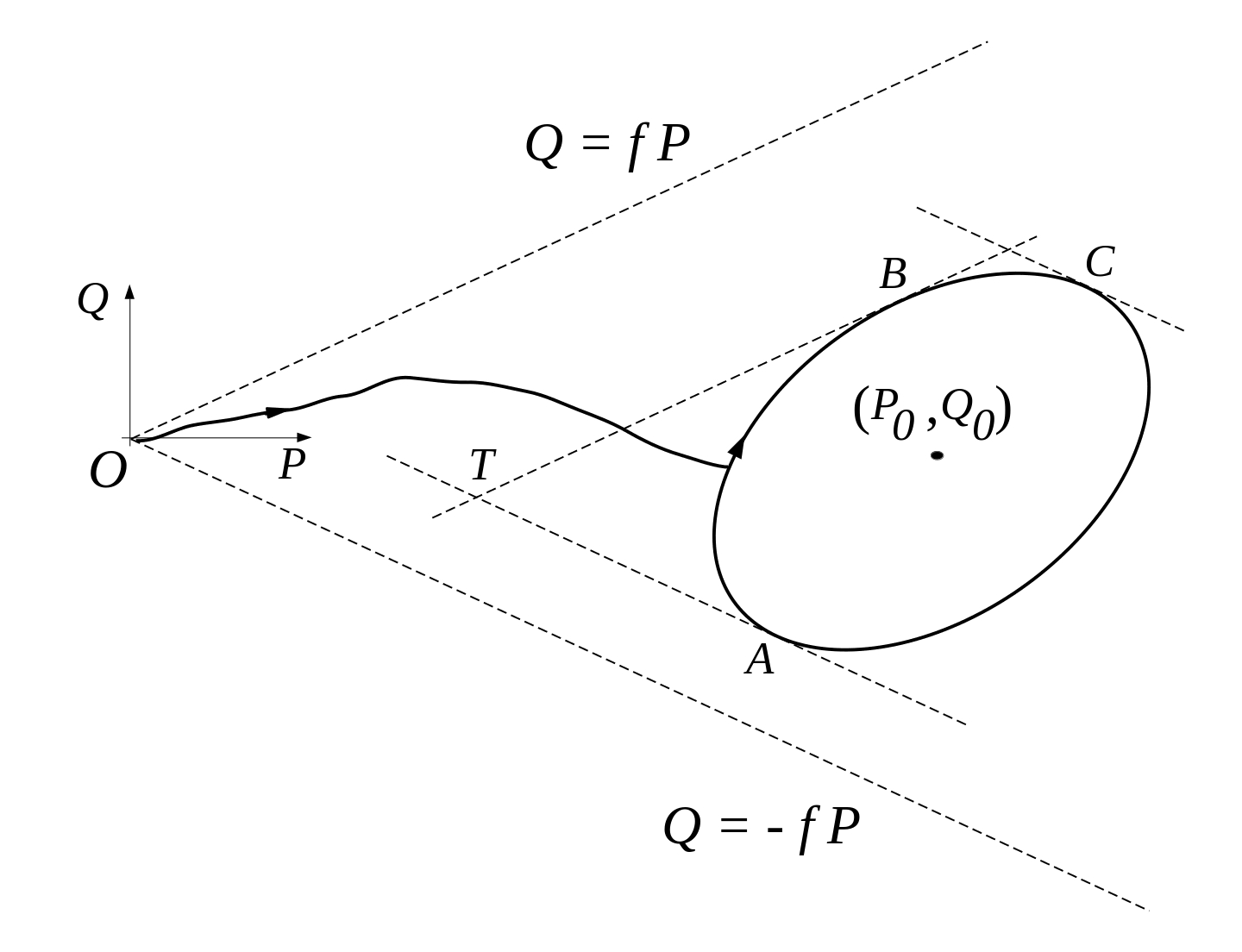
 The figure shows a possible trajectory in PQ-space. Starting from zero,the loads are increased along some initial loading path, but ultimately they vary sinusoidally in the form
However, difficulties can arise in the solution of problems if the coefficient of friction is `large'. This was first remarked in connection with the attempt to prove existence theorems for elastic systems of contacting bodies, but became of more pressing concern in connection with the development of commercial finite element codes which are required to be robust and user-friendly. Frictional problems are inherently history dependent, but we can track the evolution of the system if we can predict the change in displacements from a known initial condition due to a small (infinitesimal) known change in external loads. This is known as the rate problem. Mathematical proofs that the rate problem is well posed require that the coefficient of friction be 'sufficiently small'. From an engineering perspective of course, the question is "how small does it need to be in a particular problem".
Klarbring established a test for the critical coefficient of friction for the discrete problem, where the deformation can be characterized by a finite number of nodal displacements, but the number of computations required is prohibitvely large for most practical finite element representations. If the coefficient of friction exceeds the critical value, situations can arise in which the system must make a finite 'jump' from one state to another in response to an infinitesimal change in load, resulting in a dynamic event for arbitrarily slow loading rates [Cho and Barber, (1998)].
Also, frictional systems can become 'wedged' [Barber and Hild (2006), Kim et al. (2019)], meaning that they remain in a stressed state after all loads are removed — a state analogous to residual stress in plastically deformed structures. Wedging is an essential requirement for screwed fasteners to function, but can be a failure mechanism in an automated assembly procedure. The critical coefficient of friction for wedging is not identical to that for existence and uniqueness of the rate problem.
We have established tests based on the stiffness matrix to determine when these conditions can occur, and to characterize the nature of the resulting behaviour of the system [Ahn et al. (2008)]. Frictional vibrations have long been known to occur in many physical systems, but traditional explanations have depended on the friction coefficient being a function of sliding speed. Our work shows that instabilities (including 'stick-slip' vibrations) can arise with a constant coefficient of friction [Cho and Barber (1999)].
"If a set of time-independent tangential displacements at the interface can be identified such that the corresponding residual stresses when superposed on the time-varying stresses due to the applied loads cause the interface tractions to satisfy the conditions for frictional stick throughout the contact area at all times, then the system will eventually shake down to a state involving no slip, though not necessarily to the state so identified."
However, the proof of Melan's theorem requires that the constitutive law be associative and this condition is not satisfied by the elementary Coulomb friction law. Indeed, it is fairly easy to find counter-examples where a safe shakedown state exists, but is not reached from some initial conditions [Ahn et al. (2008)].
In discrete two-dimensional systems, we can construct an N-vector comprising the slip displacements at the N contact nodes. If the system is linear elastic, the condition for slip not to occur in a given direction at a given node then defines the region on one side of a hyperplane in the coresponding vector space. Since in two dimensions slip can occur in either of two directions ['forward' or 'backward' slip], there are 2N of these linear constraints which move as the external loads vary whilst maintaining the same direction. Shakedown is possible if and only if there exists a region that is never excluded by any such constraint at any time during the loading period. More significantly, Ahn et al. (2008) showed that shakedown occurs for any initial condition if and only if all 2N constraints are active in defining this 'safe space'.
Klarbring et al. (2007) developed a formal proof showing that Melan's theorem applies for any discrete [e.g. finite element] problem in which the normal and tangential problems are uncoupled, meaning essentially that slip displacements at the interface do not result in any change of normal contact pressure. This proof applies to the general three-dimensional discrete problem. A corresponding proof for the continuum elasticity problem is given in Barber et al. (2008). For elastic contact problems that can be modelled as half spaces, the uncoupled assumption requires that Dundurs' bimaterial constant β = 0. Counter examples to Klarbring's theorem can be found for any system involving normal-tangential coupling.
An extension of Klarbring's proof is that if the normal and tangential loads are uncoupled, but the periodic loads are above the shakedown limit so that some slip must occur in each cycle, the extent of the slip zones, the distance slipped at each point and the energy dissipated in friction per cycle is independent of the initial condition [Andersson et al. (2014)]. This has important consequences for fretting fatigue which is generally believed to be correlated with the irreversible processes in the slip region.
The same methodology was applied by Barber et al. (2014) to the case where both normal and tangential loads are arbitrary functions of time.
The figure shows a possible trajectory in PQ-space. Starting from zero,the loads are increased along some initial loading path, but ultimately they vary sinusoidally in the form
where t is time and the dashed lines all have slope + f or - f.
The loads must lie within the sector - f P(t) < Q(t) < f P(t) at all times to avoid gross slip [sliding].
The contact area increases monotonically with the normal load P. Between the two tangent points B, C in the steady-state cycle, the contact area grows, but there is no slip. New contact regions are established in a state of stick. However, a slip zone starts to develop at C and grows until we reach A, at which point the entire instantaneous contact area sticks. A region of slip in the opposite direction then grows in the segment AB and once again the whole slip area sticks when we reach B.
A significant result is that the maximum extent of the slip zones is defined by the intersection point T. All points that would be in contact at a normal load must remain in a state of stick during the steady state and therefore make no contribution to frictional dissipation.
Throughout the periodic loading process, the tractions in the slip zones can be written down in terms of generalized Ciavarella-Jäger distributions [Barber et al. (2014)], and hence the frictional dissipation per cycle can be calculated as a function of position.
In these conditions, we may hope to be able to characterize the conditions inside the slip region by the properties of a surrounding asymptotic elastic field Fleury et al. (2017). The situation is exactly analogous to that in Linear Elastic Fracture Mechanics [LEFM] where fracture is ultimately determined by complex processes immediately adjacent to the crack tip [for example, a small scale plastic zone], but the magnitude of these effects can be characterized by stress-intensity factors.
In the case of fretting, we imagine that the bodies are subjected to the mean loads only and we then 'weld' them together over the contact area creating a monolithic body in which the edge of the contact region appears as a crack. If the periodic loads are now applied to this body, the corresponding periodic stress-intensity factors must uniquely characterize the complex processes occurring in the slip region. This approach has been applied to the correlation of fretting fatigue run out data with significant success [Hills et al. (2014)].