 Credits and Thanks!
 Mason Family Parcheesi Gameboard [polychrome wood, 47.7 x 47.2]. 1992, Bird/Kobayashi Collection, 92.59, Art Gallery of Nova Scotia.
 A.K. Branden, Barque "Edwin K. Barrow", 1875 [oil on canvas, 63.0 x 97.0. Gift of Dugald and Janet MacKenzie, Bridgewater, Nova Scotia, 1982, 80.42] Art Gallery of Nova Scotia.
 Ellis Wilson, "The Funeral Procession". From the Aaron Douglass Collection at the Amistad Research Center.
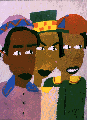 William Johnson, "Three Children," 1944-45 [serigraph on paper]. National Musuem of Art, Smithsonian Institution [MESL]. Reproduced with permission.
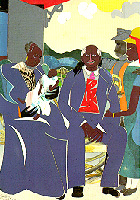 Romare Bearden, "Family", 1988 [collage on wood, 28.0 x 20.0] National Museum of American Art.
 Robert Gwathmey, "Nobody Around Here Calls Me Citizen", 1943 [oil on canvas, 14-1/2" x 17"]. Federick Weisman Art Museum.
 CBS and Beth Sullivan Productions.
 Dr. Suess [pseud.]. 1957 Hougton Mifflin.
 Illustrations for "The Tiger, the Braham and the Jackel" by Gina Triplett.
 "Joseph Cinque" was the name given by Spanish authorities and cited most often in historical documents; Sengbe, Shinquaw or Jinqua appears to be the nearest translation of his African name. The New Haven Colony Historical Society.
 Probably drawn by James or Isaac Sheffield, "Joseph Cinquez," 1839 [lithograph on wove paper]. Library of Congress [#LC-USZ62-12960]. This portrait was done while Sengbe awaited trial in New Haven, Connecticut.
 "Lewis Tappan," Amistad Research Center.
 "Grabeau". He was second in command after Sengbe of the Amistad. Grabeau was sold as a slave in payment for a debt. He spoke Vai, Mendi, Kon-no and Gissi. He was married, but had no children and was a planter of rice. Beinecke Rare Book Rook and Manuscript Library, Yale University.
 "Pedro Montez," was a Spanish slave owner.
 Akan, Fante, Ghana, "Asafo Flag," 1863 [cloth]. Detroit Institute of Arts.
 William Johnson, "Cotton Pickers," 1940 [irregular watercolor and pencil on paper]. National Museum of Art, Smithsonian Museum [MESL].
Reproduced with permission.
William Johnson, "Cotton Pickers," 1940 [irregular watercolor and pencil on paper]. National Museum of Art, Smithsonian Museum [MESL].
Reproduced with permission.
 William Johnson, "Let My People Free," 1945 [oil on paperboard]. National Museum of Art, Smithsonian Museum [MESL]. Reproduced with permission.
 William Johnson, "Art Class: Model in Yellow Chair," 1939-40 [tempera on paperboard]. National Museum of Art, Smithsonian Museum [MESL]. Reproduced with permission.
 Charles McGee, "Noah's Ark: Genesis," 1984 [oil and mixed media on masonite]. Detroit Institute of Arts.
 Makonde, Northern Mozambique, 1900-25 [wood]. Detroit Institute of Arts.
 Mask, Mwana pwo, Chokwe, early 19th century [carver wood, hemp]. Detroit Institute of Arts.
 Photo by Jim Wallace [#86-9910]. A close-up of names carved on the black granite walls of the Veterans Memorial in Washington. This photo shows portions of lines 17 through 35 on panel 46E. The names on the Wall are listed chronologically in the order the casualties occurred. The Wall holds the names of nearly 60,000 Americans who died, or are still unaccounted for, in this nation's longest war. This image file is presented by the Smithsonian's Office of Printing & Photographic Services. 1993 Smithsonian Institution.
 Photo by Paul Honzik. A close-up of the faces of the Soldiers Statue at the Veterans Memorial in Washington. The statue, by Frederick Hart, depicts three soldiers of the Vietnam era. They are placed looking to the names on the wall at the Memorial. 1993 Smithsonian Institution.
 Photo by Frederick D. "Buddy" Hodgkins [SP4]. A photo of the rich rice paddies in the Vietnam countryside.
 The poem -- "The Outpost Soldier" can be found in "Ca Dao Vietnam: A Bilinugual Anthology of Vietnamese Folk Poetry";
edited and translated by John Balaban. 1980 Unicorn Press.
The poem -- "The Outpost Soldier" can be found in "Ca Dao Vietnam: A Bilinugual Anthology of Vietnamese Folk Poetry";
edited and translated by John Balaban. 1980 Unicorn Press. Translation of the poem:
Here are only cliffs and crags, bird prints, beasts shuffling, locusts chirring, and jungle trees rustling their music.
A bird calls out from a gnarled tree. I've dwelt in the forest three years.
 "A Prayer for Peace" was written by Thich Nhat Hanh, Chair of the Buddhist Peace Delegation to the Paris Peace Accords during the Vietnam War. He was nominated for the Nobel Peace Prize by Martin Luther King, Jr. The prayer was used throughout South Vietnam in 1965 in the "Don't shoot your Own Brother" campaign to rouse the willingness to work for peace. The graphical image of the dove was done by Sandy Ackerman; it is based on Thich Nhat Hanh's pen and ink drawing of the late 1960s. Dr. Martin Luther King's comments are taken from his speeches about Vietnam.
Last Updated on Oct. 11, 1997
For problems or comments, send mail to [email protected]
or [email protected]