Selected Poems:
"The Lieutenant's Story"- published in "The Moderator", Lansing MI 1873
"READ BEFORE THE LANSING LITERARY CLUB, MAY 2 1873, BY MISS MARY BAKER, NOW MRS. DELAMARTER OF MASON."
"(The Lieutenant referred to is Lieut. L. B. Baker, of Lansing,
who was one of the party which captured J. Wilkes Booth.)"
"Oh, yes, I can tell you the story,
Tho' I never delighted to dwell
On those war-times, all death damp and gory
With the blood of the heroes who fell,
And yet I remember them well.
I can see the long lines marching Southward,
And the thin, crippled ranks coming back,
And whenever I hear a crutch clicking,
Or see the war badges of black,
I'm down on the old army track.
But I think the brave lives were not wasted,
And I hope for our country, ahead,
With the hands that are bearing her onward,
A future whence treason has fled,
A time that will honor her dead.
Her dead! what an army uprises!
Her dead! how one form towers high,
With the eyes beaming forth the true spirit,
Whose memory never shall die
While the long years of time journey by.
The day was done. A cloudy April night
Lay over Washington, whose streets were
bright
With lamps; and all the people seemed
Alive with joy, and no one thought or dreamed
Of death or trouble; for glad Victory
Was now their goddess, and while she was nigh,
What better could they wish? Or why should Fear
Whisper to them that Sorrow might be near?
And so with lightened hearts they went their
ways,
Ans looked for peace to end war's sad
days.
One heart from weariness beat slow,
The weight the nation laid upon it, was so
great.
The brain was worn with sad unceasing
thought,
The face was seamed with lines that pain had wrought.
That night he turned him from the load
that pressed
So heavily, and sought an hour of rest
From all the hard reality of day
Where life was acted, and where care was
play.
He sat there, shaded from the brilliant light,
And looked upon the faces, young and bright,
That blossomed out in clusters here and there,
Like roses from their leaves, or lilies fair.
Sweet beauty smiled there; wealth and fash-
ion gleamed
From milk-white pearls; and where the gas-
light streamed
In yellow radiance on the throng that night,
Great diamonds shot their dazzling barbs of light.
The rich silks rustled like a field of wheat
That feels the quiv'ring breeeze, and warm
and sweet
The perfumed air hung like a summer sigh
That lingers o'er the bed where violets die.
The curtain rose and fell, scene follows
scene,
With merriment and music thrown between,
And no one knew the final act would be
The horror of a real tragedy.
And so they sat in easiest content,
And so the hurrying moments came and went.
What was it? A pistol shot
That shattered all thought just then?
'Twas a woman's voice that screamed,
While the braver faces of men
Were whiter than they were wont,
As they turned their startled eyes,
To see what the cause might be
Of this sudden and strange surprise.
There was nothing to see! Just then
A man leaped through the air
With words of meaning strange
In this land so free. But where
Did he vanish so suddenly?
What means such a hurried flight>
What terrible deed has been done?
And where are those sobs? Has fright
Destroyed all power of speech?
Then some one spoke the word
That chilled like a hand of ice
The list'ning hearts that heard,
For it told how a traitor hand
Had murdered the nation's chief,
Till the cheeks aglow with joy,
Grew ashen with fear and grief.
And this was the Passion Week
And a Friday once again,
When a good and brave one died
By the power of a wicked man!
Dead! our hearts forgot their own,
In the pain the nation knew.
And the tolling of the bells
And the distant organ swells,
With the dirges throbbing through,
Spake our sorrow in their tone.
Dead! the tired heart is still,
And the weary brain at rest.
'Neath Night's watchful, golden eyes,
Calmly, quietly he lies,
In his people's mem'ry blest,
When they ponder with a thrill
Of affection warm and true,
O'er the work his will has wrought,
And the million souls no more
Chafing 'neath the chains they wore;
Freed by his grand, kingly thought,
And the power his right hand knew.
But where had the murderer gone in his
flight?
They sought him by day and they sought
him by night,
Till more than a week had rolled by, and no
word
Of his doings or place of concealment, was
heard.
Then, after long waiting, at length rumor
came
Of a man who had crossed the Potomac, was
lame,
And with these few words as our one lonely clew,
We went from the city our great work to do.
The setting sun gilded the Capitol's dome,
And tinted the white of the river's soft foam,
When the steamer went with us out into the
night,
And the city behind us drew back out of
sight.
How the stars in the heavens shone out over-
head
And somewhere they looked on a murderer
fled;
But no one would show us the spot where
he lay,
With his haggard face looking up, sleepless
always.
So onward we went, thro' the enemy's land,
That stretched out around us, so broad and
so grand
In the star-lighted shade of that long April
night;
And fairer it grew in the morn's dawning
light,
An Eden of beauty, a garden so sweet,
It scarcely seemed true the War's bloody
feet
Could trail its red curses thro' such a fair
place,
Or willingly leave of its footsteps a trace.
The noon sun was shining that bright April
day,
When wearied, we came to the river, that
lay
Decked out in its beauty of flower and tree,
That crownedit, and blessed its grand flow
to the sea.
The men we were seeking were one day
ahead
Of our own tired party, the ferryman said.
Once more it was "Forward," for horses and
men,
No time yet for resting, so onward again.
The daylight went out, and the darkness came
down,
As we wearily rode on toward Bowling Green
town.
And the midnight was there with its dark,
silent face
As we quietly entered the still, sleep-wrapped
place.
The house was all quiet, no sound could be
heard
Save our own tired breathing, and faint whis-
pered word;
But soon we had roused every dreamer, and
when
They had seen the stern looks of our travel-
worn men
(For hunger and weariness alter one quite,
And we had grown hard in that second long
night),
They stopped not for gesture, or fine speech,
or show,
But gave us the facts we were seeking to
know.
The panic-struck faces I see even yet,
But foremost of all comes the brave Captain
Jett,
His valor departed, his chivalry fled,
His lonely purpose to save his own head.
We took him our prisoner, trembling with
fright,
And once more rode out in the black April
night.
Back over the road we had traveled before
We went for a league, then we halted once
more.
Oh, well! I must hasten my story, and leave
For your minds to imagine the facts I can't
give.
How, while the slow minutes so lazily crept,
The weary men sat in their saddles and slept.
How the family wakened from resting and
sleep;
How the strong men did quake and the
women did weep;
How we found in the midst of the strife and
the clatter,
The length and the breadth and the whole of
the matter;
How quickly we guarded in stillness, the
place,
And each man aroused, with new life in his
face;
How the barn was surrounded, our prisoner
there,
Hunted down like a wounded wild beast to
his lair;
How Garrett was sent to them then to de-
mand
Their total surrender to our waiting band;
How they branded him "Traitor," and bade
him "Begone,"
And offered to fight any soldier alone;
How Harold surrendered himself, more in
fear
Of his desperate comrade than us; how the
clear
Voice of Booth sounded out on the listening
night,
More freighted with hatred and daring than
fright;
How suddenly leaped up a light high and
higher,
That sprang into flame - and the barn was
on fire!
And then was a moment of grandeur,
I can see it all gleaming there yet;
The fire, the man's helpless terror,
The face - a white flame framed in jet,
The eyes - I can never forget
How their blackness seemed kindling with anguish
As his soul's intense passion burned through.
Then the body forgot all its weakness,
In the deperate horror it knew,
And the human life-love, always true,
Struggled up, and he gazed wildly round him,
Then into the darkness of night,
While the thick smoke rolled up like a curtain,
And the background of fire blazed bright;
There he stood, in that dread, glaring light!
Then he started with quick, limping footsteps,
To haste from that terrible spot
Where fiery death glowered behind him,
That moment, an uttering shot
Struck him, and he fell in the spot;
And I caught him then, while he was falling,
We bound his poor arms, but no need
Of fetters or prisoner's clothing
For he was Death's pris'ner indeed,
With never a human to plead
At the bar where his victor would hear him.
We carried him into the air,
And laid his stiff, paralyzed body
Away from the fire's red glare.
Just then as the spring morning dawned fair.
He opened his eyes all bewildered
At first, by the faces around,
And then such a look as he gave me
Of hatred, that changed, when he found
He was helpless from that fatal wound.
I raised the thin hand I was bathing;
He saw it, he felt it no more;
The nerves were all shattered and lifeless;
"'Tis useless," he said o'er and o'er,
"All is useless" - the hand dropped once more
And it was all useless, I pondered,
His struggle for glory and fame.
The life he had squandered in weakness
Would end on a death bed of shame,
Disgraced by a murderer's name.
He was lying in motionless quiet,
His lips moved, I bent down my head;
"Tell mother, tell mother," he whispered,
"I die for my country," he said,
"I thought I did right," and was dead.
* * * * * *
Lonely was my journey back
To the blue Potomac's shore;
For the excitement died away
Now the anxious search was o'er,
And I hoped for rest once more.
But the only living face
That my tired eyes could see,
Had a ghastly, frighted look
Wrought into its ebony,
That was stamped with misery.
And the body always still,
In its army blanket wound,
Lay like any senseless thing,
Only, blood dropped on the ground
From that bleeding, fatal wound.
Once, we turned him as he lay,
And a drop of crimson red
Fell upon the negro's hand;
Mournfully he shook his head,
"Dat is murdrah's blood," he said;
"If I wash it all my life.
It will nebber go away,
It will allus stay, to haunt
Dis poor niggah ebry day,
Till dey lay my corpse away."
When we reached the river bank,
Not a steamer was in sight;
And the daylight dying down
Left a ghastly, gray twilight;
And the negro shook with fright.
But I left him there, alone
With the dead that lay so still;
Sought the boat our way had missed,
Round the broadly sloping hill,
Wile the lonely whip-poor-will
Wailed his mournful evening song,
With its piteous, doleful word;
When we rowed back up the stream
Still sang out the evening bird,
And the negro had not stirred.
Then my work was done at last!
Wearily on deck I crept,
Dropping down without a care,
Through the hurrying hours I slept,
While the night its dew-tears wept.
* * * * * *
Dead! wrapped in a murderer's fame,
And cursed with a murderer's name,
And buried at night 'neath a prison cell -
The spot not a friend or foe can tell.
A nation's scorn for his epitaph,
His requiem, the wind's cold laugh.
Cannot give back to his country him who for
his country died.
They who for the trembling in its hour of
trial bled,
Lie, in those years of triumph, with our
Army of the Dead.
When the years of earth are over, and the cares of each are done,
When the reign of time is ended and eternity begun,
When the thunders of Omniscience on our awakened senses roll,
And the sky above shall wither and be gathered like a scroll,
When, among the lofty mountains and across the mighty sea,
The sublime celestial bugler shall ring out
the reveille.
Then shall march with brightest laurels and
with proud, victorious tread,
To their station up in heaven our Grand
Army of the Dead."
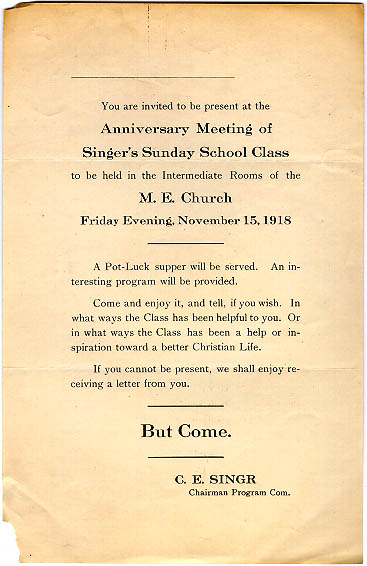
Anniversary Poem to the Singer Sunday School Class Nov. 15 1918 (link to original manuscript)
Anniversary
Greeting to the Singer Class
Nov. 15. '18:
The Singer class, despite its name
Boasts not of singing. But its fame
Evolves from many other lives
In which full many a member shines.
It greets the stranger, cheers the sad,
Spreads feasts that make the hungry glad,
Sends jellies to the boys at Custer.
And cookies - without brag or bluster.
Housewives they send to help the mending
That suits and socks need, without ending.
One hundred Testaments they bought
For soldiers, and by this they sought
To bring the "Peace on Earth" to others,
And help make all mankind good brothers.
They've helped the missionary cause,
To bring the Heavenly Kingdom's laws
To bear upon the warring Earth
And banish torture, sin, and dearth.
On Sundays, at the sermon's close,
They sit n semi-circle rows,
And talk and think of righteous things
Until the bell, disturbing, rings.
Long may the Singer class endure,
And may each member be secure
In faith, in works, and love, Excelling,
Till all shall reach the Heavenly dwelling.
Nov. 15. '18
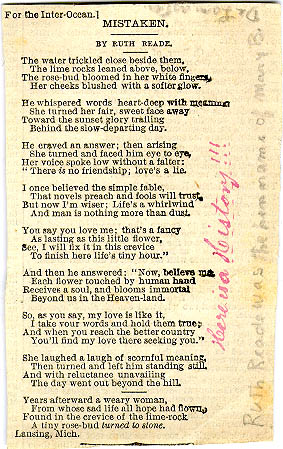
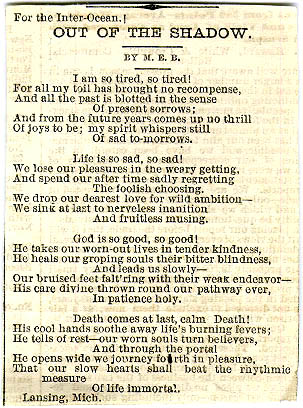
The two following poems were written for the Inter-Ocean of Chicago
-probably before
Mary DeLamarter married
BY RUTH READE (her pen name)
The water trickled close beside them,
The lime rocks leaned above, below,
The rose-bud bloomed in her white fingers,
Her cheeks blushed with a softer glow.
He whispered words heart-deep with meaning
She turned her fair, sweet face away
Toward the sunset glory trailing
Behind the slow-departing day.
He craved an answer; then arising
She turned and faced him eye to eye,
Her voice spoke low without a falter:
"There is no friendship; love's a lie.
I once believed the simple fable,
That novel preach and fools will trust,
But now I'm wiser; Life's a whirlwind
And man is nothing more than dust.
You say you love me; that's a fancy
As lasting as this little flower,
See, I will fix it in this crevice
To finish here life's tiny hour."
And then he answered: "Now, believe me
Each flower touched by human hand
Receives a soul, and blooms immortal
Beyond us in the Heaven-land.
So, as you say, my love is like it,
I take your words and hold them true;
And when you reach the better country
You'll find my love there seeking you."
She laughed a laugh of scornful meaning,
Then turned and left him standing still.
And with reluctance unavailing
The day went out beyond the hill.
Years afterward a weary woman,
From whose sad life all hope had flown,
Found the crevice of the lime-rock
A tiny rose-bud turned to stone.
Lansing, Mich.
BY M. E.B.
I am so tired, so tired!
For all my toil has brought no recompense,
And all the past is blotted in the sense
Of present sorrows
And from the future years comes up no thrill
Of joys to be; my spirit whispers still
Of sad to-morrows.
Life is so sad, so sad!
We lose our pleasures in the weary getting,
And spend our after time sadly regretting
The foolish choosing
We drop our dearest love for wild ambition -
We sink at last to nerveless inanition
And fruitless musing.
God is so good, so good!
He takes our worn-out lives in tender kindness,
He heals our groping souls their bitter blindness,
And leads us slowly -
Our bruised feet falt'ring with their weak endeavor -
His care divine thrown round our pathway ever,
In patience holy.
Death comes at last, calm Death!
His cool hands soothe away life's burning fevers;
He tells of rest - our worn souls turn believers,
And through the portal
He opens wide we journey forth in pleasure,
That our slow hearts shall beat the rhythmic
measure
Of life immortal.
Lansing, Mich