
| Detroit, MI | |||||||
![]() |
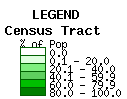
We begin our tour with Detroit, the most segregated major metropolitan area in the U.S. The metro area has just under 4.5 million people, of whom about 1 million are black. Observe how closely the areas of high black concentration track the city borders (red block). (Highland Park is a distinct town near the center of the city.) This pattern reflects high degress of private housing discrimination, documented by the Detroit News Jan. 2000 series on the costs of segregation (Parts 1, 2, 3). (One of the authors of this site [Anderson], who is white, was repeatedly "reassured" by white realtors that they did not rent housing to blacks when she was shopping for housing in the metro area in the early 1990s.) | ||||||
| 2000 Census data on segregation in Detroit from the Lewis Mumford Center | |||||||
|
The pale green areas suggest black concentrations up to 20%, but if you switch to the quintile method of classifying population concentrations, you will observe that most of these tracts have 4.3% or fewer blacks. Notice also the high correlation of income with segregation. The 2000 index of black/white dissimilarity in the Detroit metro area is 84.7, indicating that 84.7% of blacks would have to move to have a representation in each census tract proportional to their representation in the metro area as a whole. To learn more, see Thomas Sugrue, The Origins of the Urban Crisis: Race and Inequality in Postwar Detroit (Princeton University Press, 1996). |
|||||||