Segregation
of Asian-Americans and Blacks Compared
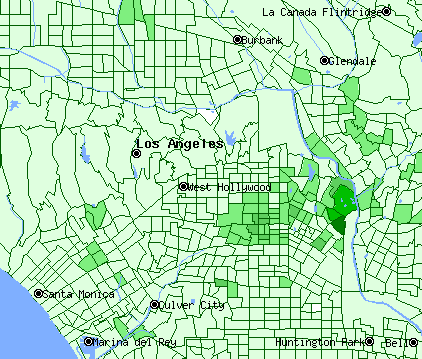
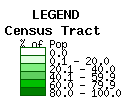
Los Angeles
New York,
NY
San Francisco Bay
Area
Chicago, IL
Washington, DC
Segregation
levels for Asian-Americans are much lower then for blacks. Where black/white
indexes of dissimilarity are commonly 50 or higher, Asian-Amerian/white
indexes rarely reach 50, and are more commonly in the 30s and 40s.
The maps for L.A., N.Y. and the Bay Area show a classic immigrant pattern:
a low-income "Chinatown" where newly
arrived immigrants from east Asia first settle in high densities (taking
advantage of the concentration of Chinese speakers), and dispersion of later-generation
ethnic-group members to more prosperous, integrated neighborhoods. The stark
contrast with black patterns of settlement reflects the fact that whites
are much more willing to live with Asian neighbors than with black ones,
so housing discrimination against Asians is very low. It also reflects the
much greater relative prosperity of later-generation Asians to blacks, enabling
them to move into richer areas.