So far I have lead three sessions of the University of Michigan Math Circle. The sudoku one was my favorite, even if it was not necessarily as "mathy" as some of the others. In my experience, some students will already be aware of the techniques introduced in the whole class discussion, while others will never have seen them, so that's something to keep in mind. Anyone is welcome to use these resources, and I'd be happy to answer any questions about them!
Tetris Pieces and Colorful Chess Wars - January 18, 2024
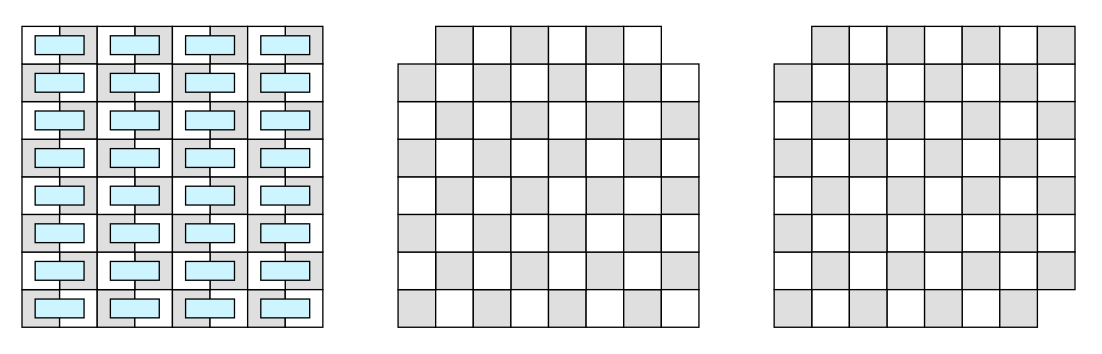
This activity is about coloring invariants. The typical problem is as follows: given a certain type of piece, for example L-shaped, can we fill out a 8x8 board with copies of this piece without overlaps? A solution usually consists of providing a configuration for the largest number of pieces we can place, and a coloring argument to prove that no more pieces can be placed. This activity can probably be improved with little boards and pieces, but I ran it with (colored) pencils and graphing paper and it was fine!
I have students this handout. It contains a couple of examples that we worked on as a class, followed by some questions exploring these examples further. Then, it has examples of colorings and problems that can be solved with this techique, the latter of which become quite hard (the very last one is an IMO problem!). Some students thought about the follow-up questions, some other on the problems. A good thing about this activity is that even if they can't fully solve the problem, they can have fun simply trying to place pieces in the best way possible.
Fun with Sudoku Variants - January 23, 2025
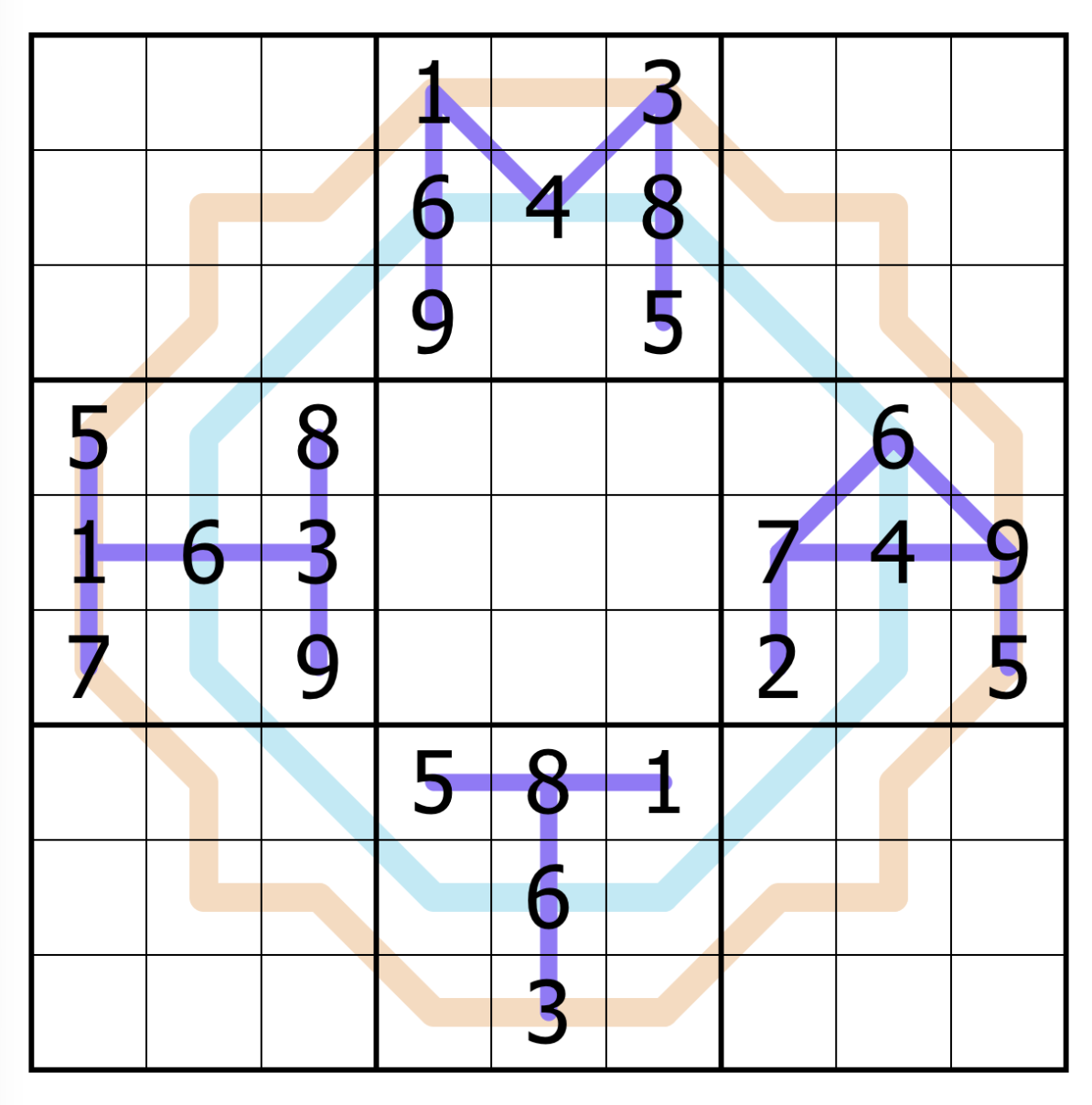
There are several fun variants one can add to sudoku to obtain fun puzzles, examples can be found for example in the youtube channel Cracking the Cryptic, where I found the sudokus below.
I created this sudoku to solve as a class. It went pretty well, with students contributing some numbers and me giving them hints as needed. Note that the sudoku can be solved without using the parity lines, which can be given as a challenge.
I gave students sudokus from this handout. The difficulty is more or less indicated in the document: the first is a bit trickier than the next nine sudokus, and the last two are marked as challenges and a great deal more complicated - I would not encourage students to start with these ones unless they are used to sudoku variants. The first ten are what the channel calls "GAS", Genuinely Approachable Sudokus and a much better place to start.
Playing with Beads and Patterns - January 22, 2026
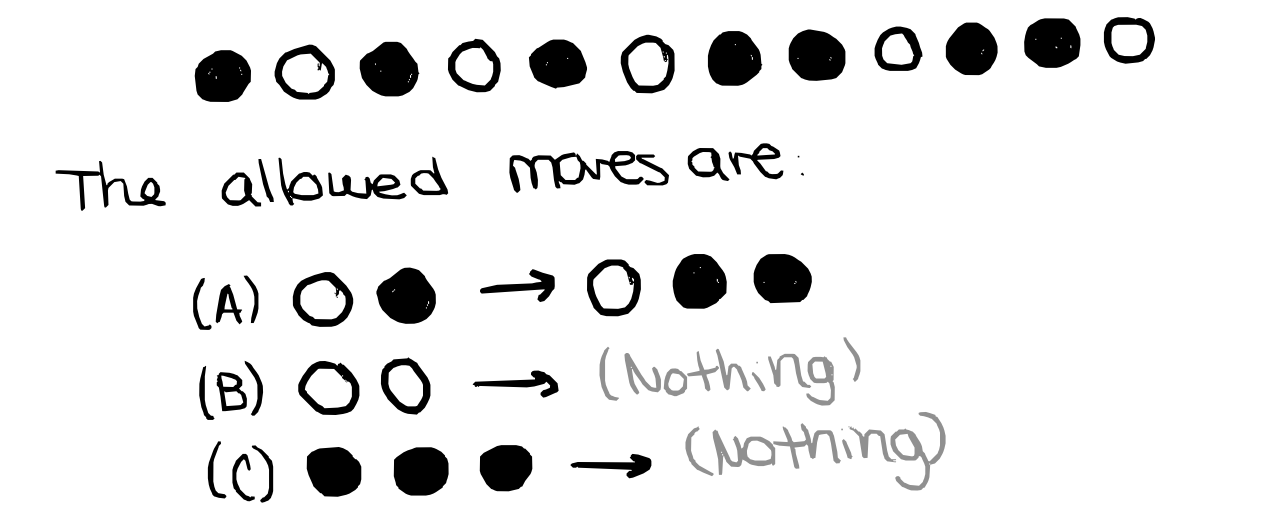
This is an activity about invariants (and algorithms a little bit). The typical problem is: given a starter sequence of beads and possible moves, can we remove all the beads? If not, what's the smallest number of beads we can obtain? The solutions usually consist of finding an algorithm to get the best sequence possible, and using invariants (for example, parity of beads of a certain color) to justify no more beads can be removed. The students can play around with actual beads or write colored circles/letters on paper, whatever they prefer!
The example for the whole class can be found here.
I have been a mentor for DRP at the University of Michigan most semesters since Winter 2024. Here are a couple of resources/projects I liked and are a little outside the standard textbooks:
Fuzzy Sets are a generalization of sets, where characteristic functions have codomain [0,1] instead of simply zero or one. The idea is that elements have a certain degree of belonging in a set, rather than the usual binary. We followed the book "Hans-Jürgen Zimmermann - Fuzzy Set Theory". This is a great project to develop/improve proof writing in an interesting context, as well as question how definitions come to be: my favorite thing about the project was thinking about cartesian products, because there are many reasonable definitions that have very different properties, and it is not necessarily obvious what should be the correct one. For the final presentation, my student studied some of these possible definitions, investigating their strengths and failures, by comparing them to the usual definition of cartesian product.
Permutation Puzzles are a very cool way to study some algebra and combinatorics. We followed the book "Jamie Mulholland - Permutation Puzzles" and later found it had an associated course, which can complement the reading well - among other things, it contains recordings of lectures which follow the book pretty closely. It also has suggestions of final projects that are probably ambitious to include in a first DRP project but can be fun for the student to think about later if interested. The book also encourages students to use some SageMath along the way, which I also found cool!