RESULTS: Angular Kinematics
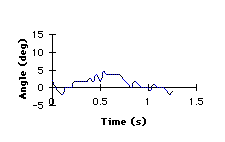
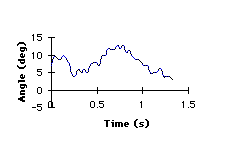
Segment angle. The absolute angle of
the trunk was analyzed for one complete gait cycle in both the
able-bodied gait and the amputee gait. The amputee trunk showed a
greater range of motion (10 deg) than that of the able-bodied trunk
(6 deg). The amputee trunk had a minimum angle of 3 degrees (at the
second heel strike) and a maximum angle of 13 degrees (during early
swing phase). The able-bodied trunk had a minimum angle of -1
degrees (at foot flat) and a maximum angle of 5 degrees (during early
swing phase).
|
|
|
|
Figure 3. Trunk angle during the able-bodied gait (left)
and the amputee gait (right). Trunk angle is calculated
between the trunk segment and a vertical axis through the
hip joint, where the upright position (anatomical)
corresponds to zero degrees. Positive values represent
clockwise rotation of the trunk and negative values
represent counterclockwise rotation
|
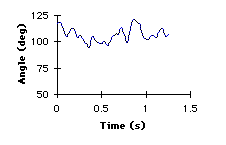
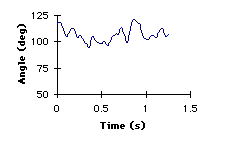
Joint angle 1. Despite the fact that
the range of motion at the ankle joint was quite similar in the
able-bodied gait (26 deg) and the amputee gait (23 deg), the actual
positions of the ankle joints were quite different. In the
able-bodied gait, the ankle joint moved from 95 degrees (during
midstance) to 121 degrees (during early swing phase). In the amputee
gait, the ankle joint moved from 66 degrees (during early swing
phase) to 89 degrees (just before toe off). The average ankle angle
in the amputee gait was 77 degrees, 30 degrees smaller than that of
the able-bodied gait.
|
|
|
|
Figure 4. Ankle joint angles in the able-bodied gait
(left) and the amputee gait (right). The ankle joint angles
were calculated as the angle between the shank segment and
the foot segment. The anatomical position of the ankle
joint is approximately 110 degrees for able bodied gait and
approximately 75 degrees for the amputee gait. In able bodied gait,
an ankle angle less than 110 degrees represents dorsiflexion
whereas an angle greater than 110 degrees represent
plantarflexion. In amputee gait, an ankle angle less than
75 degrees represents dorsiflexion whereas an angle greater
than 75 degrees represent plantarflexion.
|
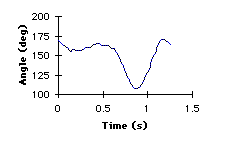
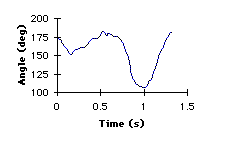
Joint angle 2. The range of motion
of the knee joint was greater in the amputee gait (75 deg) than in
the able-bodied gait (64 deg). In both movements, peak flexion
occurred in the middle of swing phase. In the able-bodied gait, peak
extension occurred during the late part of swing phase, while in the
amputee gait, it occurred at the second heel strike. The peak
flexion in both the able-bodied and amputee gait was 107 degrees. In
contrast, the peak extension differed in the able-bodied gait (171
deg) and the amputee gait (181 deg).
|
|
|
|
Figure 5. Knee joint angles in the able-bodied gait
(left) and the amputee gait (right). The joint angles are
calculated between the thigh segment and the shank
segment. Anatomical position corresponds to 180 degrees.
Increasing angles represent extension whereas decreasing
angles represent flexion.
|
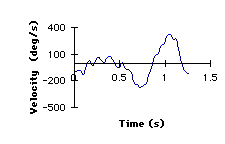
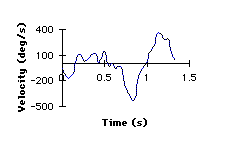
Joint velocity. The angular velocity
for knee joint was analyzed for one complete gait cycle in both
movements. While the peak flexor angular velocity in the able-bodied
gait was only 270 degrees per second, it was 429 degrees per second
in the amputee gait. The peak extensor angular velocity was similar
for both the able-bodied gait (324 degrees per second) and the
amputee gait (357 degrees per second).
|
|
|
|
Figure 6. Knee joint angular velocity in able-bodied gait
(left) and the amputee gait (right). Positive velocity
represents extension whereas negative velocity represents
flexion.
|
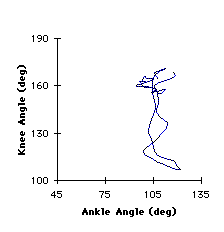
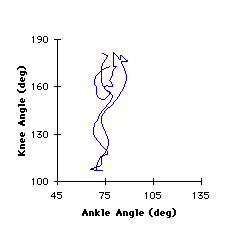
Angle-Angle Plot. The coordination
of the knee and ankle joints was quite similar. The majority of the
motion occurred at the knee joints. When the ankles did move, they
were coupled with knee movements. Increasing knee angles represented
extension while decreasing knee angles represented flexion. In the
able-bodied gait, ankle angles greater than 110 degrees represented
plantarflexion while ankle angles less than 110 degrees represented
dorsiflexion. In amputee gait, ankle angles less than 75 degrees
represents dorsiflexion whereas ankle angles greater than 75 degrees
represent plantarflexion. When the knee joint was at its greatest
flexion, just after toe off, the able-bodied ankle plantarflexed. At
that same position in the gait cycle, that amputee ankle remained
dorsiflexed. Additionally, the amputee ankle exhibited greater
plantarflexed from heel strike to foot flat.
|
|
|
|
Figure 7. Coordination of ankle and knee joint angles in
the able-bodied gait (left) and the amputee gait (right).
The arrows indicate the direction of motion (with the tails
placed close to the first frame of each movement).
|