RESULTS: Angular Kinematics
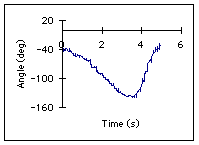
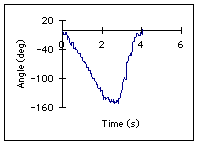
Segment angle. The upper arm segment
motion was similar between both movements, with the exception of the
range of motion. In the shoulder press with the barbell, the maximum
and minimum angles of the upper arm segment were 140 degrees and 28
degrees, respectively. In the shoulder press with the dumbbells, the
maximum and minimum angles of the upper arm segment were 152 degrees
and 2 degrees, respectively. The range of motion of the upper arm
segment in the shoulder press with the barbell was 112 degrees, while
the range of motion of the upper arm segment in the shoulder press
with the dumbbells was 150 degrees. The average angle of the upper
arm segment in the shoulder press with the barbell was 85 degrees,
while the average angle of the upper arm segment in the shoulder
press with the dumbbells was 77 degrees. All angles are in the
clockwise direction.
|
|
|
|
Figure 3. Left upper arm segment angle during the
shoulder press with barbell (left) and the shoulder press
with dumbbells (right). The left upper arm segment angle is
calculated from the vertical axis about the shoulder joint.
Anatomical position corresponds to zero degrees. Increasing
values represent clockwise rotation
|
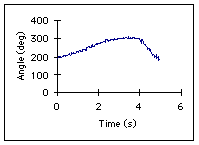
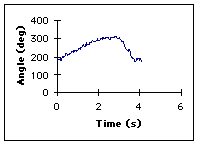
Joint angle 1. The left elbow joint
motion was very similar between both movements. In the shoulder
press with the barbell, the maximum and minimum angles of the elbow
joint were 312 degrees and 182 degrees, respectively. In the
shoulder press with the dumbbells, the maximum and minimum angles of
the elbow joint were 311 degrees and 176 degrees, respectively. The
range of motion of the elbow joint in the shoulder press with the
barbell was 130 degrees, while the range of motion of the elbow joint
in the shoulder press with the dumbbells was 135 degrees. The
average angle of the elbow joint in the shoulder press with the
barbell was 258 degrees, while the average angle of the elbow joint
in the shoulder press with the dumbbells was 253 degrees. All angles
are in the counterclockwise direction.
|
|
|
|
Figure 4. Left elbow joint angle during the shoulder
press with barbell (left) and the shoulder press with
dumbbells (right). Left elbow joint angle is calculated as
the angle between the left forearm and the left upper arm.
Anatomical position corresponds to 180 degrees. Increasing
values represent flexion.
|
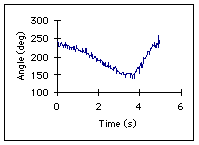
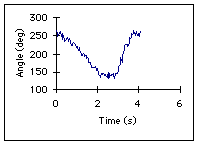
Joint angle 2. The left shoulder
joint motion was very similar between both movements. In the
shoulder press with the barbell, the maximum and minimum angles of
the shoulder joint were 258 degrees and 141 degrees, respectively.
In the shoulder press with the dumbbells, the maximum and minimum
angles of the shoulder joint were 264 degrees and 133 degrees,
respectively. The range of motion of the shoulder joint in the
shoulder press with the barbell was 117 degrees, while the range of
motion of the shoulder joint in the shoulder press with the dumbbells
was 131 degrees. The average angle of the shoulder joint in the
shoulder press with the barbell was 195 degrees, while the average
angle of the shoulder joint in the shoulder press with the dumbbells
was 199 degrees. All angles are in the counterclockwise direction.
|
|
|
|
Figure 5. Left shoulder joint angle during the shoulder
press with barbell (left) and the shoulder press with
dumbbells (right). Left shoulder joint angle is calculated
as the angle between the left upper arm and the left
shoulder segment. Anatomical position corresponds to 270
degrees. Increasing values represent abduction.
|
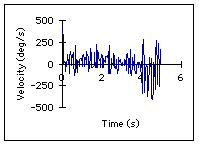
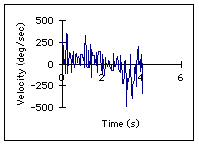
Joint velocity. The velocities of
both movements were similar. During flexion, the maximum and minimum
angular velocities of the elbow joint in the shoulder press with the
barbell were 404 degrees per second and 2 degrees per second,
respectively, while the maximum and minimum values for this same
movement with dumbbells were 341 degrees per second and 1 degree per
second, respectively. The average angular velocity for the entire
movement of the elbow joint in the shoulder press with the barbell
was 1 degree per second, while the average angular velocity of the
elbow joint in the shoulder press with the dumbbells was -1 degree
per second.
|
|
|
|
Figure 6. Left elbow joint angular velocity in the
shoulder press with barbell (left) and the shoulder press
with dumbbells (right). Positive values represent flexor
velocity.
|
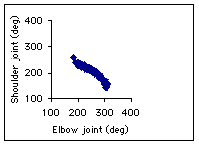
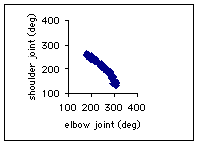
Angle-Angle Plot. The angles in
both movements were coordinated in a similar fashion. As the shoulder
joint angle decreased (adduction), the elbow joint increased
(flexion). This negative slope demonstrated that the joint angles
are moving out of phase. The diagonally aligned segment indicated
coupled coordination between the shoulder and elbow joint.
|
|
|
|
Figure 7. Coordination of the elbow angle and shoulder
angle in the shoulder press with barbell (left) and shoulder
press with dumbbells (right).
|