RESULTS: Angular Kinematics
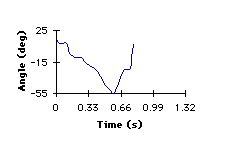
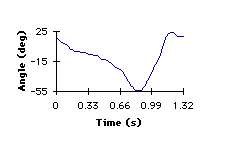
Segment angle. The child gait showed
a smaller range of motion of the leg segment (68 degrees) than the
adult gait (78 degrees), which was due to a greater amount of
clockwise rotation in the adult gait. In the child gait peak
clockwise rotation of the leg segment was 13 degrees at first left
heel strike (0.00 seconds), while in the adult gait peak clockwise
rotation was 24 degrees during the end of swing phase (1.19 seconds).
The smaller clockwise rotation in the child gait could have been due
to the smaller angle of peak knee extension in the child. Peak
counterclockwise rotation was similar for the child gait (55 degrees)
and the adult gait (54 degrees) and occurred at the beginning of
swing phase in both the child (0.59 seconds) and the adult (0.83
seconds).
|
|
|
|
Figure 3. Leg angle during child gait (left) and adult
gait (right). The leg angle was calculated with respect to
a vertical line passing through the knee joint. Zero
degrees corresponds to the anatomical position. Increasing
values on the graph represent clockwise rotation of the leg,
while decreasing values represent counterclockwise rotation
of the leg.
|
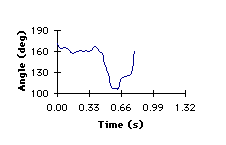
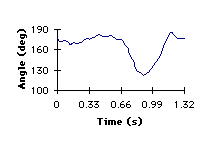
Joint angle 1. The knee flexed twice
during the gait cycle of the child and the adult. There was a small
amount of knee flexion after left heel strike during the stance phase
and a larger amount during early swing phase. Despite the fact that
the range of motion at the knee joint was quite similar in the child
gait (64 deg) and the adult gait (63 deg), the actual position of the
knee joint varied significantly between the child and the adult. The
values for peak flexion and peak extension were smaller in the child
than in the adult. Peak flexion in the child was 107 degrees and
occurred during early swing phase (0.63 seconds), while peak flexion
in the adult was 122 degrees and also occurred during early swing
phase (0.89 seconds). Peak extension was 172 degrees in the child
gait and occurred at the beginning of stance phase (0.00 seconds).
Peak extension in the adult gait was 185 degrees, and occurred near
the end of swing phase (1.19 seconds). The extension in the child
gait during swing phase was considerably less than that of the adult,
with peak extension occurring at the second left heel strike (161
deg), with a value of 128 degrees just prior to second left heel
strike. Unlike the swing phase in the adult gait, where the knee
extended and then flexed slightly before left heel strike, the swing
phase in the child gait was characterized by continuous knee
extension.
|
|
|
|
Figure 4. Knee joint angle in child gait (left) and adult
gait (right). The knee joint angle was calculated as the
angle between the thigh and leg segments. Anatomical
position occurs at 180 degrees. Increasing angles represent
extension, and decreasing angles represent flexion.
|
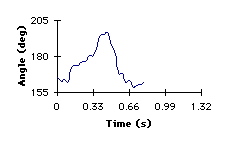
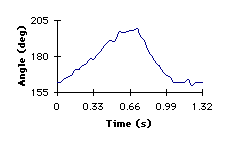
Joint angle 2. The motion at the hip
joint was very similar in the child and adult gait. Peak hip flexion
in the child gait (201 degrees) was seen during midswing (0.69
seconds), while peak hip flexion in the adult gait (200 degrees) was
seen later at the end of swing phase (1.22 seconds). The peak
extension in the child (163 degrees) and the adult (161 degrees) was
also very similar and occurred at the end of stance phase, at 0.46
seconds in the child and 0.73 seconds in the adult. Because of the
similar peak joint angles, the range of motion in the child gait (38
degrees) and adult gait (39 degrees) was nearly the same.
|
|
|
|
Figure 5. Hip joint angle in child gait (left) and adult
gait (right). The hip joint angle was calculated as the
angle between the trunk and thigh segments. Anatomical
position occurs at 180 degrees. Increasing angles represent
extension, and decreasing angles represent flexion.
|
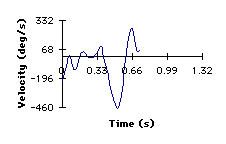
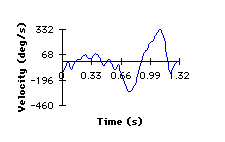
Joint velocity. The knee joint
angular velocity was analyzed for a complete gait cycle. The peak
flexion velocity was greater in the child gait (459 deg/s) than in
the adult gait (314 deg/s). This maximum flexion velocity occurred
at the end of stance phase in both the child (0.53 seconds) and the
adult (0.76 seconds). Peak extension velocity in the child gait (259
deg/s) was less than that in the adult gait (332 deg/s). In the
child gait this maximal extension velocity occurred at the end of
swing phase, while in the adult gait maximal extension velocity
occurred during the middle of swing phase (1.09 seconds). The adult
showed flexion at the end of the swing phase while the child did not.
|
|
|
|
Figure 6. Knee angular velocity in child gait (left) and
adult gait (right). Positive velocity represents extension
while negative velocity represents flexion.
|
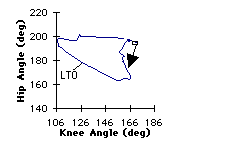
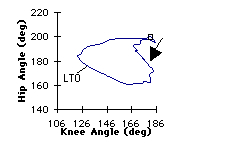
Angle-Angle Plot. The knee joint
showed a greater range of motion than the hip joint in both the child
and the adult in the gait cycle. The motion between the knee and hip
joint was relatively decoupled in both the child and the adult, and
the child's knee flexed less during the stance phase. At the
beginning of the stance phase, the hip extended, while the knee
flexed. This was followed by a period of knee extension, and
continued hip extension. There was a decoupled coordination between
the hip and knee joints as the knee joint switched from extension to
flexion and the hip joint began to flex. There was closer coupling
between the knee and hip joints in the child at this transition than
in the adult. Following this transition, the hip and knee joint
angles were coordinated in phase and changed at a constant ratio
until the end of stance phase, with knee and hip flexion. At the
start of the swing phase, the hip and knee joint angles continued to
be coordinated in phase and were changing at a constant ratio. This
was followed by a period of coupling between the hip and knee with
hip flexion and knee extension. At the end of swing phase, the knee
angle was increasing (extending) while the hip joint angle remained
relatively constant.
|
|
|
|
Figure 7. Coordination of knee joint and hip joint angles
in child gait (left) and adult gait (right). Arrows
indicate the direction of movement and the small boxes
indicate the start positions. LTO stands for left toe-off
and represents the end of stance phase.
|