
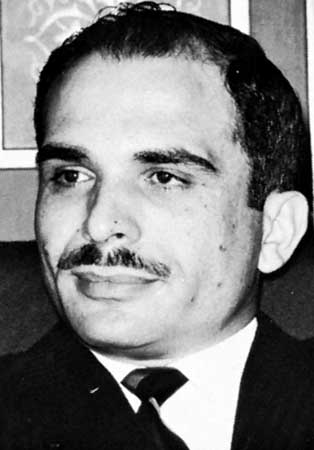
As-Sayyid Hussein I bin Talal, King of Jordan
1935-1999
"It was a little after 11 A.M. The Norwegian General informed me that the Israeli Prime Minister had addressed an appeal to Jordan. Mr. Eshkol had summarily announced that the Israeli offensive had started that morning, Monday June 5, with operations directed against the United Arab Republic, and then he added: "If you dont intervene, you will suffer no consequences." By that time we were already fighting in Jerusalem and our planes had just taken off to bomb Israeli airbases..." Memoirs of King Hussein
Hussein... was proclaimed King of the Hashemite Kingdom of Jordan on
August 11, 1952. A Regency Council was appointed until King Hussein’s
formal accession to the throne on May 2, 1953, when he assumed his
constitutional powers after reaching the age of eighteen, according to
the Islamic calendar2. Educated in the west, specifically in
Britain, Hussein suffered rejection throughout his reign from other
Arab leaders for what they saw as Hussein's close connections with
western influence. He was the survivor of a number of assassination
attempts.
Despite intense Israeli attempts to convince Hussein to keep Jordan out of any war that might erupt, Hussein reluctantly allowed the wave of pan-Arab nationalism that was flourishing in the days before the Six Day War to influence his policy. In May of 1967, Jordan signed a mutual defense treaty with Egypt. After the Israeli air strikes on Egyptian targets on June 5, Hussein received what he believed to be information about a victorious Egyptian defense and counterattack, and initiated the Jordanian troops.
After the Six Day War, King Hussein played a central role in creating UNSC Resolution 242 which calls for Israel to withdraw from all Arab lands occupied after the Six Day War in exchange for peaceful co-existance with its Middle Eastern neighbors. The resolution remains a central part of today's peace negotiations. He remained a central figure in the peace process from that day, and was seen as a stabilizing figure in many other Middle Eastern conflicts.
In 1998, King Hussein was diagnosed with non-Hodgkins lymphoma cancer. Despite agressive treatment in the United States, he passed away in February of 1999 to the great bereavement of his subjects.