
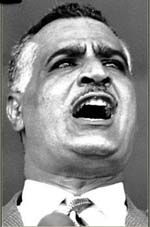
Egyptian President Gamal Abdel Nasser
1918-1970
"The Arab national aim is the elimination of Israel" May, 1965.
The second president of Egypt, Nasser, then a Lieutenant Colonel in the
Egyptian army, helped lead the overthrow of King Farouk in 1952. In
1956, Nasser was elected president and helped guide through
ratification a constitution that declared Egypt a single party
"Socialist State" recognizing Islam as its official religion. A staunch anti-colonialist, Nasser like
other Arabs saw Israel as nothing more then colonial intrusion on Arab
land. Nasser was a believer
in the concept of Pan-Arabism, or the unification of the Arab world
under his sole leadership. He saw himself as an agressive reformer who
yearned to modernize Egypt and cleanse it of the corruption that had
plagued Egyptian politics of years past.
Nasser soon began to have conflicts with other Arab countries, especially Saudi Arabia and Jordan, which opposed his aspirations to lead the Arab world. There were multiple attempts by Egyptian intelligence to assassinate Jordan’s King Hussein, and in 1962 Egypt intervened in Yemen against royalists backed by Saudi Arabia. Expecting an easy victory, Egyptian forces instead got bogged down in a guerilla war. Nasser responded by attempting to subvert Saudi Arabia itself and by attacking supposed Yemeni royalist bases in Saudi Arabia. The attacks against Jordan and Saudi Arabia caused a marked deterioration in US-Egyptian relations and also harmed Nasser’s reputation in the Arab world1.
In May of 1967, Nasser expelled UN peacekeepers from the Sinai peninsula and announced a blockade of the Straits of Tiran to Israel-bound shipping. The blockade sealed off the major Israeli port of Eilat and violated the armistice agreements that had followed the 1956 Sinai war. These bold... moves provoked massive pro-Nasser street demonstrations in Arab capitals, and one after another Arab government endorsed Nasser's steps and put its military under direct Egyptian control. Open warfare had seemed a distant possibility before May, but now everything had changed. Nasser had engineered the Arab unity that he had judged necessary to confront Israel1. As June approached, Nasser's rhetoric became increasingly agressive.
Shortly after the Arab defeat in the Six Day War, Nasser attempted to resign the presidency, but thousands of Egyptians marched in his support through Cairo. For the next three years, Nasser did his best to rebuild the Egyptian army with some success. His death in 1970 of a heart attack sent shock waves throughout the Arab world. In a stunning display of emotion, millions of Egyptians followed his funeral procession through the streets of Cairo. Nasser remains a significant figure of Arab pride and nationalism to this day.