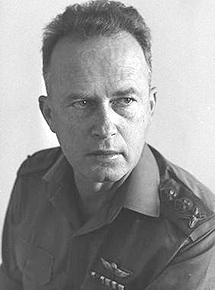
Commander Yitzhak Rabin
1922-1995
"Jerusalem is united, it will never be divided again." June 1995
Joining the Israeli Defense Forces after
their creation in 1948, Yitzhak Rabin rose to the rank of Major-General
at the age of 32. Rabin established the IDF training
doctrine and the leadership style which became known by the command
"follow me." In 1962 he was appointed Chief of the General Staff and
promoted to the rank of Lieutenant General. He developed the IDF
fighting doctrine - based on movement and surprise - which was employed
during the Six Day War. By 1967, he had risen to
the position of commander of the Israeli Defense Forces.
In the tense waiting period between the Arab mobilization in May and the Six Day War, Rabin suffered a massive nervous breakdown, overwhelmed by the knowledge that a wrong decision on his part would allow the combined armies of 100 million Arab countrymen to strike and overwhelm his country of just 3 million citizens. However, Rabin recovered quickly and along with Moshe Dayan crafted a plan to strike at the Arab forces first, leading to "Operation Focus," and the beginning of the war.
In the tense waiting period between the Arab mobilization in May and the Six Day War, Rabin suffered a massive nervous breakdown, overwhelmed by the knowledge that a wrong decision on his part would allow the combined armies of 100 million Arab countrymen to strike and overwhelm his country of just 3 million citizens. However, Rabin recovered quickly and along with Moshe Dayan crafted a plan to strike at the Arab forces first, leading to "Operation Focus," and the beginning of the war.
At the conclusion of the Six Day War, Rabin retired his military post
after a 26 year career. The next year, Rabin became Israel's
representative ambassador to the United Nations. In 1973 he was elected
to the Israeli Knesset. In 1974 he became Prime Minister of Israel,
however, he resigned the post after a series of minor scandels,
including allowing the country to receive a shipment of F-16 fighter
jets on the Sabbath. In 1992, Rabin once again became Prime Minister,
and in 1994, he was a signatory of the Oslo Peace Accords, seen as the
most significant step towards peaceful relations since the Camp David
Accords. He was later awarded the Nobel Peace Prize, along with Yasser
Arafat and Shimon Peres for his efforts.
On November 4, 1995, Rabin was assassinated by a right-wing Orthodox Jew who violently opposed the signing of the Oslo Peace Accords.
On November 4, 1995, Rabin was assassinated by a right-wing Orthodox Jew who violently opposed the signing of the Oslo Peace Accords.