| Management of Localized Fatigue T. Armstrong, U of Michigan |
1. Introduction
Localized fatigue in the hands, elbows, and shoulders can lead to pain and disrupt normal work, daily living, and leisure time activities. It can also be an early sign of chronic musculoskeletal injuries. This site is intended to provide basic knowledge and tools for managing upper limb localized fatigue among persons performing manual work.
Topics include:
- Some historical and contemporary background about localized fatigue
- An overview of biomechanical and physiological mechanisms of fatigue
- How work patterns affect load patterns on different parts of the body
- Assessment of load and fatigue patterns
- Fatigue limits for sustained static exertions
- Repetitive/cyclical work patterns
- The ACGIH TLV® for repetitive work with the upper limb
- Examples that demonstrate
- Some ways of assessing workload patterns
- The application of recommended limits to manage fatigue
2. Some Background
- In the beginning:
So God blessed the seventh day and made it holy, because on it God rested from all his work that he had done in creation.
Genesis 22 circa 6th Century BC. (English Standard Version)
- The Romans:
Battle scenes in Rome depict authentic Roman infantry fighting techniques including the tightly-packed "Roman Wall" of shields, gladius thrusting techniques above and below the "shield wall", and the rotation of troops on the front lines every 30–45 seconds." The rotation part makes perfect sense. Having a soldier in the first line fight until he dies and his fellows do almost nothing until it is their turn in the first line seems at best to be a waste of human life. Yet, this is how ancient fighting is generally perceived. Taking turn makes much more sense. Close combat will exhaust you quickly and no matter how skilled you are, when you are exhausted you rapidly become much slower. If you are not rotated away by when, you are pretty much dead meat.
"Military Affairs of Rome," by Lt. Col. S.G. Brady, 1947” Roman infantry tactics, Wikipedia, 2023, October 28) - Ramazzini (1713) on writers and scribes:
… the diseases of persons incident to this craft arise from three causes. First constant sitting, second the perpetual motion of the hand in the same manner, and thirdly the attention and application of the mind … constant writing also considerably fatigues the hand and the whole arm on account of the continual and almost tense tension of the muscle and tendons.
- Taylor (1911):
For a first-class shoveler there is a given shovel load at which he will do his biggest day's work. What is this shovel load? Will a first-class man do more work per day with a shovel load of 5 pounds, 10 pounds, 15 pounds, 20, 25, 30, or 40 pounds? Now this is a question which can be answered only through carefully made experiments. By first selecting two or three first-class shovelers, and paying them extra wages for doing trustworthy work, and then gradually varying the shovel load and having all the conditions accompanying the work carefully observed for several weeks by men who were used to experimenting, it was found that a first-class man would do his biggest day's work with a shovel load of about 21 pounds.
This was the beginning of "Phsycophisical studies of work" that would later made famous by Snook & Irvine (1966) - Barcroft and Millen (1939)
Reviewed studies of muscle bloodflow and fatigue going back to 1878. Building on this work they showed that blood flow incrased with muscle force up to 10% of maximum force. Blood flow then began to level off and became completely occluded with above 30% of maximum force. These studies helped to provide a Physiological basis for Taylor's work and provide a foundation for future work. (Humphreys & Lind 1963)
- Earnest Hemingway (1952)
I still need more healthy rest in order to work at my best. My health is the main capital I have and I want to administer it intelligently.
- Monod and Sherrer (1957) and Rohmert (1960):
Developed fatigue prediction curves for grip exertion. Endurance was an inverse fuction of force "Rohmert curve" -- see Monod and Sherrer (1965).
- Elkus & Basmajian (1973):
Normally, it [shoulder pain] would be thought of as "muscular fatigue," but we see now that this is incorrect. The sensation of "fatigue" that is experienced probably originates from the painful feeling of tension in the articular capsule and ligaments, not from overworked muscles. In fact, as we have seen, the muscles need not be working at all. Cain (1973) confirmed that feelings of fatigue in static contraction arise in part from structures outside the muscles. (Basmajian & De Luca 1985).
- Byström & Fransson-Hall (1994):
Comprehensive study of local blood flow, heart rate, blood pressure, electromyography, % maximal voluntary handgrip contraction (%MVC), and venous concentration of potassium and lactate during and up to 24 hours after intermittent handgrip exertions with the same "force+time" product, %MVCwork×Twork/(Twork+Trest), but with various contraction-relaxation periods. Concluded: intermittent handgrip contractions at (or higher than) a mean contraction intensity of 17% MVC and continuous handgrip contractions at (or higher than) 10% MVC were considered unacceptable.
Ttotal×17% ≤ Twork×%MVCwork+Trest×%MVCrest
- Rashedi & Nussbaum (2015):
Provide an up to date review of various models relevant for predicting localized fatigue for manual work.
- Henny Youngman
The patient says, "Doctor, it hurts when I do this." The doctor says, "Then don't do that!” goodreads
Great advice if you can not "do that" and still do your job!
3. Fatigue causes & effects
A definition:- Transient physiological and biomechanical changes, which may adversely affect motor performance and produce discomfort, that result from repeated or sustained exertions of the body.
- Localized fatigue is a transient response which develops and recovers within periods of seconds, minutes or hours.
- Symptoms that persist from one day to the next may indicate a chronic musculoskeletal or neurological condition that merits medical attention.
- Symptoms may be thought of something to be tolerated and ignored
- Localized fatigue may be a precursor or harbinger of chronic musculoskeletal disorders.
Symptoms:
- Discomfort in active body parts
- Reduced strength
- Reduced endurance
- Tremor & reduced motor control
- Electrical changes
- Biochemical changes
- Circulatory changes
- Adaptation
- Chronic musculoskeletal impairments
Mechanisms
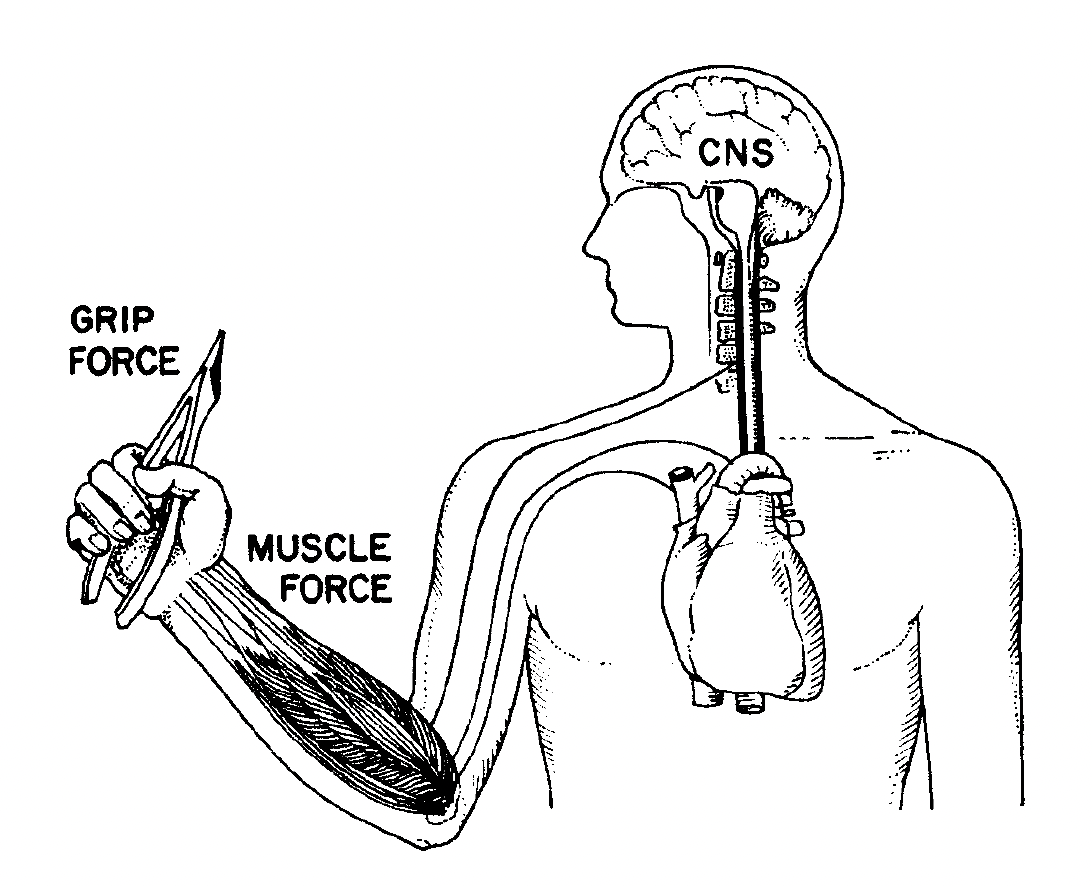
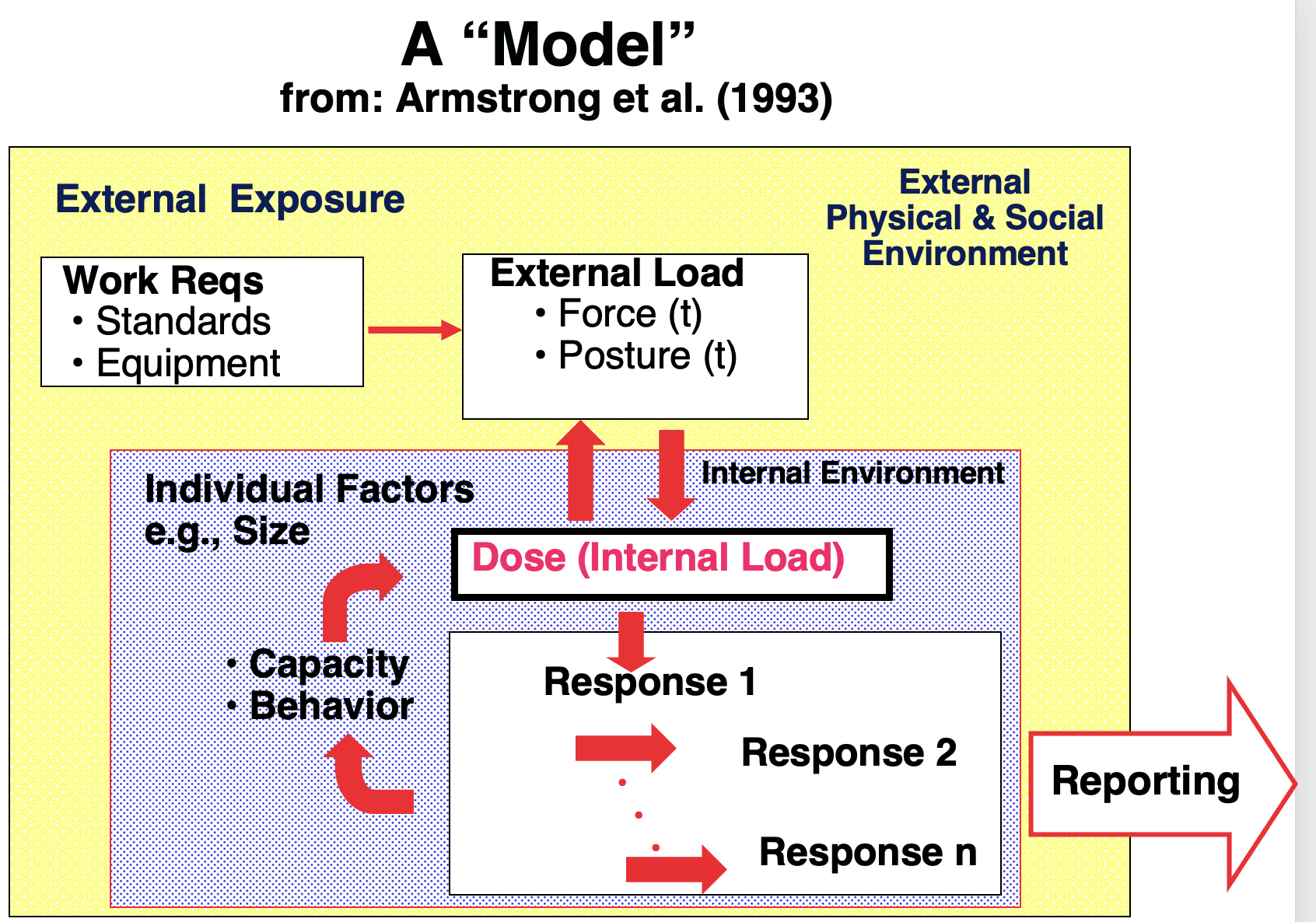
- Manual work involves repeated sequences of steps (actions or elements) to reach, grasp, move, position, or hold work objects. (see section 3: Workload Patterns). Examples can be found in manufacturing, food processing and services, and health care operations -- among others. Each step produces biomechanical and physiological loads (demands or does) and responses. Responses depend on the load intensity, duration and frequency and vary with time. (Edwards 1975; Armstrong, et al. 1993)
- Loads (forces & moments) --- "Dose"
- Each work step or element produces loads (forces and moments) on various parts of the body --- "Physical Demands". Load patterns may differ from one part of the body to another, for example, an assembly line or meat processing jobs might involve sequences of brief exertions. Dental hygiene or laparoscopic surgery job, might involve sequences of brief hand exertions, but prolonged shoulder exertions.
- Muscle contractions produce moments about various joints to support and move the body each step produce mechanical loads within the muscles and on connective tissues.
- Muscle contractions involve and produce a cascading series of steps that require metabolism to produce energy --- "Physiological demands"
Aerobic: O2 + C6H12O6 --> Energy + CO2 + H2O
or Anaerobic: C6H12O6 -->2CH3CHCOOH
Task Energy Demands, Physical Work Capacity and Fatigue- Mechanical loads casuse tissues to stretch. Stretching may be cumulative over time --- "viscoelastic"
- "Responses" occur over seconds, minutes, or hours.
- Biochemical changes, e.g., depletion of metabolic substrates & accumulation of metabolites
- Physiological changes, e.g., electrical and circulatory responses
- Biomechanical changes, e.g., compression and stretching of tissues, e.g., tendon/ligament strain
- Mental changes, e.g., e.g., effort, perceived exertion, pain
- Recovery occurs over seconds, minutes or hours. Depends on:
- Work intensity
- Work time
- Recovery time
- Occurs over minutes or hours. Symptoms should not persist from one day to the next.
- Insufficient recovery can result in:
- Pain (your body's way of telling you -- stop doing that! (take a break) -- may interfere with work and activities of daily living and liesure
- impairment -- disability
- Other factors:
- Fatigue is not the only cause of musculoskeletal pain
- Pain can be caused by chronic conditions such such as myofacial pain syndrome.
- Pain from work and chronic conditions can co-exist in the same patient. (mastaglia 2012)
- Identification of fatigue requires examination of work and pain patterns (mastaglia 2012).
|
|
4. Assessing worker fatigue
Fatigue can be assessed by quantifying its effects or various intermediate factors. There is a vast body of literature describing the use of these metrics in various settings for various purposes. The laboratory study by Byström and Fransson-Hall (1997) demonstrated the use of the most commonly used fatigue metrics to determine acceptable workloads for handwork:- Biochemical changes -- generally involve biopsies to collect muscle samples for laboratory analysis
- Electrophysiological changes surface electrodes attached to the skin over the muscles or needle electrodes inserted into the muscles.
- Discomfort patterns -- worker reports
- Discomfort pattern surveys are suitable for routine field work. They are non-invasive and, if administered properly, are reasonably objective.
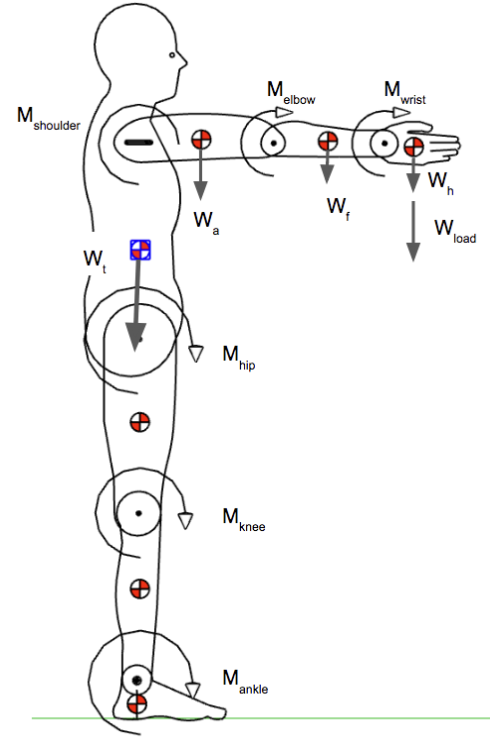
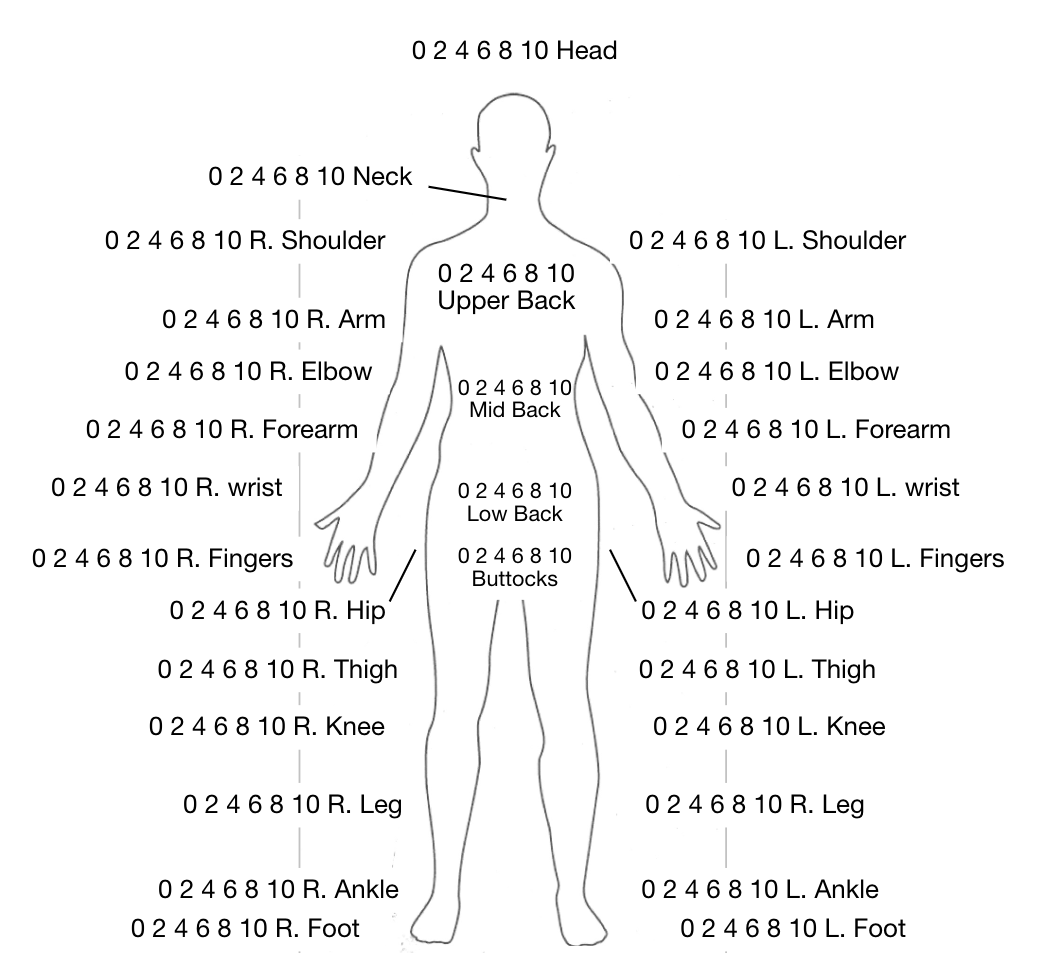
- An examination of the biomechanical loads associated with the job can be used to develop hypothese about where workers are most likely to develop discomfort and develop a survey accordingly (see Fig 3a).
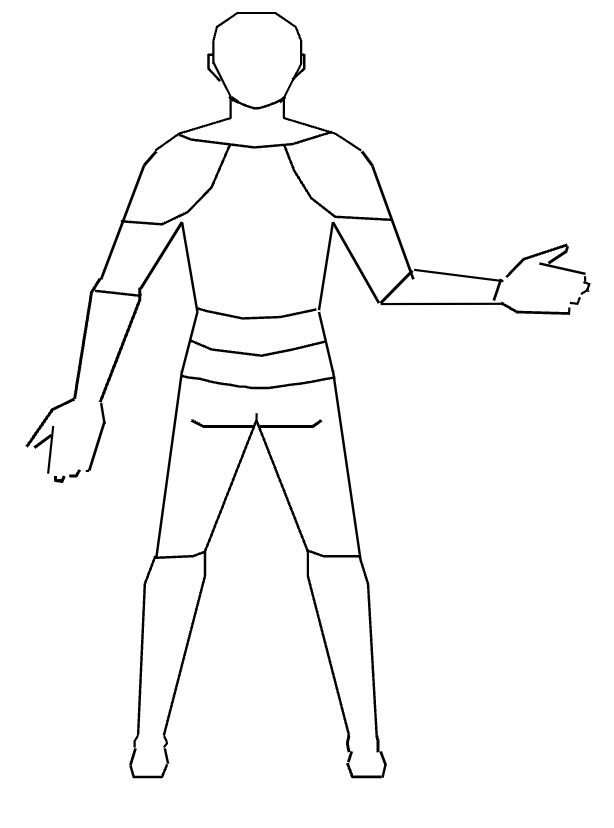
- Body discomfort diagrams can be used for workers to objective where workders may be experiencing discomfort and how that comports with biomechanical loads (see Fig 3b)
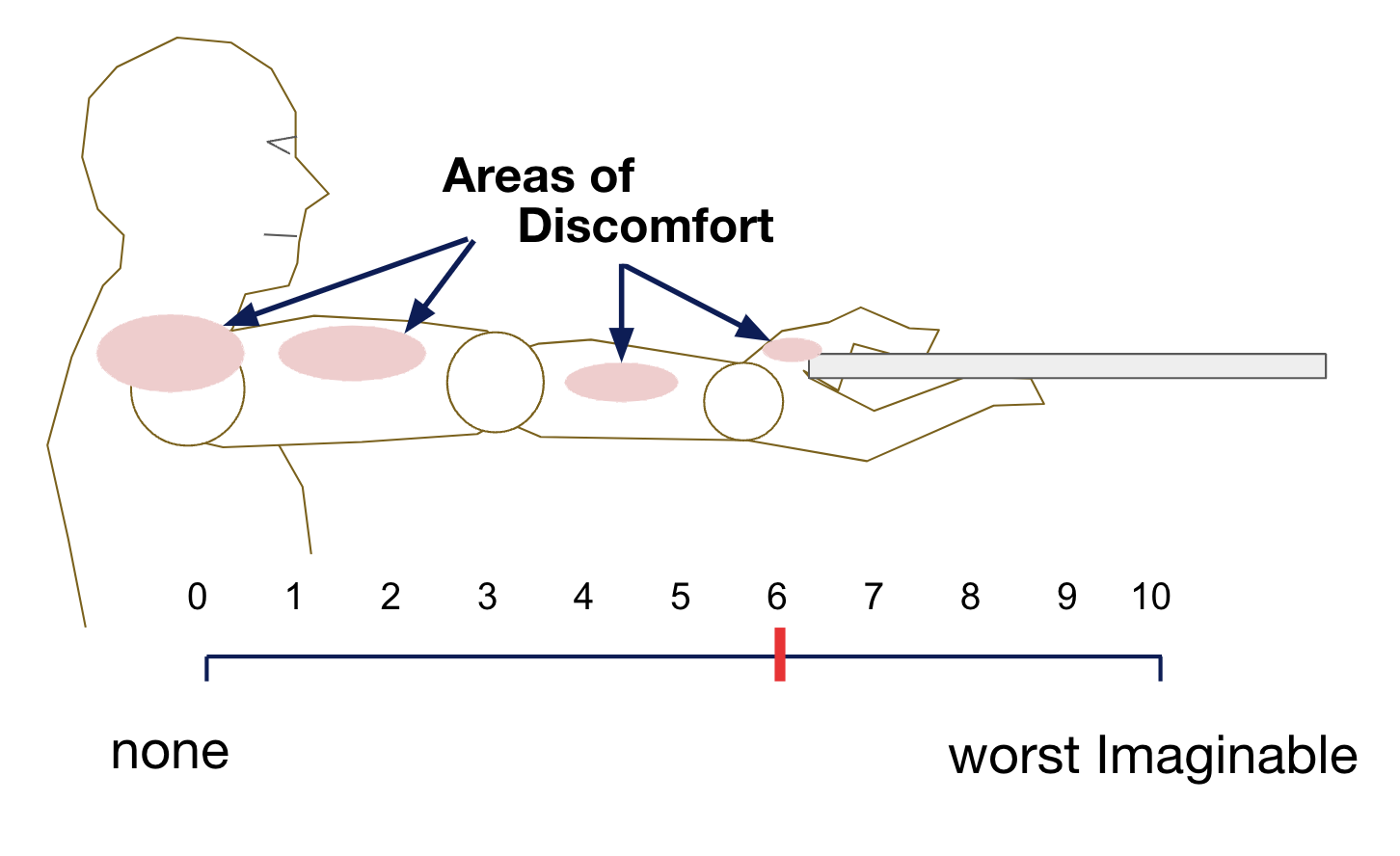
- Rating scales can be used for workers to quantify the level of discomfort that they experience (see Fig 3c).
- Discomfort surveys should be repeated at different times in the work shift to see how discomfort changes form the beginning to the end of the shift.
- Workers may experience discomfort from non-fatigue causes or fatigue from other tasks that they previously performed.
- Conducting a survey
- Ask the worker: "Are you currently experiencing discomfort in any parts of your body?" -- be careful not to suggest that workers should be experiencing discomfort, e.g., "where to you hurt the most?"
- "Use this picture to show me where you are experiencing discomfort." (see Fig 3b)
- "Rate the area of most discomfort on a scale of 0 to 10 where 0 is no discomfort and 10 is the worst discomfort imaginable. (see Figs 3c & 3d).
- "Now Rate the next most uncomfortable area"
- Continue until all of the areas of discomfort have been rated or the ratings fall below a level of concern.
- Compare discomfort patterns with biomechanical load patterns (Fig 3a).
- Changes in discomfort patterns from the beginning to the end of the task or shift, differences among workers, and biomechanical load are used to assess and interpret fatigue patterns. (see work by Saldana, et al. 1994; corlett and Bishop 1978).
(a)
(b)
(c)
(d)
Anticipate fatigue-related discomfort patterns
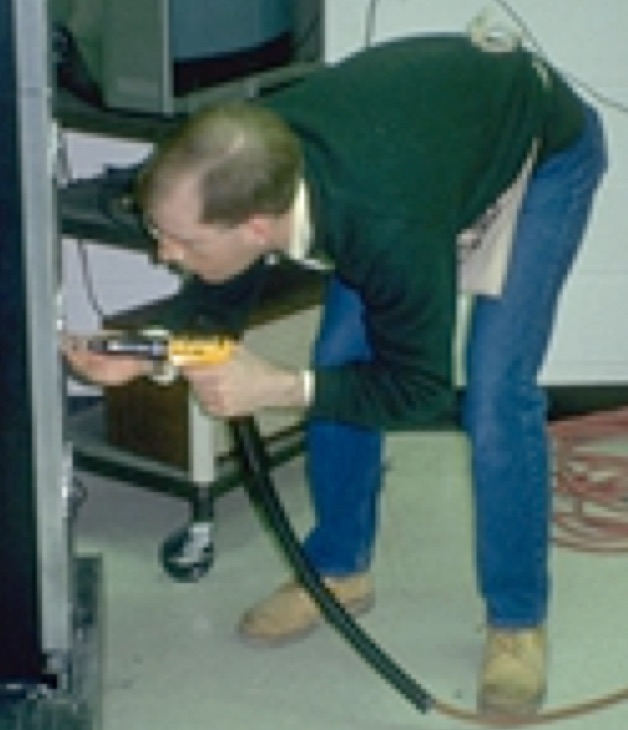
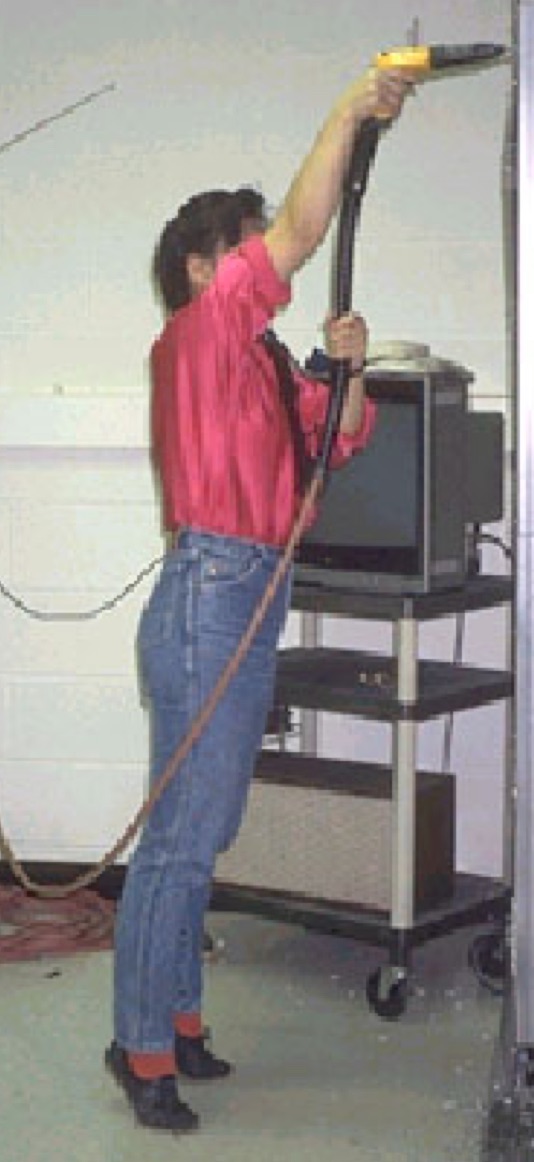
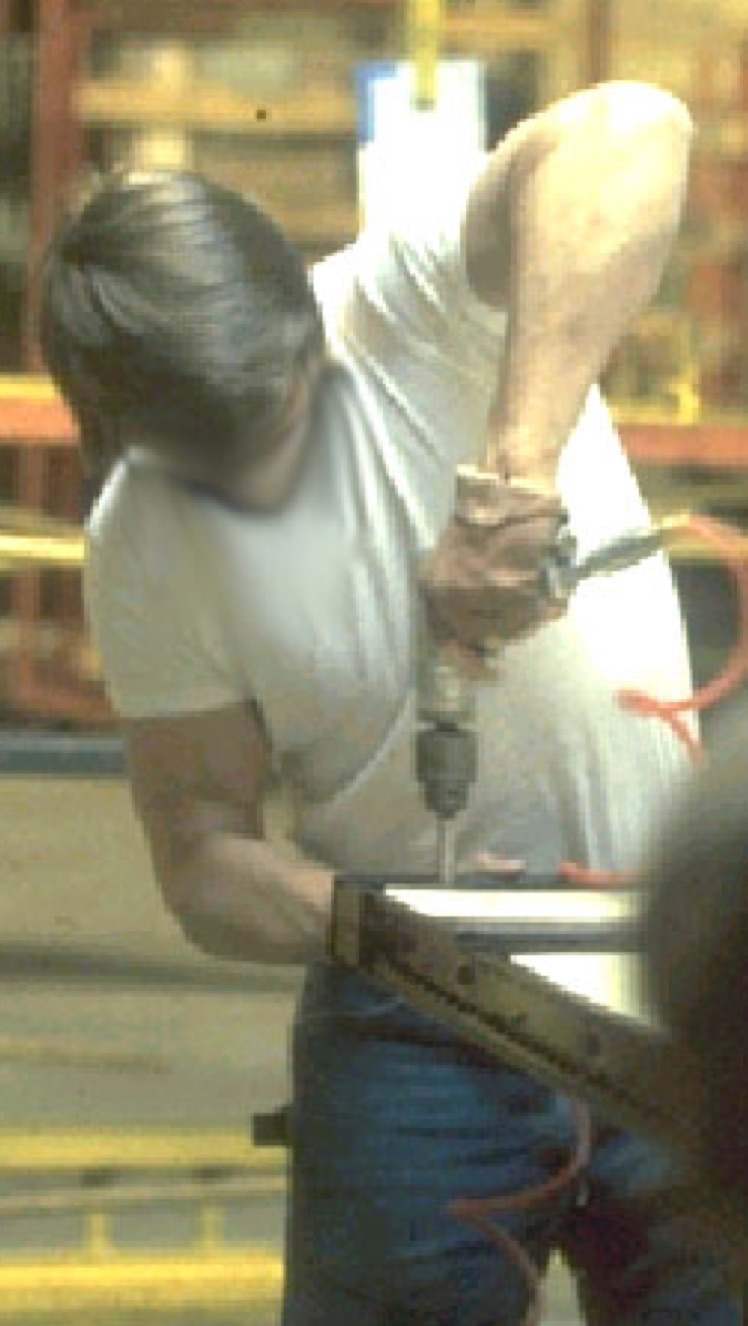
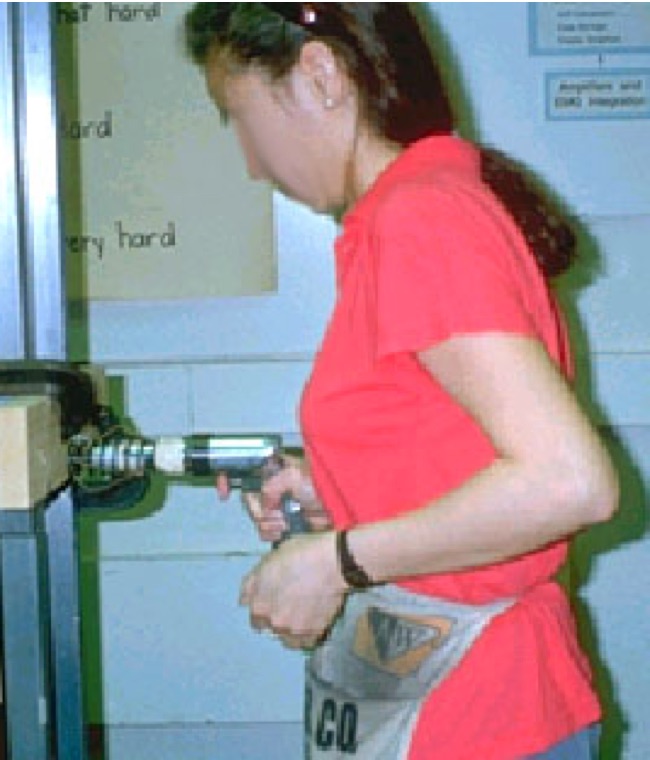
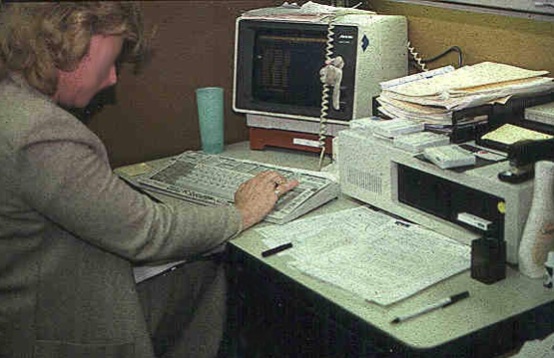
- Examples of typical work tasks that involve repetitive and sustained quasi-static exertions are shown in Fig 4.
- Where would you hypothesize the workers shown in Fig 4 would be likely to experience fatigue-induced discomfort?
- Based on the preceding exercise, what would you consider acceptable discomfort level for working all day?
- Design a discomfort survey to test your hypotheses.
- What kind of interventions could be used to reduce fatigue-related discomfort in these cases?
(a)
(b)
(c)
(d)
(e)
Discussion Questions
- How do you feel after sitting in class for 20 minutes? 40 minutes? 60 minutes? Where do you feel it? Why?
- Reconcile discomfort patterns with biomechanical load patterns.
- Where do you anticipate the workers shown in Fig 4 are likely to experience discomfort if the position show is repeated 1) 1x/hour, 2) 1x/minute or 3) 3x/minut or 4) is maintained continuously? How could you test your predictions? Point at areas of the body shown in Fig 4 that are likely to be affected in each case shown in Fig 5.
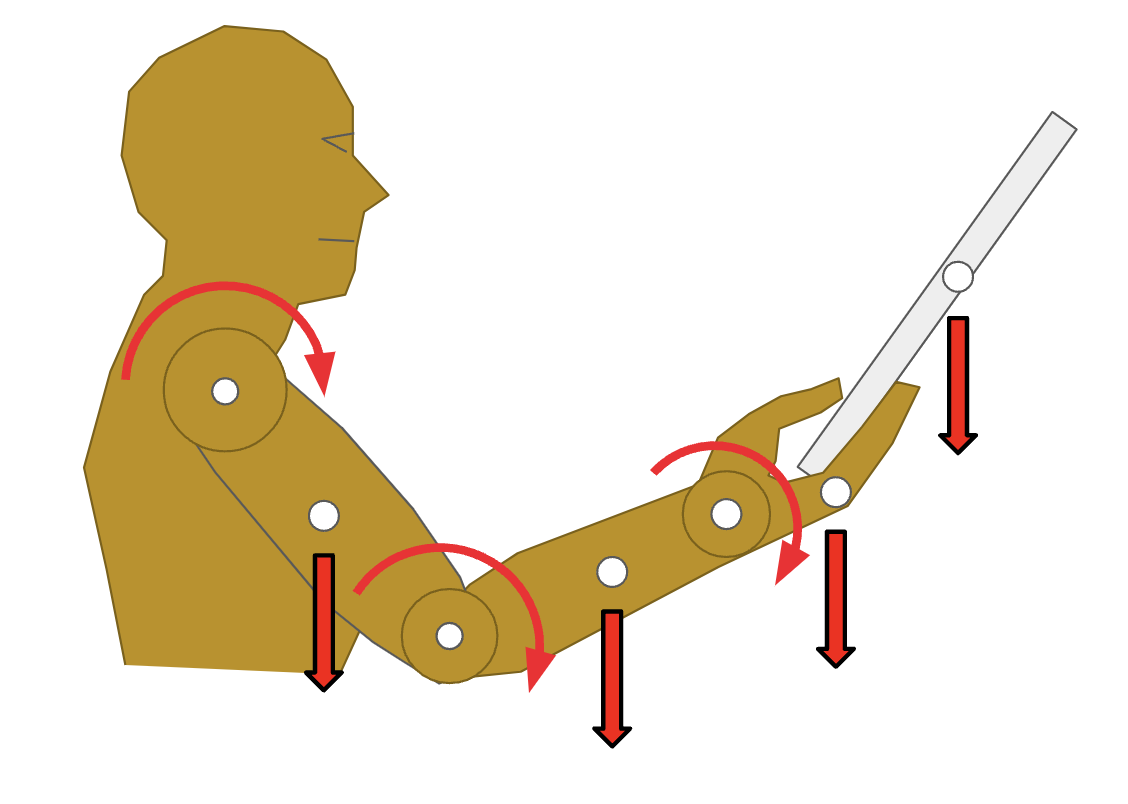
Hold your tablet 20" in front of your face, as shown in Fig 7.
- How does your shoulder feel after 1 minute? 2 minutes? 3 minutes ...
- Rate your level of discomfort on a scale from 0 to 10 after each minute.
- Click on the cell in Table 2 that corresponds to the level of discomfort at the end of each minute.
- What discomfort score do you consider acceptable for a normal day of work.
- Take a screenshot to save your work.
(a)
| 10 | |||||||||||
| 9 | |||||||||||
| 8 | |||||||||||
| 7 | |||||||||||
| 6 | |||||||||||
| 5 | |||||||||||
| 4 | |||||||||||
| 3 | |||||||||||
| 2 | |||||||||||
| 1 | |||||||||||
| 0 | |||||||||||
| Time: | 0 | 1 | 2 | 3 | 4 | 5 | 6 | 7 | 8 | 8 | 10 |
| Score: |
To save: 1) highlight the last two rows, 2) right-click "Print" or "Copy," & 3) paste into a spreadsheet.
5. Workload Patterns
- Workload patterns refer to the temporal pattern of the forces and moments required to position and move the and to gain control and manipulate work objects.
- Workload patterns can be divided into categories based on temporal and movement patterns:
- Temporal patterns:
- Sustained static work: exertions that are maintained until the individual cannot continue or feels sufficient discomfort to stop.
- Repetive/intermittent/cyclical work: repeated exertions punctuated with regular periods of reduced load sufficient for some degree of recovery.
- Movement patterns
- Dynamic work: exertion of force by one or more parts of the body while moving.
- Static work: exertion of force by one or more parts of the body without movement.
- Quasi-tatic work: small or slow movements that are for practical purposes treated as static work.
- Work may involve both static and dynamic elements, e.g., a worker maintains a static grip on the handle of a knife while wielding it with the shoulder and elbow to bone a carcasses.
- The following terms are used to characterize workloads.
- Forces expressed as pounds, newtons or Kg. Typically used to characterize loads on the fingers or hands
- Moments expressed as inch-pounds, foot-pounds, newton-meters, etc. Typically used to characterize loads on the elbow and shoulder
- %MVC or %ME a relative measure of force or effort based on the ratio of the required force or moment to the strength of a given individual or population in that position.
- %MVC= Exertion force or moment / Strength *100%
- (Also may be expressed on a scale from 0 to 1 or a scale of 0 to 10) = / × 100% =
- Average force: time-weighted average of the forces, moments, or %MVCs required to perform a job.
- Average work force: time-weighted average* of the forces, moments, or %MVCs that are greater than the force threshold for fatigue or measurement of force required to perform a job.
- %MVCworkavg = Σ Δti × %MVCworki∕ ΣΔti; where: %MVCwi > 5%
- In this example, the fatigue threshold assumed to be 5%, but some may select higher values.
- Force levels less than 5% are are near the limits of most tools for estimating force.
- %MVCavg = Σ Δti × %MVCi ∕ Σ Δti
- Total time Tt or cycle time, Tcycle, The total time spent or observed performing a job or a task (may include one or more cycles).
- Work timeTW, The total time spent or observed performing a job or a task for which the workload is greater than a specified fatigue threshold.
- Recovery time, TR, The total time spent or observed performing a job or a task for which the workload is below a specified fatigue threshold.
- Tt = TW + TR
- Duty cycle = TW / Tt * 100%
- In this example, there is a constant load on the hand, arm, and shoulder equal to the weight of the toolbox. There is no recovery until the worker releases his or her grip - voluntarily or involuntarily.
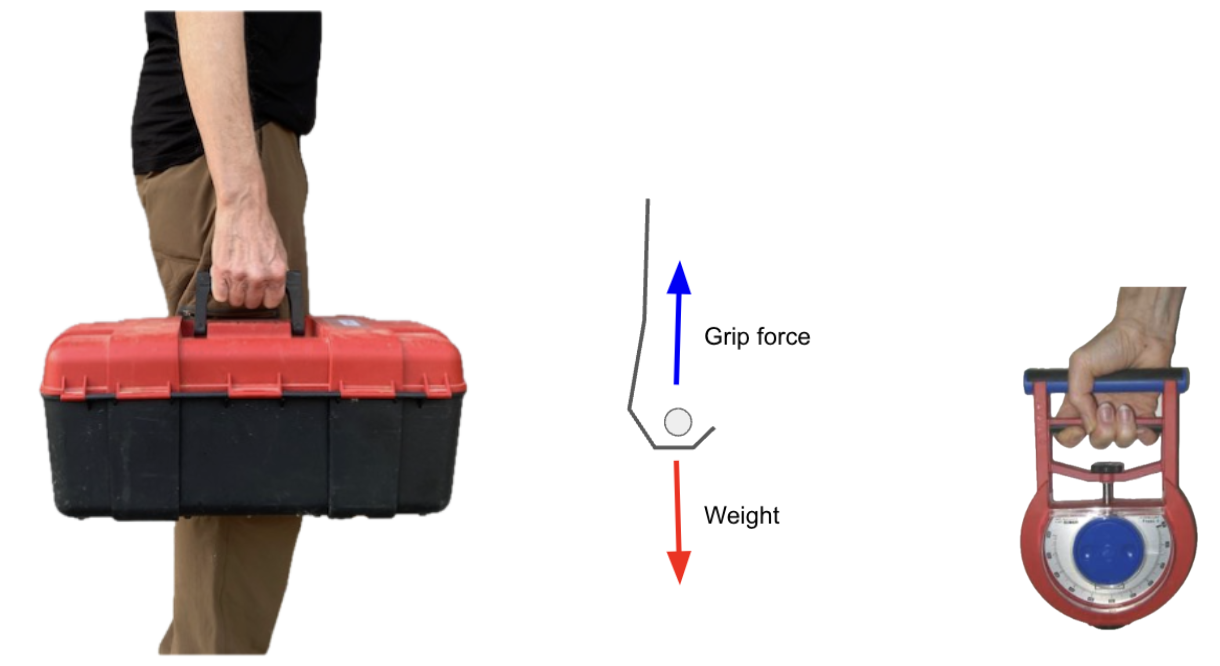
(a) (b) (c) (d)
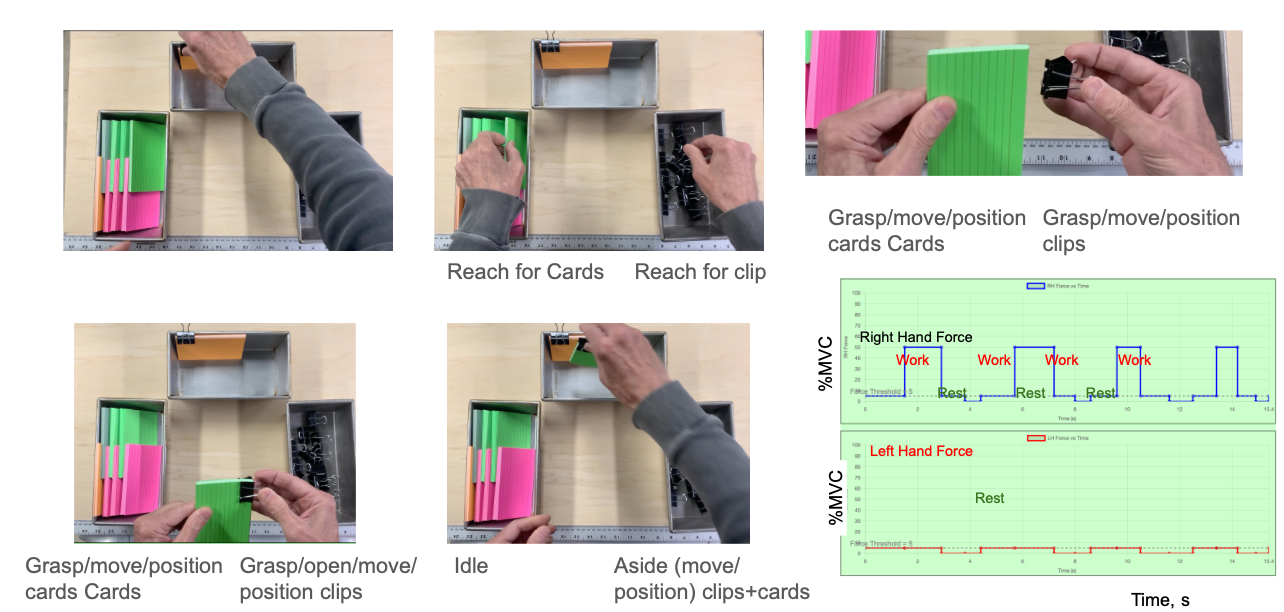
- Example of repeated intermittent work: Fig 6 shows a task in which a worker exerts repeated/intermittent/cyclical finger forces attach clips to cards.
- Dynamic shoulder and elbow movements movenets are exerted to move the hands into position to grasp, move, and position the cards and clips, but the finger movements are most static or quasi-static.
- The steps and force estimates for four cyles of this job are shown in Table 1a. This information is used to compute work time, recovery time, duty cycle, and average work forces necessary to characterize the workload pattern shown in Table 1b.
- These parameters are used to evaluate possible work fatigue.
- Determining work patterns is the starting point for managing localized fatigue.
| n | t (sec) | RH Action | RH Force | LH Action | LH Force | Points |
|---|---|---|---|---|---|---|
| 2 | 0.3 | reach for clip bin1 | 0 | reach for clip bin2 | 0 | |
| 3 | 2 | grasp/move/position clip | 5 | grasp/move/position cards | 5 | |
| 4 | 2.7 | open/move/position clip | 50 | clip | 5 | |
| 5 | 4.1 | aside clip/cards bin3 | 10 | idle | 0 | |
| 6 | 4.9 | reach for clip bin1 | 0 | reach for clip bin1 | 0 | |
| 7 | 6 | grasp/move/position cards | 5 | grasp/move/position clip | 5 | |
| 8 | 7.1 | open clip/move/position | 50 | move/position cards | 5 | |
| 9 | 8.5 | aside cards bin3 | 10 | idle | 0 | |
| 10 | 9.6 | reach for clip bin1 | 0 | reach for cards bin2 | 0 | |
| 11 | 11.4 | move/position clip | 5 | move/position cards | 5 | |
| 12 | 12 | open/move/position clip | 50 | move/position cards | 5 | |
| 13 | 13 | aside blip/cards bin3 | 10 | idle | 0 | |
| 14 | 14.2 | reach for clip bin1 | 0 | reach for cards bin2 | 0 | |
| 15 | 15.7 | grasp/move/position clip | 5 | grasp/move/position cards | 5 | |
| 16 | 16.6 | open/move/position clip | 50 | move/position cards | 5 | |
| 17 | 17.6 | aside clip/cards | 10 | idle | 0 |
| Time (4 cycles) | 17.60 sec |
| Time Force > 5%MVC | 8.10 sec |
| Duty Cycle | 46% |
| %MVCwork | 26% |
Determining Workload patterns
- Determine the job steps/elements; see: Job/task Analysis Fundamentals
- Observations: direct, video recordings, computer vision
- Worker does it says it
- Predetermined time systems, e.g., Work Factor, MTM, MOST, MODAPTS, etc.
- Existing job descriptions. Companies often maintain job descriptoins for determining job time standards, balancing workloads, determining labor costs, worker training, etc.
- Describe the steps
- Use Therbligs or predetermined time system. According to Gilbreth, all jobs can be described as a sequence of Therbligs (Gilbreth spelled backwards (see Table 2)
- Augment step names with addition information, e.g., move/position part on assembly (e.g., see Table 1)
|
|
- get = reach/grasp
- put = move/position
- aside = move/position
- grasp/move/position -- three elements that require continuous force (see Table 1)
- Stopwatch
- video player
- Predetermined time systems
- Computer vision
- Observer estimates
- Worker Estimates
- Biomechanics
- Force gauges
- Electromyography
- The observational methods analysis can be performed in real-time, but it is much easier to use a video recording that can be stopped, moved ahead, or moved back as desired.
- Work patterns may vary of space and time. Be sure to observe observe multiple workers at different times. Determine the "standard method.
- Enlist the cooporation of workers and supervisors to:
- Obtain all necessary permissions.
- Obtain recordings representative of normal work or parts of the job of particular interest.
- The are a number of suitable video players that provide the time between the first and current video frame and have slider bars or other controls that enable the user to quickly move forward or backward to find the beginning or end of a job action.
- Apple "Quick Time Player©"
- Microsoft "Windows Media Player©"
- Multimedia Video Task Analysis™ (MVTA™)(Must be purchased)
- Video Methods Analysis App
- Estimate or measure the load and other relevant attributes affecting the loads on each body part.
- For example, to determine the load moments acting on the shoulder, it is necessary to determine the forces acting on the hand or arm and the location of those forces with respect to the shoulder.
- Various methods for estimating and measuring loads are described in: "Task Hand Strength Demands and Capacities"
6. Fatigue Limits -- Sustained Static Exertions
- Sustained (quasi-static) exertions refer to exertions that are maintained with little or no movement without regular reductions in load sufficient to provide recovery.
- Examples include carrying an object long distances, holding a tool or control for long periods, and continuously reaching to get and use work objects. (See Fig 3)
- Discomfort versus exhaustion -- they are not the same.
- Both are the result of physiological and biomechanical demands exceeding capacity.
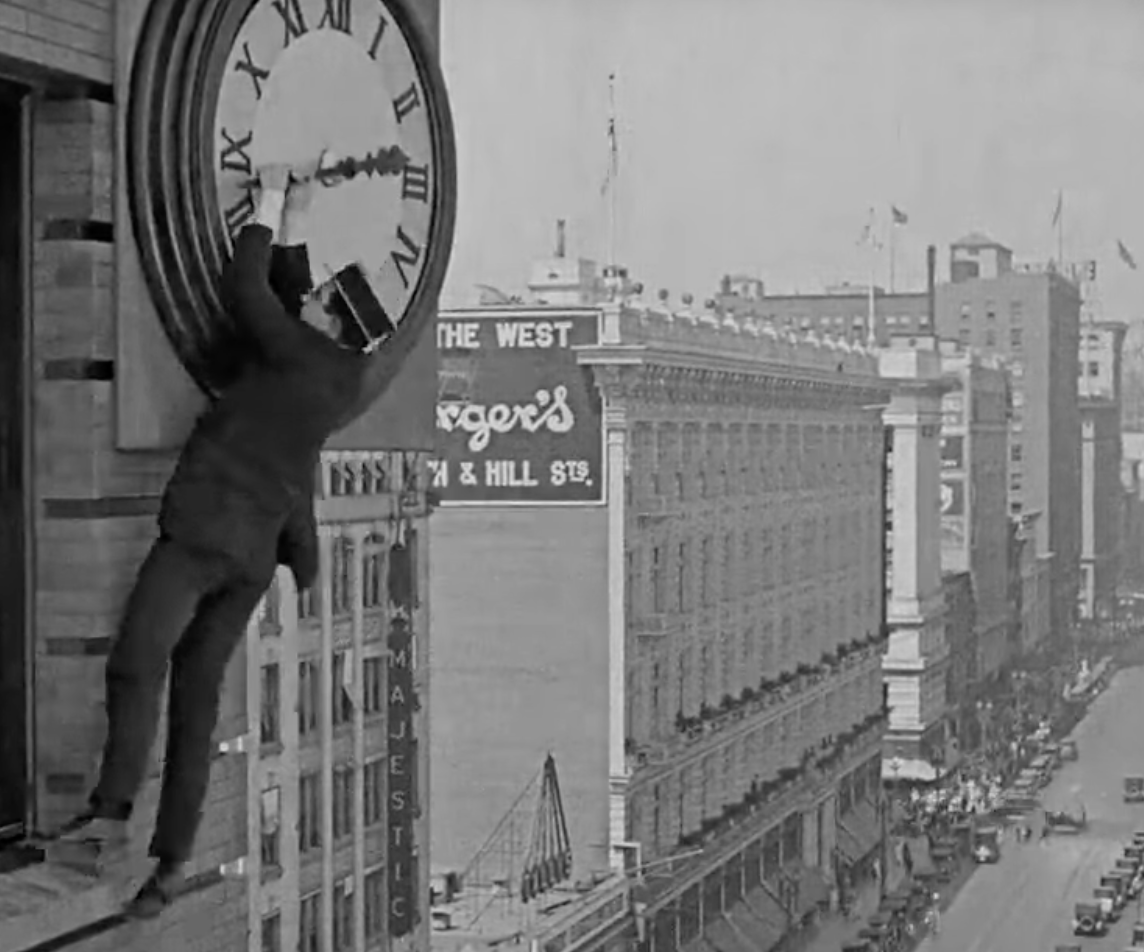
- Exhaustion -- unable to continue even if it means falling to your death -- up against a wall.
- Discomfort ranges from "just noticeable" to "intolerable pain" or from a minor distraction to a disruption of task.
- Fig 8 shows the relationship between time to objectionable discomfort in the hand and forearm and the time to complete exhaustion. Notice that discomfort occurs well before exhaustion.
- The relationship between time to discomfort and time to exhaustion can be modeled as an inverse, log, log-log, or similar mathematical function (Table 3)
- Use the calculator built into Table 3 to compare time to discomfort and exhaustion for different levels of %MVC
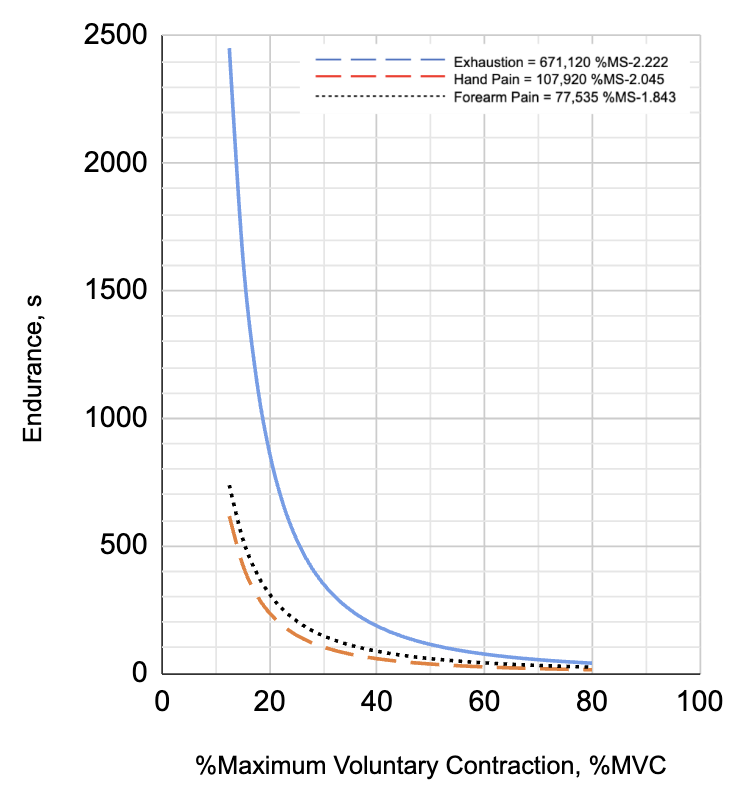
Fig 8: Time to objectionable forearm pain or hand pain precedes exhaustion (from Armstrong 1976) Table 3: Time to objectionable discomfort and exhaustion equations (Armstrong 1976). Enter %MVC and click button below. Predicted times for specified %MVC Time Endurance, s = 671,120 × %MVC-2.222 Hand Pain, s = 107,920 × %MVC-2.0453 Forearm Pain, s = 77,535 × %MVC-1.8427 Enter %MVC (12-80%): % - Fatigue by body part
- Not all body parts are the same.
- The characteristics of the fatigue curves are similar for all body parts, but the fatigue rates for a given %MVC may vary from one body part to another (Fig 9).
- Notice which body parts fatigue the fastest and the slowest.
- The calculator in Table 4 can be used to compute endurances for each body part.
- Remember that workers will experience objectionable discomfort before reaching the point of exhaustion (Fig 8).
Fatigue Problem 1: How far are you going to carry that?
- A normal walking pace of 3mph (4.4 ft/s)?
- The force required to carry a suitcase or toolbox at the side of the body using a hook grip is related to the weight of the suitcase or toolbox.
- Hook grip strength is most closely related to power grip strength that can be directly measured using a standard grip dynamometer (see Section 4, Fig 3)
- Assume that the weight of the body is divided equally between the two hands.
(see: see: "Task Hand Strength Demands and Capacities" section 3.3.; from Safety Last! (2024, January 27). In Wikipedia.
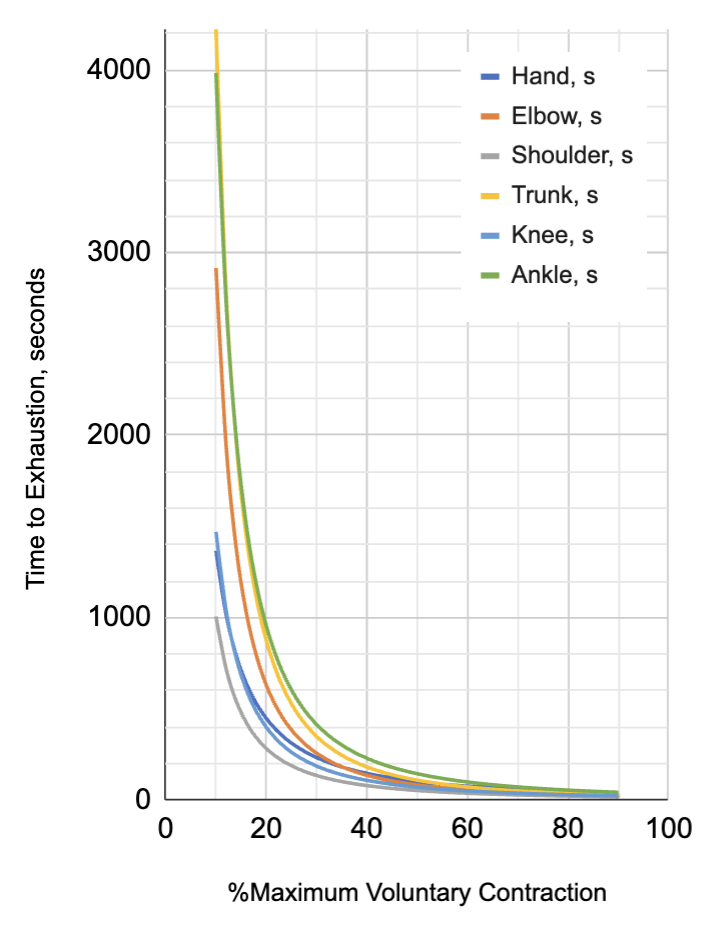
| Time to exhaustion by body part | Predicted time, s |
|---|---|
| Hand, s = 33.55*(mvc/100)-1.61 | |
| Elbow, s = 17.98*(mvc/100)-2.21 | |
| Shoulder, s = 14.89*(mvc/100)-1.83 | |
| Trunk, s = 22.69*(mvc/100)-2.27 | |
| Knee, s = 19.38*(mvc/100)-1.88 | |
| Ankle, s = 34.71*(mvc/100)-2.06 | |
|
Enter %mvc % |
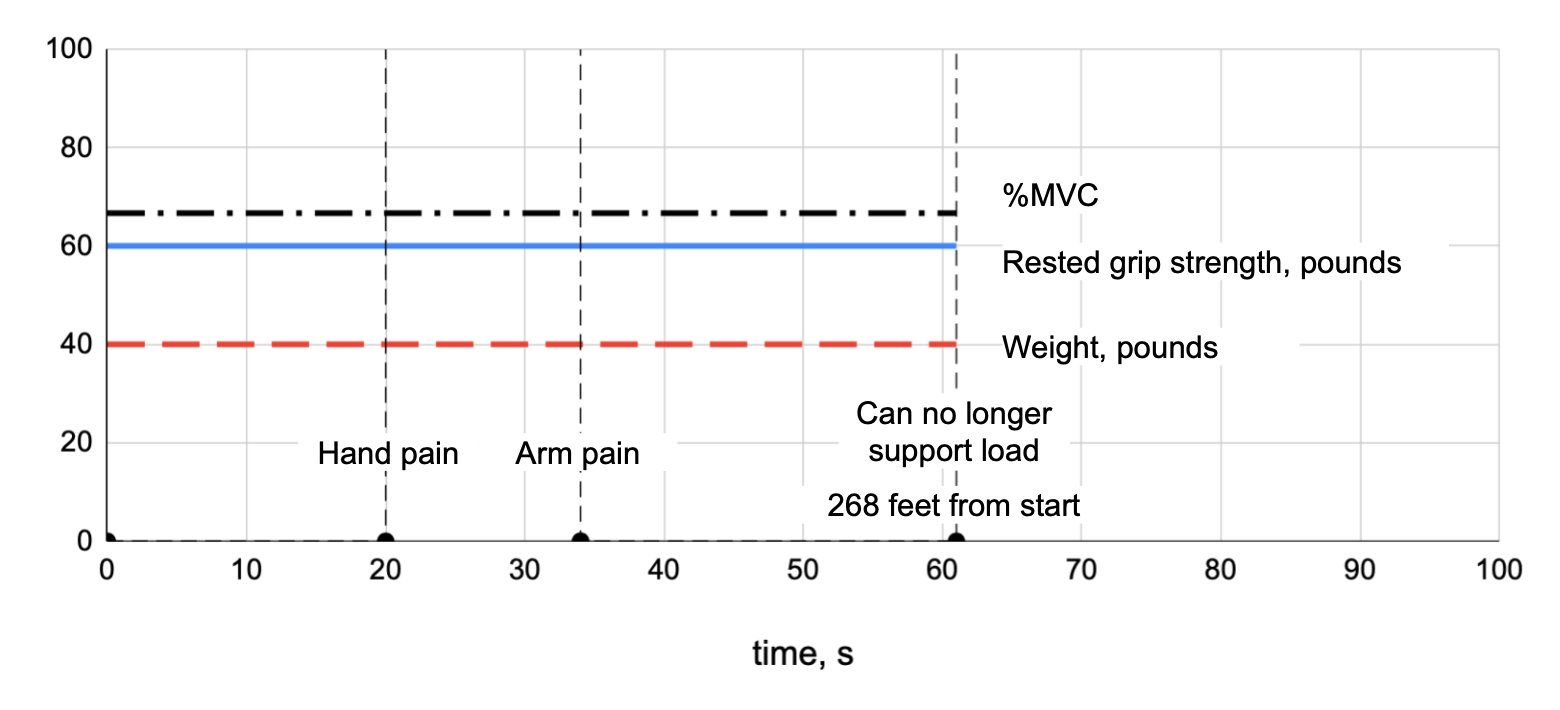
How long and how far could someone with average female grip strength (assume 50 lb) be expected to carry a 40-pound suitcase (see Fig 9) based on 1. exhaustion and 2. unreasonable discomfort?
Assume:
How far could someone with Average male grip strength (100 pounds) carry a 40 lb suitcase?
How could you modify the equipment to reduce fatigue and increase the distance the suitcase can be carried?
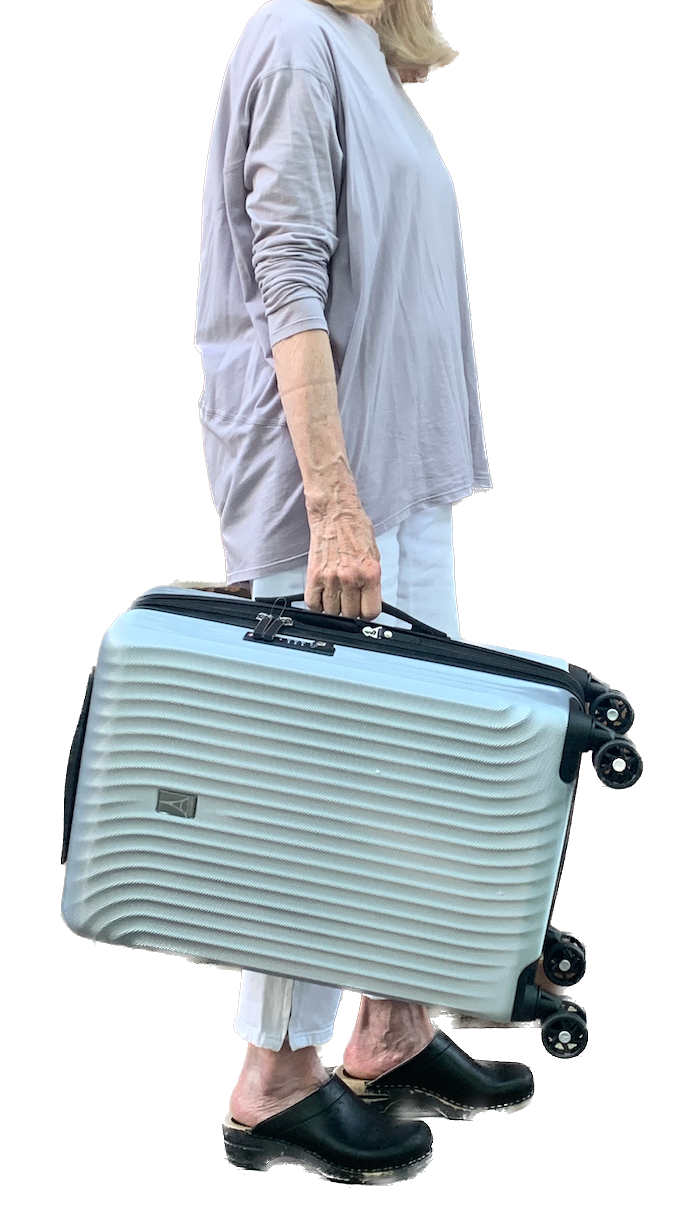
Hand load = 40 pounds
Female hand grip strength = 50 pounds
%MVC = 40 / 50 × 100% = 80%
Time to hand exhaustion = 671,120 × 80-2.222 = 40s
Distance to hand exhaustion = 4.4 × 40s = 176 feet1
Time to hand pain = 107,920 × 80-2.0453 = 14s
Distance to hand pain = = 4.4 × 14s = 62 feet1
Forearm Pain = 77,535 × 80-1.8427 = 24s
Distance to hand exhaustion = 4.4 × 24s = 106 feet1
1Based on standard walking pace of 4.4 feet per second (3mph)(1.34m/w)
Note: As a practical matter, most people can carry the suitcase further than predicted.
This is due to friction between the hand and the handle and to the effect that opening of
the hand has on muscle strength.
The use of a roller bag can be used to transfer the weight of the bag from the hand to the floor (see Fig 11. The force to pull the roller bag will be related to friction and mechanical interference between the bag and the floor or ground.

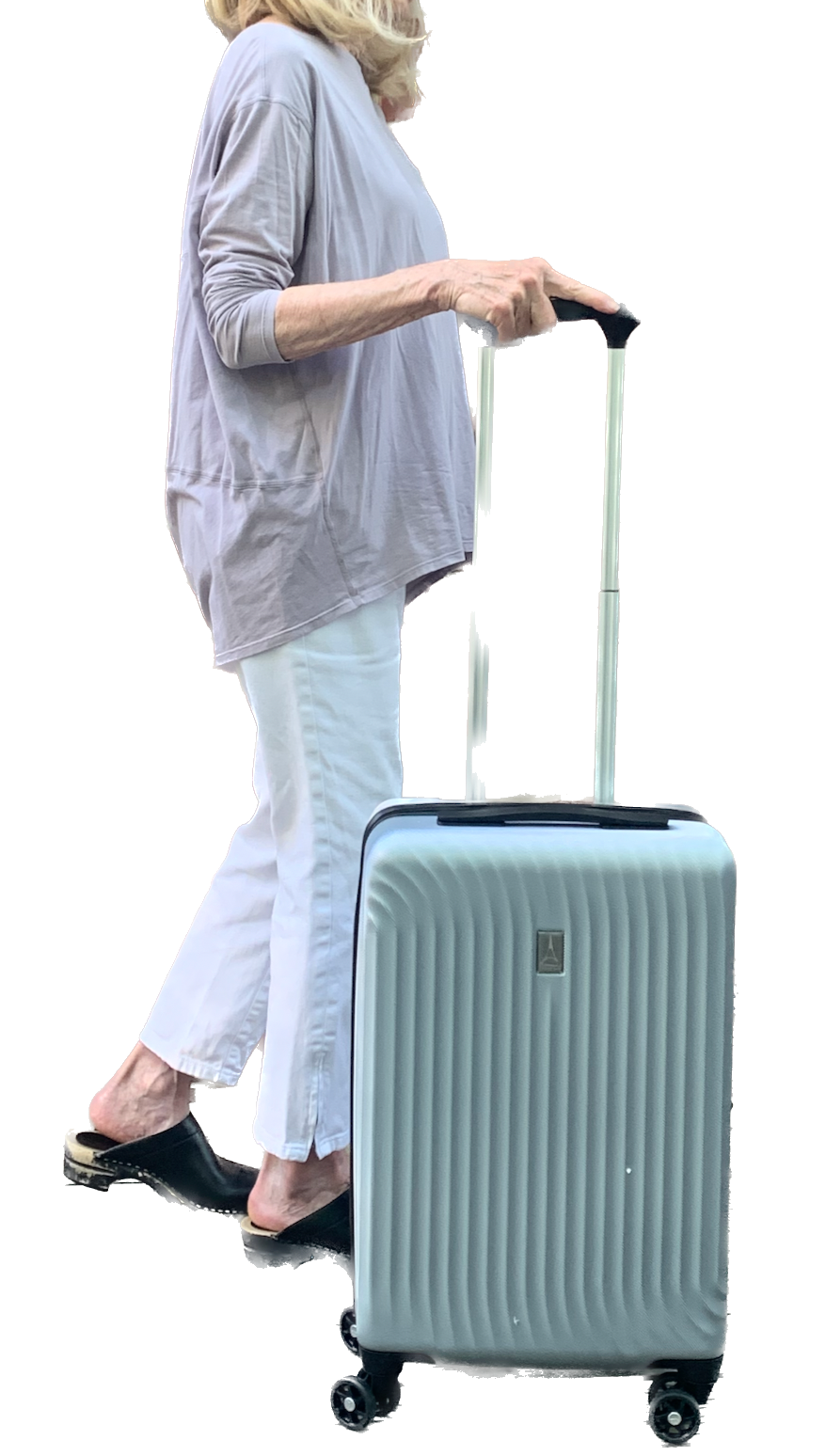
(a) (b)
Fatigue Problem 2: Hanging on.
How long would you expect to hang on if you found yourself in the position shown in Fig 12?
Should you reach into your pocket for a phone to call for help?
Assume:
8. Fatigue Limits --Repetitive intermittent work
- Applies to involving repetitive exertions of a hand, elbow, or shoulder work performed for 2 or more hours
- Quasi-static exertions
- Recommends maximum %MVC for a given duty cycle (or maximum duty cycle for given %MVC) to minimize localized fatigue to acceptable levels
- TLV® applied separately to each task performed 2 or more hours.
- Single exertions should not exceed 20 minutes
- The TLV® specifies a maximum recommended %MVC for a given Duty Cycle or a maximum recommended duty cycle for a given %MVC (see Fig 14).
- TLV®s are advisory. They are not enforced standards.
- Advises:
- maximum average %MVCwork for %Duty Cycle
- maxium %Duty Cyce for given average %MVCwork
- References: ACGIH® (2022, 2024)
- Meta-study of psychophysical studies of acceptable effort for repetitive upper limb exertions (Potvin 2012)
- Subjects demonstrated acceptable efforts for given conditions based on assumptions of an 8-hour work shift
- At least 40 minutes per test condition
- Each condition examined on different days
- Effort duration and duty cycle could be estimated from published data
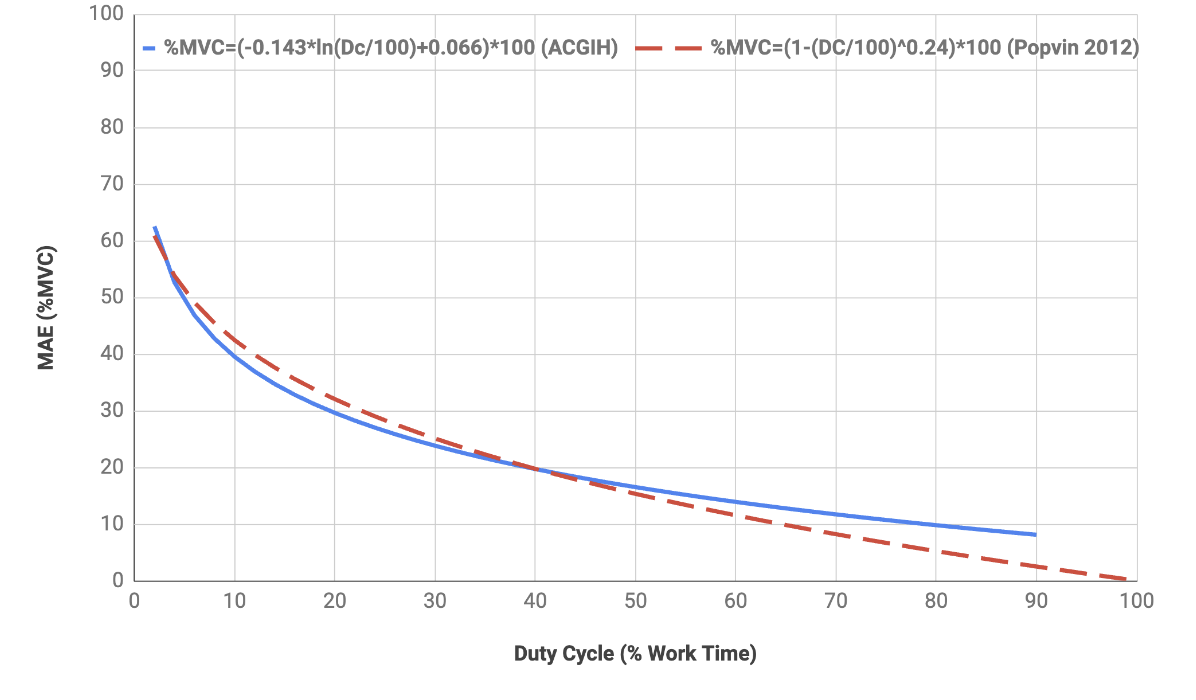
- Potvin (2012) fitted a curve to extracted data (Maximum acceptable force versus Duty-cycle). The fitted curve was forced through 0% MVC at 100% duty cycle (see Fig 13).
- The ACGIH Physical Agents Committee re-fitted a curve to Maximum Acceptable Exertions, MAEs, and truncated the cures at 0.5% and 90% duty cycle based on the assumption that working for 2 or more hours per day with a %MVC less than 5% and duty cycles greater than 90% are rare. (see Fig 13)
- References: ACGIH® (2022, 2024), Potvin (2012); Abdel-Malek, et al. (2022)
|
Enter %DC (5-90):
Max recommended %MVC |
Recommended %MVCworkforce versus %DC limits (ACGIH 2024) |
|
Enter %MVC (8-60%):
Max recommended %DC |
Application of the TLV®
- Determine the duty cycle
- Use the TLV® graphic or equation to determine the maximum recommended %MVCWork
- The observed %MVCWorkshould be less than or equal to the recommended %MVCWork
- Explore interventions for reducing %MVCWork
- Determine the average %MVCWork
- Use the TLV® graphic or equation to determine the maximum recommended duty cycle
- The observed duty cycle should be less than or equal to the recommended duty cycle
- Calculate additional recovery time required
- Explore interventions for reducing duty cycle
Calculate additional recovery time recommended if TLV® is exceeded.
|
Duty cycle = Tw / Ttotal and Ttotal =Twork + Trest Recommended: Trest = Twork × ((1 - DC) / DC)
Duty Cycle (Observed): Duty Cycle (Recommended): Total Recovery Time (Recommended): Additional recovery time (recommended): Additional recovery time does not mean idle time. |
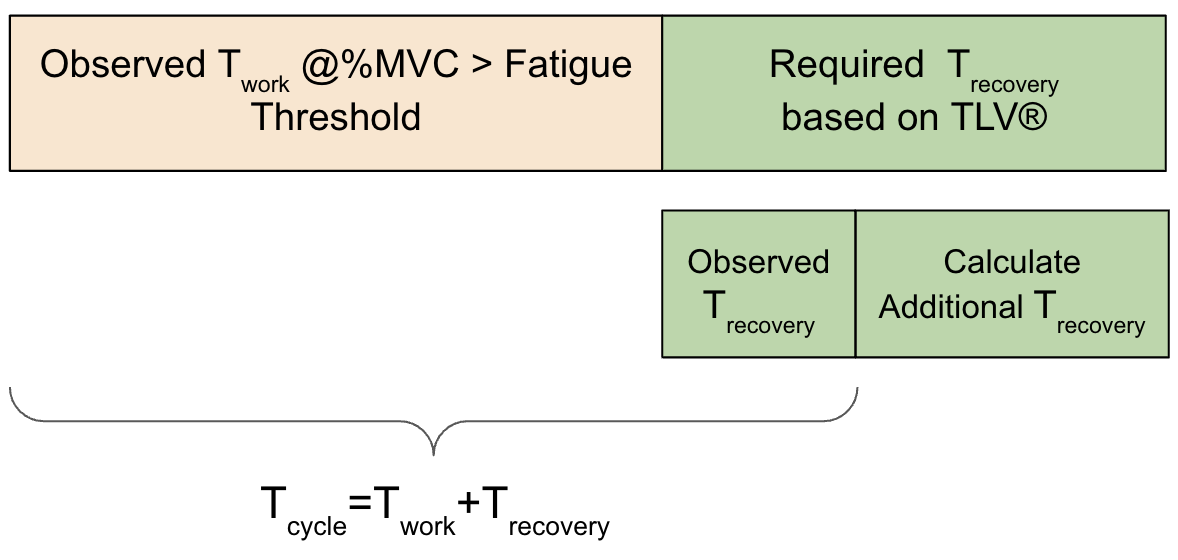 Observed Trecovery is compared with recovery time recommended by ACGIH TLV® to determine how much additional recovery time is needed to prevent localized fatigue. |
Examples:
- The workload parameters based on observations of 4 cycles of the "attach clips to cards" job described in Section 5 above are shown in the table below.
- Compare the observed %MVCwork with the recommended limit for the observed duty cycle
- compare the observed duty cycle with the recommended limit for the given %MVCwork
- What possible job improvements can you suggest?
- Given duty cycles of 25%, 50%, and 75% for the hand, what are the maximum recommended average %MVC during work (excluding rest) for each case?
- Given average %MVCs during work of 15%, 30%, 45%, and 60% for the hand, what are the maximum recommended duty cycles for each case?
- In the example shown in Section 7 (Fig 14), it was found average %MVCWork = 33%; TCycle = 19.5s, and DC = 42%.
- What is the maximum recommended duty cycle for this job?
- How much total recovery time is recommended for the observed work time?
- How much additional recovery time (excluding the observed) is recommended?
- Given an observed %mvc work for the shoulder of 10%, what is the maximum recommended duty cycle?
| Observed | Reccommended Limit | |
| Time (4 cycles) | 17.60 sec | |
| Time Force > 5%MVC | 8.10 sec | |
| Duty Cycle | 46% | %MVC < |
| %MVCwork | 26% | %DC < |
9. Examples
Example 1: Application of ACGIH TLV® to case packing job
Example 2: Application of ACGIH TLV® to application of binder clips to 3"x5" cards
Example 3: Application of ACGIH TLV® to turkey thigh boning job
10. Selected References
- Abdel-Malek DM, Foley RC, Wakeely F, Graham JD, La Delfa NJ. Exploring localized muscle fatigue responses at current upper-extremity ergonomics threshold limit values. Human Factors. 2022 Mar;64(2):385-400.
- ACGIH® 2024. Upper Limb Localized Fatigue 2024 Guide to Occupational Exposure Values, Cincinnati, OH: ACGIH, pp 206-208
- ACGIH® 2022: Upper Limb Localized Fatigue: TLV(R) Physical Agents 8th Edition Documentation, Cincinnati, OH: ACGIH
- Armstrong T (1976). Circulatory and Local Muscle Responses to Static Manual Work. Ph.D. Dissertation, The University of Michigan.
- Armstrong T, Buckle P, Fine L, Hagberg M, Jonsson B, Kilbom A, Kuorinka I, Silverstein B, Sjogaard G, Viikari-Juntura E (1993). A conceptual model for work-related neck and upper-limb musculoskeletal disorders. Scand J Work Environ Health. 1993:73-84.
- Armstrong T, Burdorf A, Descatha A, Farioli A, Graf M, Horie S, Marras W, Potvin J, Rempel D, Spatari G, Takala E (2018) Scientific basis of ISO standards on biomechanical risk factors, Scand J Work Environ Health 44(3), 323-329.
- Armstrong T (2024) Strength Demands and Capacities (Get a grip on it!) https://websites.umich.edu/~tja/strength/strnDemands.html#main
- Barcroft, H., Millen L.. "The blood flow through muscle during sustained contraction." The Journal of physiology 97.1 (1939): 17.
- Basmajian, J. V., & De Luca, C. J. (1985). Muscles alive: their functions revealed by electromyography. pp 239-244. Williams and Wilkins. Baltimore.
- Borg G. Psychophysical scaling with applications in physical work and the perception of exertion. Scand J Work Environ Health 1990:55-8.
- Byström S, Fransson-Hall C. Acceptability of intermittent handgrip contractions based on physiological response. Human Factors. 1994;36(1):158-71.
- Byström S, Kilbom Å. Physiological response in the forearm during and after isometric intermittent handgrip. European journal of applied physiology and occupational physiology. 1990; 60:457-66.
- Byström S, Mathiassen SE, Fransson-Hall C. Physiological effects of micropauses in isometric handgrip exercise. European journal of applied physiology and occupational physiology. 1991; 63:405-11.
- Chaffin D. Localized muscle fatigue—definition and measurement. Journal of Occupational and Environmental Medicine. 1973;15(4):346-54.
- Corlett E, Bishop R. The ergonomics of spot welders. Applied Ergonomics, 1978; 9:23-32.
- Deeb J. Muscular fatigue and its effects on weight perception. International Journal of Industrial Ergonomics. 1999 May;24(2):223-33.
- Ebersole M, Armstrong T. Analysis of an observational rating scale for repetition, posture, and force in selected manufacturing settings. Human factors, 48(3), pp.487-498 (2006).
- Edwards R. (1975). Muscle fatigue. Postgraduate Medical Journal, 51(593), 137-143.
- EDWARDS R. (1986) Muscle fatigue and pain. Acta Medica Scandinavica, 220(S711), pp.179-188.
- Elkus R, Basmajian J. Endurance in hanging by the hands. Why do people hanging by their hands let go?. American journal of physical medicine. 1973;52(3):124-7.
- Frey Law L, Avin K. Endurance time is joint-specific: a modelling and meta-analysis investigation. Ergonomics. 2010;53(1):109-29.
- Gallagher S, Schall Jr MC. Musculoskeletal disorders as a fatigue failure process: evidence, implications and research needs. Ergonomics. 2017;60(2):255-69.
- Gerard MJ, Armstrong TJ, Martin BJ, Rempel DM. The effects of work pace on intra-subject and inter-subject keying force, electromyography, and fatigue. Hum. Factors. 2001.
- Hagberg M. workload and fatigue in repetitive arm elevations. Ergonomics. 1981; 24(7):543-55.
- Hagberg M, Kvarnström S. Muscular endurance and electromyographic fatigue in myofascial shoulder pain. Archives of physical medicine and rehabilitation. 1984;65(9):522-5.
- Hemingway, E. Letter (21 February 1952); published in Ernest Hemingway: Selected Letters 1917–1961 (1981) edited by Carlos Baker wikiquote
- Humphreys, P. W., & Lind, A. R. (1963). The blood flow through active and inactive muscles of the forearm during sustained hand-grip contractions. The Journal of physiology, 166(1), 120.
- Hünting W, GRANDJEAN TL. Postural and visual loads at VDT workplaces I. Constrained postures. Ergonomics. 1981;24(12):917-31.
- Iridiastadi H, Nussbaum MA. Muscle fatigue and endurance during repetitive intermittent static efforts: development of prediction models. Ergonomics. 2006;49(4):344-60.
- Jonsson B. The static load component in muscle work. European journal of applied physiology and occupational physiology. 1988;57:305-10.
- Kilbom Å. Repetitive work of the upper extremity: Part II—The scientific basis (knowledge base) for the guide. International journal of industrial ergonomics. 1994 Aug;14(1-2):59-86.
- Kuorinka I, Jonsson B, Kilbom A, Vinterberg H, Biering-Sørensen F, Andersson G, Jørgensen K. Standardised Nordic questionnaires for the analysis of musculoskeletal symptoms. Appl Ergo. 1987 Sep 1;18(3):233-7.
- Kumar S. Theories of musculoskeletal injury causation. Ergonomics. 2001; 44(1):17-47.
- Lind AR. Muscle fatigue and recovery from fatigue induced by sustained contractions. J Physiol. 1959;147(1):162.
- Mastaglia F. (2012) The relationship between muscle pain and fatigue. Neuromuscular Disorders, 22, pp.S178-S180.
- Mathiowetz V, Kashman N, Volland G, Weber K, Dowe M, Rogers S. Grip and pinch strength: normative data for adults. 1985; Arch Phys Med Rehabil, 66(2), 69-74.
- Monod, H., & Scherrer, J. (1965). The work capacity of a synergic muscular group. Ergonomics, 8(3), 329-338.
- Monod, H., & Scherrer, J. (1957). Capacité de travail statique d’un groupe musculaire synergique chez l’homme. Soc Biol, 151, 1358-1362.
- Petrofsky JS, Burse RL, Lind AR. Comparison of physiological responses of women and men to isometric exercise. Journal of Applied Physiology. 1975;38(5):863-8.
- Potvin J. Predicting maximum acceptable efforts for repetitive tasks: an equation based on duty cycle. 2012; Human factors, 54(2), 175-188.
- Young JG, Woolley C, Armstrong TJ, Ashton-Miller JA. Hand-handhold coupling: effect of handle shape, orientation, and friction on breakaway strength. Human factors. 2009;51(5):705-17.
- Ramazzini B. Treatise on the Diseases of Workers, 1713. Translated by W.C. Wright (1940), New York: Hafner Publ. Co., 1964. Am J Pub Hlth 91, 1380_1382, 2001.
- Rashedi E. & Nussbaum M. (2015) Mathematical models of localized muscle fatigue: sensitivity analysis and assessment of two occupationally-relevant models. PloS one, 10(12), e0143872.
- Reynolds JL, Drury CG, Broderick RL. A field methodology for the control of musculoskeletal injuries. Appl Ergo. 1994 Feb 1;25(1):3-16.
- Rohmert W. Problems in determining rest allowances: part 1: use of modern methods to evaluate stress and strain in static muscular work. Applied ergonomics. 1973; 1;4(2):91-5.
- Rohmert W.(1960) Ermittlungvon Erholungspausenfurstatische Arbeitdes Menschen. Internationale Zeitschriftfurangewandte Phvsiologie,18,123.
- Saldana N, Herrin G, Armstrong T. Automated assessment of musculoskeletal discomfort in the workforce: a tool for surveillance. Ergonomics 37(6):1097-1112, 1994.
- Snook S, Irvine C. The evaluation of physical tasks in industry. Am Indus Hyg Assoc J. 1966;27(3):228-33.
- Taylor F: The Principles of Scientific Management. 1911