Literacy

Culture
Why offer a Spanish program for native speakers?
Rapid increase in the Spanish-speaking population in Ann Arbor, Michigan.
Since 1990, Detroit has experienced a 50% increase in its Spanish-speaking population. In 2009 in Ann Arbor, 18.7% of the students enrolled in elementary schools such as Mitchell and Pittsfield were potentially Spanish-speaking. In 2009, 9.1% of the students attending Bach Elementary School were Spanish-speaking. Many of these children already use spoken Spanish proficiently in a home context, but need to develop their academic Spanish and literacy skills. If they are limited English proficient, they receive instruction en ESL, but few receive instruction in their native/heritage language, although numerous studies show that developing Spanish academic and linguistic skills in these children greatly advances their English development.
Advantages of speaking Spanish
The ability to speak more than one language is an asset in a global society. Spanish is the second most widely spoken language in the world and is increasingly important for business, trade, schools, government agencies, the legal systems, the media, advertising, the internet, politics, and the private sector in a global context.
Studies show conclusively that students who have grown up speaking both Spanish and English often have linguistic, cognitive, and cultural advantages over monolingual speakers of either language, and they may be better prepared to face the challenges of a multilingual and multicultural world.
Despite the advantages of speaking both Spanish and English, many Spanish-speaking students in the US have limited opportunities to use their Spanish for academic purposes or to read and write Spanish.
Characteristics of Spanish-speaking students
Spanish-speaking children have already attained a certain level of competence in Spanish and often have strong connections to the Hispanic/Latino culture. They have different characteristics and needs from those English-speakers who are learning Spanish as a second language. Whenever possible, it is best to design separate instructional contexts for these two groups, particularly in the early levels.
Spanish-speaking students in North American schools frequently have very limited contexts in which they can use Spanish, and consequently use English in their formal and academic interactions. In order to promote bilingualism in these children, it is necessary to develop Spanish communicative skills and to also relate to Spanish as an academic and professional language, including reading and writing skills.
Nearly 30% of Hispanic students in high school drop out
Many young people have been conditioned to believe that speaking Spanish is a liability in the US school system. Documented evidence shows that minority students stop attending classes because they feel no connection to the school: their culture and/or their language are invisible and are not valued in the larger scholarly environment. Often this situation causes a rupture between Spanish-speaking parents and their children as well.
What are the benefits of a Spanish program for your child?
NO TUITION COSTS: The program is free for Spanish-speaking children grades K-3. A preschool program is also available for toddlers (3-4 years old).
TRANSFER OF SKILLS: Research demonstrates that students who begin to acquire literacy skills in Spanish reach a higher reading level in English more quickly.
BILINGUAL DEVELOPMENT: Students perform better than monolingual students in higher reasoning and comprehension activities, pattern recognition and problem-solving
PRESERVATION OF FAMILY TIES AND CULTURE: Students develop total knowledge of Spanish that will allow them to maintain close ties with family and with the Spanish-speaking community
REDUCTION OF DROPOUT RATES: ‘En Nuestra Lengua’ establishes academic contexts for using Spanish in the early grades. By doing so, we construct a foundation of self-esteem, identity and hope that will help Spanish-speaking children maintain interest in their studies and their culture
A BETTER FUTURE: Increased employment opportunities when students finish their studies
What is the program of instruction like for ‘En Nuestra Lengua’?
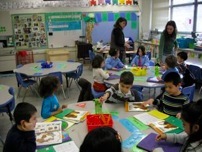
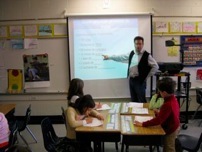
Professional instructors, learning through cultural activities and educational games
The ‘En Nuestra Lengua’ program is based on pedagogical models and experience proven over many years of investigation concerning how both child languages and academic knowledge are acquired. The program provides instructors of Spanish for teaching native speakers of Spanish. The instructors have special training in the understanding and treatment of cultural and linguistic features of the children who will participate in the ENL sessions. Moreover, our instructors have access to curricular designs and materials prepared specifically for Spanish-speaking children. As professionals, they are conscious of the cultural backgrounds, the ranges of capacities to use Spanish and the attitudes towards the language that Spanish-speaking children bring. Our instructors will reinforce the rich heritage and help your child continue learning Spanish in an entertaining and interesting way.
Information sessions for parents
The ‘En Nuestra Lengua’ program is committed to strengthening ties between school, home and community in order to create a strong educational system and to better the quality of life for the students. On Saturdays, during the class sessions for the children, we will hold a concurrent information session for the parents. In the information session we will discuss a variety of topics of interest such as the rights of parents in the schools, in order to build a climate of mutual trust based on communication and cultural education, with the purpose of supporting parental participation in the school.
Resources for families and information about the
‘En Nuestra Lengua’© project

Links and resources:
¡Colorín colorado!
http://www.colorincolorado.org/
In Spanish and English
An excellent website for bilingual families and teachers.
Del Sol Books
In English
A bookstore in California with a good selection of bilingual, Spanish, and English books for bilingual children. They offer the textbook series Hagamos Caminos by Alma Flor Ada, which is used by ENL.
America Reads Spanish
http://www.americareadsspanish.org/
In English
A website with book reviews and information about books for US Spanish readers of all ages.
Scholastic en español
https://shop.scholastic.com/parent-ecommerce/featured-shops/spanish-books-libros-espanol.html
In Spanish and English
The largest publisher and vendor of books in Spanish in the US.
Lectura ≪ Blog de aplicaciones
http://aramo.wordpress.com/areas/lectura/
In Spanish
A collection of articles on reading and how to motivate children to read.
Links to
activities and educational
games in Spanish:
123 TEACHME http://www.123teachme.com/learn_spanish/children_songs_lyrics Videos of children’s songs (with lyrics)-Arroz con leche, Los cinco lobitos, De colores, Chocolate, etc. Children 3-8.
COSICOSAS http://poemitas.org "Website of children’s poetry from all Spanish-speaking countries” Children of all ages.
CHILDTOPIA http://childtopia.com/index.php?module=home&newlang=spa "For boys and girls from pre-K through elementary school” Webpage in Spanish, Catalan, Basque, English, and German. More than 1200 online educational games, activities, worksheets, and stories. Children 3-11.
Help us: If you find a website that would be helpful for another bilingual family, click here and we will add a link to the site on this page.