Sight Lines at University Health Services
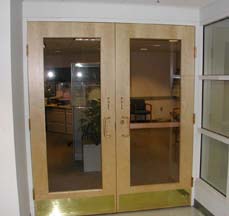
Glass windows on the doors leading into the Audiology, Gynecology and Psychiatry clinic (above).
Doors play an important role in defining sight lines. In the examples to the left and right, large windows on the doors allow a patient to see inside the office. One benefit of this is that the office becomes much more inviting.
At the same time, the doors partitian the room from the rest of the hallway. This allows for an added sense of privacy. Given the primary roles of this clinic, senses of both invitation and privacy would be very important.
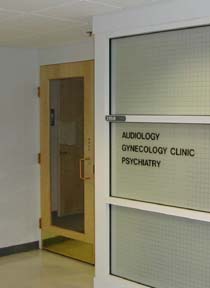
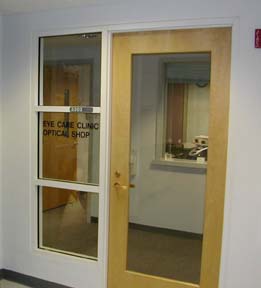
Better sight lines can improve the flow of traffic.
To the left is another example in which large windows in doors improve sight lines. UHS recently underwent rennovations in which several old doors were replaced. The older doors had smaller windows, making it difficult to see what was on the other side. One problem this caused was congestion at the doorways. People at either end could not see if there was another person at the other end. As such, they would fequently collide with each other or play tug of war with the handles.
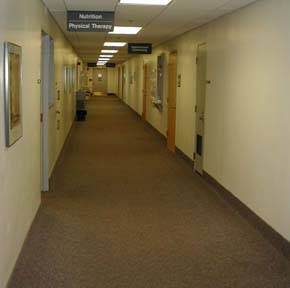
Signs make it easier to see what lies at the end of a long hallway.
The examples to the left and right show several elements of sight lines. The hallway on the left extends well beyond the limits of sight, yet cues have been added to account for this. Signs are posted above important areas where a patient would likely need to go. Even if a patient could not read the sign, that person would at least know there was something there.
The hallway to the right runs perpendicular to the hallway at the left. The sight lines in the right hallway, however, have been cut short by a door with very narrow windows embedded in a wall. One purpose this accomplishes is to discourage people from going in that direction (unless they know they need to).
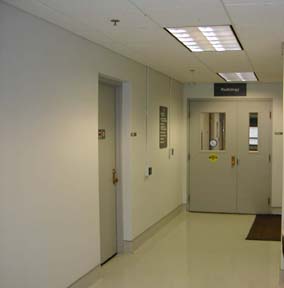
Shortened sight lines keep people from wandering into Radiology - a department where few need to be and extra traffic may be troublesome.
