|
Mouth Development & Induction
Mammal
Mouth Development:
As an example in the human, development of the face
depends on epithelial - mesenchymal interactions. Most
of the face is formed from the first 2 of 5 pharyngeal
arches (Marino, Thomas PhD). Here we will be focusing on
the formation of the human mouth.
The oral cavity, the hole that connects the
foregut to the amniotic fluid, develops from the contact
of the embryonic endoderm with the ectoderm. This is one
of two places in the human which lacks the mesoderm that
usually lies between the two embryonic tissues. This
contact induces the ectoderm to invaginate, forming the
primitive mouth called the stomodeum (K.Tosney). The
cavity is originally covered by the buccopharyngeal
membrane which breaks down to leave the open oral cavity
(K.Tosney).
The upper jaw of the human being develops
from 5 primordial buds of tissue; the frontonasal
process, the two nasal placodes, and the two maxillary
swellings (Odaci, Ersan MD,
PhD). The lower jaw develops from the two
mandibular swellings (Odaci,
Ersan MD, PhD).
The facial primordia contribute to other parts of
the face as well, such as;
-
Frontonasal
prominence - Forehead and the dorsum apex of the
nose
-
Lateral nasal prominences - Sides of the nose
-
Medial nasal prominences - Nasal septum
-
Maxillary prominences - Upper cheek region and most
of the upper lip
-
Mandibular prominences - Chin, lower lip, and lower
cheek regions
-
Mesenchyme in the facial prominences - Fleshy
derivatives and various bones
(Odaci, Ersan MD, PhD)
Human Embryo: The neural crest
cells of the brain migrate to the mesodermal cells which
together form the facial primordia.
Face of Chicken Embryo cut through first pharyngeal
arch.
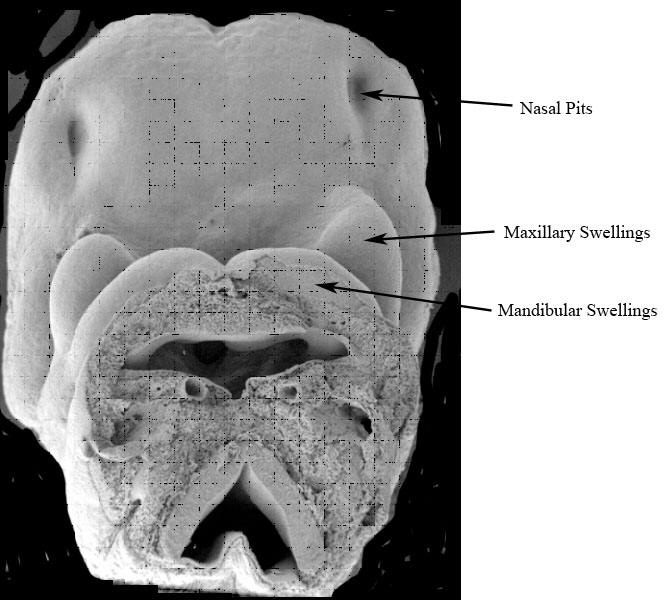
Used and modified with permission � K Tosney
The frontonasal prominence and the nasal placodes come
together to form the medial and the lateral nasal
processes. The medial nasal processes then fuse to form
the philtrum of the upper lip. (K.Tosney)
The palate of the mouth is developed from the medial and
lateral palantine processes growing out from the sides
of the mouth cavity and fusing together when the meet at
the middle. The fusion stops near the dorsal side of the
head. The fusion of the palate and other parts of the
face rely on apoptosis. (K.Tosney)
The tongue develops on the floor of the
oral cavity. Tongue formation requires assistance from
four of the pharyngeal arches. It begins as lingual
swellings which fuse together. The fusion of the two
lateral lingual swelling creates and indentation called
the median sulcus. (Hill, Mark Dr.) This is the visible
part of a human tongue.
Arch 1 - oral part of
tongue (anterior 3/2)
Arch 2 - initial
contribution to surface is lost
Arch 3 - pharyngeal part of
tongue (posterior 1/3)
Arch 4 - epiglottis and
adjacent regions
(Hill, Mark Dr.)
The teeth of the human mouth form as neural crest molar
mesenchyme condenses and induces jaw epithelium to
thicken. Both the neural crest molar mesenchyme and jaw
epithelium follow a series of reciprocal inductions to
form teeth. (K.Tosney)
_________________________________________________________________________________________________
Puppeteer Mouth Formation:
�
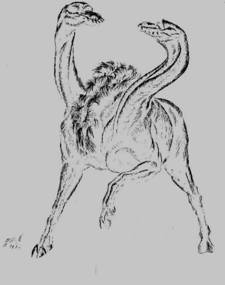
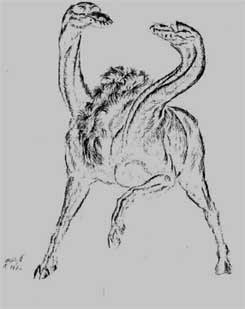
The most obvious difference between
mammals and ourselves, is that mammals only have one
head with one mouth, whereas Puppeteers have two heads
with one mouth on each head. This is a result of our
diencephalon splitting early in embryonic development.
The splitting causes two sets of fully functional
pharyngeal arches to form.
�
Oddly, although we are such different
organisms the formation of our mouth is fairly similar.
The same interaction between endoderm and ectoderm causes
the opening to our mouths.
�
Puppeteer jaws form from the same
primordial facial buds. However, the maxillary swellings
protrude farther forward. In the formation of facial
bones of our upper and lower jaws grow farther forward
from our eye creating what humans would call a �snout�.
�
Some differences can be found in our lips.
They too, are developed from the maxillary and
mandibular prominences. However, in our lips apoptosis
divides our embryonic solid lip into small digit like
sections. With the musculature of our face we are able
to use our lips as a human might use a hand.
�
The formation of the puppeteer tongue is
completed much like humans. The 4 pharyngeal arches
participate and the primordial tongue buds fuse. However
fusion is restricted along 1/3 of the anterior of the
median sulcus. This is how the fork of our tongue is
developed. The muscle in the tongue continues to grow
outward stretching the tongue until it is longer and
more slender then a human tongue.
�
Our teeth are also slightly different. We
have flat teeth, made for the eating of vegetation only.
Humans, being omnivores have sharper teeth in the front
and molars similar to ours in the back. The reciprocal
inductive reactions that occur between the neural crest
molar mesenchyme and the jaw epithelium are the same for
our teeth as they are for humans.
� Leviathan
Studios
(Click on Image to view Original Source)
Sources:
Hill, Mark Dr.. UNSW Embryology. 2005. <embryology.med.unsw.edu.au/Notes/head6.htm>.
Odaci, Ersan, MD, PhD. Face Embryology. 2005.
<www.emedicine.com/ent/topic30.htm>
K.Tosney. Lecture Notes. Epithelial Mesenchymal
Interactions. 2005.
Marino, Thomas PhD. Development of the Pharyngeal
Arches. 2001. < isc.temple.edu/marino/embryology/parch98/parchdev.htm>
 |