Click here for even more dankness!!!!
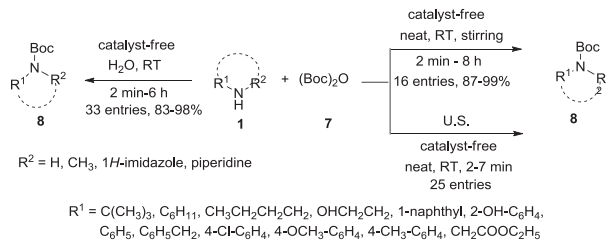
Within this paper, an interesting method of using ultrasound to conduct chemical reactions is utilized. The ultrasound would act as a substitute that is more sustainable and environmentally friendly than organic catalysts. Thus in this paper, Banarjee conducts several experiments with this unique method of organic synthesis. One of these reactions, Banarjee utilizes di-tert-butyl dicarbonate, commonly referred to as a Boc anhydride in order to protect the amine group to which the di-tert-butyl dicarbonate is attached to. Banarjee does this with several different protected amines and notes a respectable seventy-seven and eighty-five percent yield. To study the anion interactions and position within the avidin protein, eight anions needed to be formed; the first part of the procedure to form these anions required the Boc-protection of the amino acid proline. This paper used the procedure outlined in the original paper to perform the Boc-protection of proline, which is why it cited the original paper.
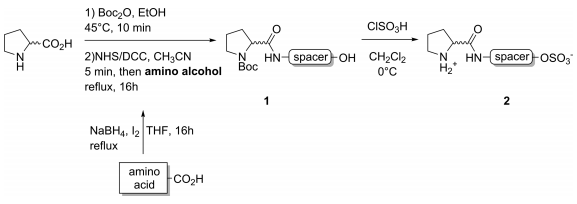
The purpose of this paper is to explore the potential that certain types of catalytic anions have as biohydrid catalysts, active in ionic liquid/aqueous media for an aldol reaction. These biohydrid catalysts will be made in conjunction with avidin, a biotin-binding protein. One of these specific substrates that were made in conjunction with the avidin is a tera-butyl 2-((3-Hydroxypropyl) carbamoyl)pyrrolidine-1-carboxylate was synthesized along with several other tert-butyl derivatives with one equivalent of Boc-proline and one equivalent of N-hydroxysuccinimide. This paper references our original paper when it mentions Amberlyst-15 in a list of catalysts that are used to drive the reaction of the protection of amines with a tert-butoxycarbonyl (Boc) group.
Supporting Paper #3: Gauchot, V.; Schmitzer, A. R. J. Org. Chem 2014, 79, 2694-2701.
Supporting Paper #2: Banarjee, B. Ultrason. Sonochem. 2017, 35, 1-14.