Chapter 6: Isothermal Reactor Design: Molar Flow Rates
Example 6.5: Acid Catalyzed Semibatch Reaction
A → B Acid Catalyzed
The irreversible liquid phase acid catalyzed isomerization reaction
\( A \xrightarrow{H_2SO_4} C \)
is carried out isothermally in a semibatch reactor.
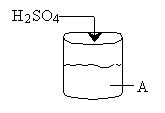
A 2 molar solution of H2SO4 is fed at a constant rate of 5 dm3/min to a reactor that initially contains no sulfuric acid. The initial volume of pure A solution in the reactor is 100 dm3. The concentration of pure A is 10 mol/dm3. The reaction is first order in A and first order in catalyst concentration and the specific reaction rate is 0.05 dm3/mol min–1. The catalyst, of course, is not consumed during the reaction.
a) Write a complete POLYMATH program (line by line in POLYMATH notation) to determine both the number of moles of A and of H2SO4 in the reactor and the concentration of A and of H2SO4 as a function of time. Use the mole balance expressed in terms of NA.
b) Obtain an analytical solution for the number of moles of A, NA and the concentration of A, CA, as a function of time. What is the concentration of A and of H2SO4 after 30 minutes?
Additional Information
\(\int_0^2 \left( \frac{z}{a + bz} \right) dz = \left( \frac{1}{b^2} \right) \left[ bz + a \ln \left( \frac{a}{a + bz} \right) \right] \)
Solution:
(a) POLYMATH Solution
Mole Balance
\(\frac{d(N_A)}{d(t)} = r_A \cdot V \)
\(\frac{d(N_s)}{d(t)} = F_s \)
Rate Law and Stoichiometry
\(r_A = -k \cdot \frac{N_A}{V} \cdot \frac{N_s}{V}\)
\(V = V_0 + v_0 \cdot t\)
Parameters
\(V_0 = 100\)
\(v_0 = 5\)
\(k = 0.05\)
\(F_s = C_{s0} \cdot v_0\)
\(C_{s0} = 2.0\)
Polymath will combine
\(I.C.\) \(t = 0, N_{s0} = 0, N_{A0} = 1000\)
(b) Analytical Solution
A → B
Mole Balance
\(\frac{dN_A}{dt} = r_A \cdot V \) (SS-1)
\(\frac{dN_s}{dt} = F_s \), \(N_s = F_s t \) (SS-2)
Rate Law
\(-r_A = k \cdot C_A \cdot C_S \) (SS-3)
Stoichiometry
\(V = V_0 + v_0 t \) (SS-4)
\(C_A = \frac{N_A}{V} = \frac{N_A}{V_0 + v_0 t} \) (SS-5)
\(C_S = \frac{N_S}{V} = \frac{F_s t}{V_0 + v_0 t} \) (SS-6)
Combine
\(\frac{dN_A}{dt} = -k \cdot \frac{N_A}{V} \cdot \frac{N_S}{V} = -k \cdot N_A \cdot \frac{F_s t}{V_0 + v_0 t} \) (SS-7)
\(- \frac{dN_A}{N_A} = k \cdot F_s \cdot \frac{t}{V_0 + v_0 t} dt \) (SS-8)
Dividing by \(v_0\) and recalling \(t_0 = \frac{V_0}{v_0}\)
\(- \frac{dN_A}{N_A} = k \cdot F_s \cdot \frac{t}{t_0} dt \) (SS-9)
Using the integral
\(\int_{0}^{2} \left( \frac{z}{a + bz} \right) dz = \left( \frac{1}{b^2} \right) \left[ bz + a \ln \left( \frac{a}{a + bz} \right) \right]\) (SS-10)
with \(b = 1 , a = t_0\)
\(t = 0, \ N_A = N_{A0} \)
we obtain
\(\ln \left( \frac{N_A0}{N_A} \right) = \frac{k E_s}{v_0} \left[ it + t_0 \ln \left( \frac{t_0}{t_0 + t} \right) \right] \) (SS-11)
\(N_A = N_{A0} \exp \left( \frac{-k E_s}{v_0} \left[ it + t_0 \ln \left( \frac{t_0}{t_0 + t} \right) \right] \right) \) (SS-12)
Note! If one does not divide by \(v_0\) in Equation (SS-8), then
\(\ln \left( \frac{N_A}{N_A0} \right) = - \frac{k E_s}{v_0} \int_0^t \frac{t}{V_0 + v_0 t} dt \) (SS-13)
Here \(b = v_0\), \(a = V_0\)
The integral becomes
\(\ln \left( \frac{N_A}{N_A0} \right) = - \frac{E_s k}{v_0^2} \left[ v_0 t + V_0 \ln \left( \frac{V_0}{V_0 + v_0 t} \right) \right] \) (SS-14)
Factoring out a \(v_0\) from the term in brackets
\(\ln \left( \frac{N_A}{N_A0} \right) = - \frac{E_s k}{v_0^2} \left[ v_0 t + t_0 \ln \left( \frac{V_0}{V_0 + v_0 t} \right) \right] \) (SS-15)
we see we get the same result as Equation (SS-11).
Evaluate
\(\frac{k E_s}{v_0} = \frac{(0.05)(2 \times 5)}{5} = 0.1 \text{ min}^{-1}\)
\(\tau_0 = \frac{V_0}{v_0} = \frac{100}{5} = 20 \text{ min}\)
\(N_{A0} = 1000 \text{ moles}\)
At \(t = 30\), We substitute into Equation (SS-12)
\(N_A = 1000 \exp \left[ -0.1 \times 30 + 20 \ln \left( \frac{20}{30 + 20} \right) \right]\)
\(N_A = 0.311 \times N_{A0} = 311 \text{ moles}\)
\(C_A = \frac{N_A}{V} = \frac{311}{100 + (30)(5)} = \frac{311}{250} = 1.245 \text{ mol/dm}^3\)
\(F_s = v_0 C_{S0} = 5 \frac{\text{dm}^3}{\text{min}} \times 2 \frac{\text{mol}}{\text{dm}^3} = 10 \frac{\text{mol}}{\text{min}}\)
\(C_S = \frac{N_S}{V} = \frac{F_s t}{V_0 + v_0 t} = \frac{(10)(30)}{100 + (5)(30)} = \frac{300}{250} = 1.2 \text{ mol/dm}^3\)