Chapter 6: Isothermal Reactor Design: Molar Flow Rates
Gas Phase PFR
Problem:
The elementary irreversible gas phase reaction 2A -> B is carried out isothermally with no pressure drop in a PFR.
Given:
\( y_{A0} = 1 \)
\( P_0 = 8.2 \, \text{atm} \)
\( T_0 = 227^\circ C \)
\( v_0 = 25 \, \frac{\text{dm}^3}{\text{s}} \)
\( k = 10 \, \frac{\text{dm}^3}{\text{mol} \cdot \text{s}} \)
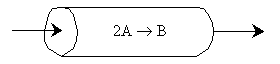
Use measures other than conversion to plot molar flow rates of A and B down the reactor.
Hint 1: What are the mole balances on A and B and the rate law?
mole balances on A ?
(a) $\frac{dF_{A}}{dV} = 2r_{A}$
(b) $\frac{dF_{A}}{dV} = -2r_{A}$
(c) $\frac{dF_{A}}{dV} = -r_{A}$
(d) $\frac{dF_{A}}{dV} = r_{A}$
mole balances on B ?
(a) $\frac{dF_{B}}{dV} = r_{A}$
(b) $\frac{dF_{B}}{dV} = -2r_{A}$
(c) $\frac{dF_{B}}{dV} = \frac{-r_{A}}{2}$
(d) $\frac{dF_{B}}{dV} = \frac{r_{A}}{2}$
rate law ?
Hint 2: What are the concentrations of A and B?
(a) $C_{A} = C_{T0}\frac{F_{A}}{F_{B}}p\frac{T_{0}}{T}$
(b) $C_{A} = C_{T0}\frac{F_{A}}{F_{A}+F_{B}}p\frac{T_{0}}{T}$
Hint 3: What is the rate of formation of B?
(a) $r_{B} = \frac{1}{2}C_{T0}\frac{F_{B}}{F_{T}}p\frac{T_{0}}{T}$
(b) $r_{B} = -2C_{T0}\frac{F_{B}}{F_{T}}p\frac{T_{0}}{T}$
(c) $r_{B} = -\frac{1}{2}C_{T0}\frac{F_{B}}{F_{T}}p\frac{T_{0}}{T}$
Hint 4: What are the combined mole balance, rate law and stoichiometry?
(a) $\frac{dF_{A}}{dV} = k_{A}C_{T0}\frac{F_{A}}{F_{A}+F_{B}}$
(b) $\frac{dF_{A}}{dV} = -k_{A}C_{T0}\frac{F_{A}}{F_{A}+F_{B}}$
Hint 5: What is the polymath program?
Hint 1 - Mole Balances and Rate Law
Mole Balances
\( \frac{dF_A}{dV} = r_A \)
\( \frac{dF_B}{dV} = r_B \)
Rate Law
\( -r_A = k_A C_A^2 \)
Hint 2 - Concentrations
Stoichiometry
\( \nu = \nu_0 \left( \frac{F_T}{F_{T0}} \right) \frac{P_0 T}{P T_0} \)
\( C_A = C_{T0} \frac{F_A}{F_T} \frac{P}{P_0} \frac{T}{T_0} \)
For Isothermal and No DP
\( C_A = C_{T0} \frac{F_A}{F_T} \)
\( C_B = C_{T0} \frac{F_B}{F_T} \)
\( F_T = F_A + F_B \)
Hint 3 - Rate of Formation of B
For \( A + \frac{b}{a} B \rightarrow \frac{c}{a} C + \frac{d}{a} D \)
\( \frac{r_A}{-a} = \frac{r_B}{-b} = \frac{r_C}{c} = \frac{r_D}{d} \)
For \( 2A \rightarrow B \)
\( \frac{r_A}{(-2)} = \frac{r_B}{(1)} \)
\( r_B = \frac{1}{2}(-r_A) = \frac{k_A}{2} C_A^2 \)
Hint 4 - Combined Mole Balances, Rate Law and Stoichiometry
Combine
\( \frac{dF_A}{dV} = -k_A C_A^2 = -k_A C_T^2 \left( \frac{F_A}{F_T} \right)^2 \)
\( \frac{dF_B}{dV} = \frac{1}{2} k_A C_A^2 = \frac{k_A}{2} C_T^2 \left( \frac{F_A}{F_T} \right)^2 \)
\( F_T = F_A + F_B \)
\( C_T^0 = \left( \frac{8.4 \, \text{atm}}{0.082 \, \text{atm dm}^{-3} \, \text{mol}^{-1} \, \text{k}^{-1}} \right) \cdot 500 \, \text{K} = 0.2 \, \text{mol/dm}^3 \)
Hint 5 - Polymath Code
[Note: To=227C=500K]
\( k_A = 10 \, \frac{\text{dm}^3}{\text{mol} \cdot \text{s}} \)
\( V = 0 \quad F_A = F_{A0} \quad F_B = 0 \)
\( V_f = 100 \, \text{dm}^3 \)
Use Polymath to solve
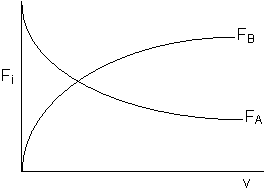
One can back calculate X
\( X = \frac{F_{A0} - F_A}{F_{A0}} \)
See the Polymath Solution Below
|
POLYMATH 5.0 Results |
|
01-19-2001 |
|
Calculated values of the DEQ variables |
| Variable | Initial Value | Minimal Value | Maximal Value | Final Value |
| V | 0 | 0 | 25 | 25 |
| Fa | 5 | 1.0026274 | 5 | 1.0026274 |
| Fb | 0 | 0 | 1.9986863 | 1.9986863 |
| Cto | 0.2 | 0.2 | 0.2 | 0.2 |
| ka | 10 | 10 | 10 | 10 |
| Ft | 5 | 3.0013137 | 5 | 3.0013137 |
| x | 0 | 0 | 0.7994745 | 0.7994745 |
ODE Report (RKF45)
Differential equations as entered by the user:
[1] d(Fa)/d(V) = -ka*Cto^2*(Fa/Ft)^2
[2] d(Fb)/d(V) = 0.5*ka*Cto^2*(Fa/Ft)^2
Explicit equations as entered by the user:
[1] Cto = 0.2
[2] ka = 10
[3] Ft = Fa + Fb
[4] x = (5 - Fa)/5
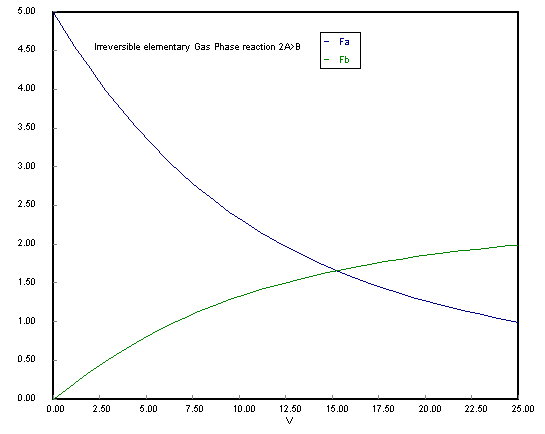
Full Solution
Mole Balances
\( \frac{dF_A}{dV} = r_A \)
\( \frac{dF_B}{dV} = r_B \)
Rate Law
\( -r_A = k_A C_A^2 \)
Stoichiometry
\( \nu = \nu_0 \left( \frac{F_T}{F_{T0}} \right) \frac{P_0 T}{P T_0} \)
\( C_A = C_{T0} \frac{F_A P}{F_T P_0 T_0 T} \)
For \(A + \frac{b}{a} B \rightarrow \frac{c}{a} C + \frac{d}{a} D\)
\( -r_A = -r_B = r_C = r_D \)
\( \frac{-r_A}{a} = \frac{-r_B}{b} = \frac{r_C}{c} = \frac{r_D}{d} \)
For 2A->B
\( \frac{-r_A}{(2)} = \frac{r_B}{(1)} \)
\( r_B = \frac{1}{2} (-r_A) = \frac{k_A}{2} C_A^2 \)
For Isothermal and No DP
\( C_A = C_{T0} \frac{F_A}{F_T} \)
\( C_B = C_{T0} \frac{F_B}{F_T} \)
\( F_T = F_A + F_B \)
Combine
\( \frac{dF_A}{dV} = -k_A C_A^2 = -k_A C_{T0} \left( \frac{F_A}{F_T} \right)^2 \)
\( \frac{dF_B}{dV} = \frac{1}{2} k_A C_A^2 = \frac{k_A}{2} C_{T0} \left( \frac{F_A}{F_T} \right)^2 \)
\( F_T = F_A + F_B \)
\( C_{T0} = \left( \frac{8.4 \, \text{atm}}{0.082 \, \text{atm} \, \text{dm}^3 \, \text{mol} \cdot \text{k}} \right) \frac{1}{500 \, \text{K}} = 0.2 \, \text{mol/dm}^3 \)
[Note: \( T_0 = 227^\circ \text{C} = 500K \)]
\( k_A = 10 \, \frac{\text{dm}^3}{\text{mol} \cdot \text{s}} \)
\( V = 0 \)
\( F_A = F_{A0} \)
\( F_B = 0 \)
\( V_f = 100 \, \text{dm}^3 \)
Use Polymath to solve
One can back calculate X
\( X = \frac{F_{A0} - F_A}{F_{A0}} \)
See the Polymath Solution Below
|
POLYMATH 5.0 Results |
|
01-19-2001 |
|
Calculated values of the DEQ variables |
| Variable | Initial Value | Minimal Value | Maximal Value | Final Value |
| V | 0 | 0 | 25 | 25 |
| Fa | 5 | 1.0026274 | 5 | 1.0026274 |
| Fb | 0 | 0 | 1.9986863 | 1.9986863 |
| Cto | 0.2 | 0.2 | 0.2 | 0.2 |
| ka | 10 | 10 | 10 | 10 |
| Ft | 5 | 3.0013137 | 5 | 3.0013137 |
| x | 0 | 0 | 0.7994745 | 0.7994745 |
ODE Report (RKF45)
Differential equations as entered by the user:
[1] d(Fa)/d(V) = -ka*Cto^2*(Fa/Ft)^2
[2] d(Fb)/d(V) = 0.5*ka*Cto^2*(Fa/Ft)^2
Explicit equations as entered by the user:
[1] Cto = 0.2
[2] ka = 10
[3] Ft = Fa + Fb
[4] x = (5 - Fa)/5