Parsimonious model.
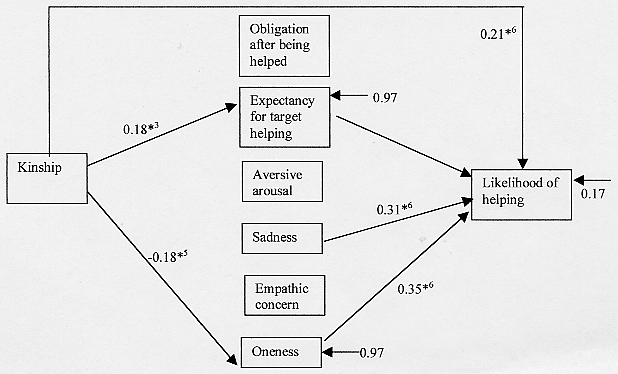
The baseline model, in which several of the error terms were allowed to covary based on hypothesized relationships between item errors, had a very good fit to the data (see Tables 5 and 6). The relationships between the following error terms remained constrained at 0; sadness and expectancy for target helping, sadness and indebtedness, aversive arousal and expectancy for target helping, oneness and indebtedness, empathy and indebtedness, and expectancy for target helping and indebtedness. Nonsignificant paths were eliminated from this model to create a more parsimonious model (see Figure 5). The parsimonious model also had a very good fit, the chi-square value was not statistically significant, and the fit did not significantly differ from the baseline model with fewer constraints (all gammas and betas freed). The path coefficients in the parsimonious model showed no substantive differences from the results of the baseline model. Kinship, empathic concern, oneness, and reciprocity (as indicated by expectancy) respectively accounted for 5%, 10%, 12%, and 56% of the variance in the likelihood of helping in this model.
Figure 5. Parsimonious model with standardized coefficients
Table 6. Structural coefficients for the parsimonious mediational model with covaried error terms
| Kinship on expectation | 0.50 | 0.12 | 0.37 | 4.15 | < .00001
| Kinship on oneness | -0.40 | 0.10 | 0.37 | -4.19 | < .00001
| Kinship on likelihood of helping | 0.57 | 0.19 | 0.43 | 6.07 | < .000001
| Expectation on likelihood of helping | 0.75 | 0.03 | 2.27 | 24.85 | < .000001
| Empathic concern on likelihood of helpingXXXX | 0.32 | 0.04 | 0.65 | 7.41 | <. 000001
| Oneness on likelihood of helping | 0.44 | 0.05 | 0.75 | 8.24 | < .000001 | |