Testing Alternative Models
Although it is difficult to improve upon the fit of the parsimonious model, there is a possibility that alternative models would fit equally well. Alternative arrangements based on the previously hypothesized models of other research groups were imposed on the data to test for this possibility. Because some of these constructions were not nested models, direct comparisons of fit via differences in chi-square could not be made. However, the correspondence of each model with the data can be examined and compared using several other indicators of the goodness of fit. The same pattern of covariance between error terms was retained for these models.
The first alternative model was based on Batson�s empathy-altruism hypothesis (see Figure 1). This model used oneness as a proxy for perspective taking, but otherwise used the previously tested measured variables in the framework specified by Batson et al. (1997). In this conceptualization, kinship produces feelings of oneness, which produces sadness, aversive arousal and empathic concern. Sadness, aversive arousal, and empathic concern in turn, have an impact helping. The effect of kinship as mediated by the reciprocal altruism indicators was also included in this model for comparison purposes, although Batson et al. (1997) do not mention reciprocal altruism. The fit of this model can be seen under �Batson�s 1: O. --> E.C.� in Table 6. This model did not fit as well as the parsimonious model (see Table 6). The c2/d.f. (where a smaller ration indicates a better fit) was 26.033 for Batson�s model 1 and .985 for the parsimonious model. The Goodnesss of Fit Index, Normed Fit Index, and Incremental Fit Index (where larger values indicate a better fit) were .80, .49, .50 for Batson�s model 1 and .99, .99, 1.00 for the parsimonious model, respectively. Other indicators of fit, such as the critical sample size (CN), also indicated a better fit for the model hypothesized in this study.
Another model of Batson et al.�s (1997) framework was also used, due to the ambiguity about the equivalence of perspective taking and oneness. This model is equivalent to the baseline model without the influence of oneness on helping or the direct effect of kinship. Because this is a nested model, it can be directly compared to the parsimonious model. As can be seen under ''Batson�s 2'' in Table 6, this model did not fit as well as the parsimonious model, Change in Chi-Square(5)= 61.31, p < .001. This figure is especially striking, because the parsimonious model constrains more parameters, the expected change in Chi-square would be in the opposite direction.
Table 7. Goodness of fit indicators for tested models
| ModelXXXXXXXXXXXXX | Chi-SquareXXX | d.f.XXX | Chi-Square/d.f.XXX | RMSEAXXX | SRMRXXX | GFIXXX | NFIXXX | IFIXXX | CNXXXX |
| CFA with no factorial complexity | 808.70 | 247 | 3.3 | 0.072 | 0.060 | 0.87 | 0.91 | 0.94 | 169.29 |
| CFA with some factorial complexity | 634.57 | 240 | 2.6 | 0.061 | 0.040 | 0.90 | 0.93 | 0.95 | 204.31 |
| (improved fit with factorial complexity) | Delta Chi-square(7) = 174.13, p < .00001 |
| ModelXXXXXXXXXXXXXXXXX | Chi-SquareXXX | d.f.XXX | Chi-Square/d.f.XXX | RMSEAXXX | SRMRXXX | GFIXXX | NFIXXX | IFIXXX | CNXXXX |
| Baseline model with no covaried error | 562.58 | 15 | 37.5 | 0.29 | 0.20 | 0.76 | 0.43 | 0.44 | 23.55 |
| Baseline model, error terms covary | 4.16 | 6 | 0.7 | 0.0 | 0.022 | 1.00 | 1.00 | 1.00 | 1799.30 |
| (improved fit with correlated error) | Delta Chi-square(9) = 558.42, p < .00001 |
| ModelXXXXXXXXXXXXXXXXX | Chi-SquareXXX | d.f.XXX | Chi-Square/d.f.XXX | RMSEAXXX | SRMRXXX | GFIXXX | NFIXXX | IFIXXX | CNXXXX |
| Parsimonious model | 12.81 | 13 | 1.0 | 0.0 | 0.024 | 0.99 | 0.99 | 1.00 | 954.01 |
| (does not differ from baseline) | Delta Chi-square(5) = 8.65, p > .10 |
| ModelXXXXXXXXXXXXXXXXX | Chi-SquareXXX | d.f.XXX | Chi-Square/d.f.XXX | RMSEAXXX | SRMRXXX | GFIXXX | NFIXXX | IFIXXX | CNXXXX |
| Batson�s 1: O �C | 442.57 | 17 | 26.0 | 0.24 | 0.18 | 0.80 | 0.49 | 0.50 | 28.51 |
| Batson�s 2: w/o oneness, kinship | 74.14 | 8 | 9.3 | 0.14 | 0.082 | 0.96 | 0.92 | 0.93 | 105.82 |
| (parsimonious model has better fit) Delta Chi-square (5) = 61.31, p < .001 |
| ModelXXXXXXXXXXXXXXXXX | Chi-SquareXXX | d.f.XXX | Chi-Square/d.f.XXX | RMSEAXXX | SRMRXXX | GFIXXX | NFIXXX | IFIXXX | CNXXXX |
| Cialdini�s conception | 49.74 | 7 | 7.1 | 0.12 | 0.077 | 0.97 | 0.95 | 0.96 | 156.37 |
| (parsimonious model has better fit) Delta Chi-square (1) = 36.93, p < .001 |
| ModelXXXXXXXXXXXXXXXXX | Chi-SquareXXX | d.f.XXX | Chi-Square/d.f.XXX | RMSEAXXX | SRMRXXX | GFIXXX | NFIXXX | IFIXXX | CNXXXX |
| Multistage model 1: O. E.C. | 54.11 | 14 | 3.9 | 0.081 | 0.055 | 0.97 | 0.95 | 0.96 | 232.28 |
| Multistage model 2: E.C. O. | 63.41 | 14 | 4.5 | 0.088 | 0.055 | 0.97 | 0.94 | 0.95 | 203.67 |
| Parsimonious model with gender effects | 28.66 | 23 | 1.2 | 0.024 | 0.039 | 0.99 | 0.97 | 0.99 | 621.65 |
A model based on Cialdini et al.�s (1997) conceptualization and results contained the egoistic influences on helping (oneness, sadness, aversive arousal), but did not include the effect of empathy. This model also included the direct effect of kinship because Cialdini et al.�s (1997) model contained a direct effect of relationship closeness (between a near-stranger, an acquaintance, a good friend, and a family member). Indicators of reciprocal altruism were also included in this model, although Cialdini et al. (1997) did not mention this type of influence. This nested model had a significantly worse fit than the parsimonious model, Delta Chi-square(1) = 36.93, p < .001. Again, this figure is striking, because the parsimonious model contains one more constrained parameter, the expected change in Chi-Square would be in the opposite direction. Also, this is a very liberal comparison, because an indicator of reciprocal altruism was the strongest predictor of the likelihood of helping. Variations of Cialdini et al.�s (1997) and Batson et al.�s (1997) models would fit significantly worse no matter what the arrangement of the cognitive mediators, if the effects of expectancy, a construct related to reciprocal altruism, were not included. For example, discounting the effect of expectancy for target helping in Cialdini�s conceptualization resulted in a Delta Chi-square(1) of 213.45, p < .00001.
In addition to the models based on previously supported conceptual frameworks, alternative models based on multi-stage mediational pathways were also tested. Both the baseline and parsimonious models contained a simple, one stage mediation of the effects of kinship. One possible complex mediational pathway specifies kinship impacting directly on aversive arousal, oneness, indebtedness, likelihood that the target would help if positions were reversed, and also directly on the likelihood of helping. Aversive arousal influences sadness, which influences empathy, which influences the likelihood of helping. Oneness also influences empathy and the likelihood of helping, as well as indebtedness and the likelihood that the target would help if positions were reversed. These reciprocal altruism indicators (indebtedness and the likelihood that the target would help if positions were reversed) also have an impact on helping. Although this complex, multistage model allowed for more pathways between the mediators, it still did not fit as well as the parsimonious model (see �Multistage model 1: O. --> E.C.� in Table 6). A similar complex, multistage model reversing the positions of oneness and empathic concern did not fit as well as the previous model (see �Multistage model 2: E.C --> O.� in Table 6). This model is also inferior to the parsimonious model as an accurate representation of the data.
Testing the effects of respondent gender and target gender.
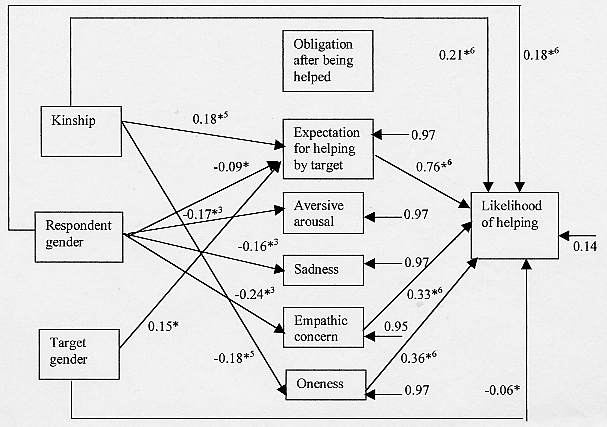
The gender of the respondent was found to have a significant impact on sadness, aversive arousal, and empathy (see Table 7 and Figure 6). Female respondents felt significantly more sadness, aversive arousal, and empathy for the character in the scenario. Post-hoc analysis revealed that females also experienced a higher degree of involvement with the scenario,t(438) = 3.75 , p < .001. Respondent gender also had a significant direct effect on the likelihood of helping, where males were more likely to help. These results indicate a complex pattern, where females have a stronger empathy-mediated pathway boosting helping intentions, z = -3.69, p < .0002, although when this is combined with the direct effect of gender on helping, the total effect of gender on helping intentions is non-significant, z = 0.82, p = .21.
Figure 6. Standardized structural coefficients for the parsimonious mediational model including gender effects
The gender of the target in the scenario had a significant direct effect on the likelihood of helping, female targets were more likely to receive help. Including respondent gender and target gender in the model did not alter any of the previously established effects. The parsimonious model including gender effects accounted for 86% of the variance in the likelihood of helping, an increase of 3%. Figures for the percentage of variance accounted for by this model differ slightly from the model that does not include gender effects. The values for the model including gender effects will be considered the results of the final analysis. The effect of empathic concern, explaining 11% of the variance in the likelihood of helping, was slightly weaker than the effect of oneness, accounting for 13% of the variance in the likelihood of helping. This difference was statistically significant, Delta Chi-square(1)=15.09, p < .001.
Table 8. Structural coefficients for the parsimonious mediational model including gender effects
| Kinship on expectancy | 0.50 XXX | 0.12XXX | 0.37XXX | 4.15XXX | < .00001
| Kinship on oneness | -0.40 | 0.10 | 0.37 | -4.13 | < .00001
| Kinship on likelihood of helping | 0.57 | 0.09 | 0.43 | 6.14 | < .000001
| Respondent gender on sadness | -0.61 | 0.18 | 0.32 | -3.44 | < .0006
| Respondent gender on aversive arousal | -0.64 | 0.17 | 0.35 | -3.69 | < .0002
| Respondent gender on empathy | -0.64 | 0.12 | 0.49 | -5.34 | < .0006
| Respondent gender on expectancy | -0.27 | 0.13 | 0.18 | -2.11 | < .018
| Respondent gender on likelihood of helpingXX< | 0.54 | 0.10 | 0.37 | 5.39 | < .000001
| Target gender on expectancy | 0.37 | 0.10 | 0.30 | 3.66 | < .0002
| Target gender on likelihood of helping | -0.16 | 0.07 | 0.12 | -2.18 | < .015
| Expectancy on likelihood of helping | 0.76 | 0.03 | 2.34 | 25.71 | < .000001
| Empathic concern on likelihood of helping | 0.35 | 0.04 | 0.70 | 7.85 | <. 000001
| Oneness on likelihood of helping | 0.45 | 0.05 | 0.77 | 8.32 | < .000001 | |