Ellis Subsurface Engineering Lab · University of Michigan

Engineering the subsurface
for a sustainable future

Our research bridges geoscience and environmental engineering to decarbonize energy systems — from locking CO₂ safely underground to unlocking clean geologic hydrogen. We build the physical and chemical understanding needed for a net-zero world.

Brian R. Ellis

Brian R. Ellis

Associate Professor & Division Chair, Environmental and Water Resources Engineering

Department of Civil & Environmental Engineering · University of Michigan, Ann Arbor

My research focuses on engineered subsurface systems including geologic carbon storage, geothermal energy production, geologic hydrogen, biomineralization-based permeability control, and water quality in the context of energy development. I received my Ph.D. from Princeton University in 2012 and first joined Michigan as a Michigan Society of Fellows Postdoctoral Scholar and then as a tenure-track faculty member in 2014. I am an NSF CAREER awardee, co-Director of the U-M MI Hydrogen Initiative, and currently serve as Division Chair for Environmental and Water Resources Engineering.

Carbon Capture & Storage Subsurface Energy Systems Biomineralization CO₂ Utilization in Concrete Hydraulic Fracturing & Water Quality Geologic Hydrogen

Education

2012

Ph.D., Civil & Environmental Engineering

Princeton University

Advisor: Dr. Catherine A. Peters · Thesis: Geologic Carbon Sequestration in Deep Saline Aquifers: Brine Acidification and Geochemical Alterations of Reactive Leakage Pathways

2009

M.A., Civil & Environmental Engineering

Princeton University

2006

B.S. with High Distinction, Geological Sciences (Honors)

University of Michigan, Ann Arbor

2006

B.S. with High Distinction, Economics

University of Michigan, Ann Arbor

Awards & Honors

2020
NSF Early CAREER Award
2019
CEE Faculty Excellence Award, University of Michigan College of Engineering
2018
National Academy of Engineering US Frontiers of Engineering Symposium
2015
ASCE ExCEED Fellowship
2015
Doctoral New Investigator Award, ACS Petroleum Research Fund
2014
National Academies of Science, Arab American Frontiers (invited speaker)
2012
NSF Science, Engineering & Education for Sustainability (SEES) Fellow
2012
Junior Fellow, Michigan Society of Fellows
2010
Freeman Fellowship, American Society of Civil Engineers
2009
NSF-AEESP Grand Challenge Student Paper Award
52+
Peer-Reviewed Publications
$6M+
Research Funding
8
Ph.D. Graduates
6
Active Research Themes

Lab Highlights

New Publication

January 2026

Clay content mediates microbial mineralization in sandstones

A new study from the Ellis lab shows that clay minerals play a previously underappreciated role in controlling how suspended Sporosarcina pasteurii bacteria drive calcite precipitation in porous rock — with direct implications for biogrouting and CO₂ storage site integrity.

Read in Water Resources Research →
Press Spotlight

December 2025

CEE Spotlight features Ellis lab CO₂ storage research

The Michigan College of Engineering's CEE spotlight highlighted our work on carbon-negative subsurface energy systems, including geologic carbon sequestration and CO₂-enabled geothermal power generation — research with potential to decarbonize the energy sector at scale.

Visit CEE News →
Pilot Scale Result

2025

CO₂ curing of bendable concrete validated at pilot scale

A multi-institution team including the Ellis lab demonstrated pilot-scale carbonation curing of Engineered Cementitious Composite (ECC) railroad ties — showing that CO₂ can simultaneously strengthen concrete and be permanently sequestered in infrastructure materials.

Read in Journal of Cleaner Production →
Leadership

Ongoing

Co-directing the U-M MI Hydrogen Initiative

Ellis serves as co-Director of the University of Michigan MI Hydrogen Initiative, a university-wide effort to advance geologic and clean hydrogen research — positioning Michigan as a national hub for hydrogen energy science and policy.

Learn about MI Hydrogen →

Research Areas

Carbon Negative Subsurface Energy

Carbon-Negative Subsurface Energy

Meeting climate targets requires not just reducing emissions but actively removing CO₂ from the atmosphere. We develop subsurface energy technologies that achieve net-negative emissions — including geologic carbon sequestration in deep saline aquifers, CO₂ mineral trapping in fractured basalts, and CO₂-enabled geothermal power generation.

🏆 NSF CAREER Award · Sloan Foundation
CO₂ utilization in cementitious composites

CO₂ Utilization in Infrastructure

What if concrete could remove carbon while becoming stronger? We harness CO₂ as a reactive curing agent for Engineered Cementitious Composites (ECC) — producing tougher, more durable infrastructure materials while permanently sequestering carbon. Pilot-scale validation of bendable concrete railroad ties has demonstrated industrial feasibility.

🏭 DOE-NETL · Pilot Scale Validated
Biomineralization in porous media

Biomineralization in Porous Media

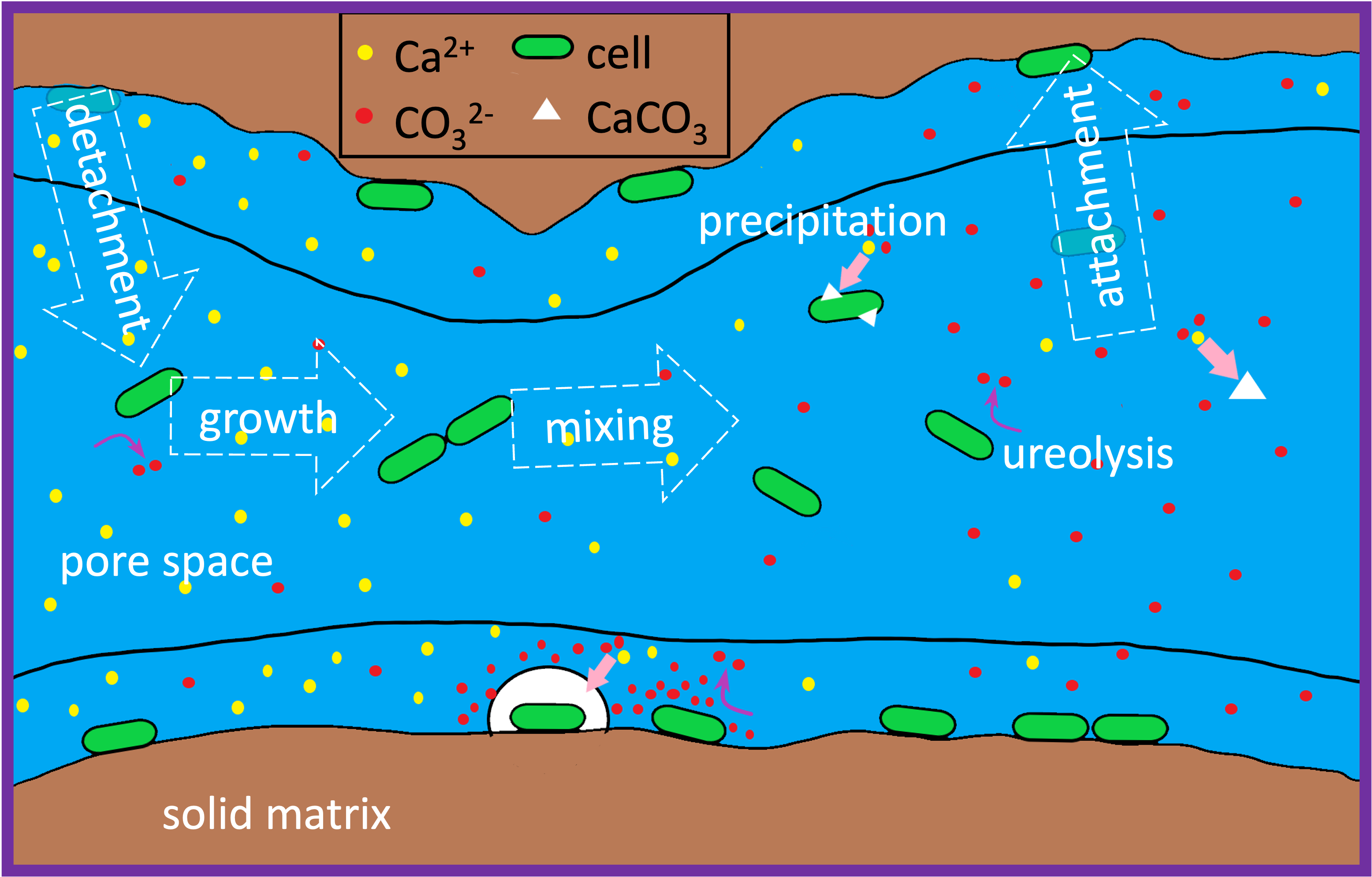
Microbes can seal fractures, reinforce soils, and control fluid flow underground — if we understand them well enough. We investigate microbially-induced calcite precipitation (MICP) for controlled permeability modification in subsurface systems, combining synchrotron X-ray imaging, reactive transport modeling, and microfluidic rock experiments.

🔬 Synchrotron Imaging · Pore-Scale Models
Energy-Water Nexus & Shale Gas

Energy-Water Nexus & Shale Gas

Energy development places enormous pressure on water resources. We examine water quality impacts of unconventional energy development — including mobilization of radionuclides and trace metals during hydraulic fracturing — and develop sustainable wastewater management strategies for produced water from oil and gas operations.

💧 Hydraulic Fracturing · Produced Water Management
Geologic hydrogen production

Geologic Hydrogen

The earth's mantle produces hydrogen through serpentinization — a natural rock-water reaction that offers a potentially vast, clean fuel source. We investigate stimulated production of geologic hydrogen, including the subsurface chemistry, flow dynamics, and engineering controls needed to harness this resource. Ellis co-directs the U-M MI Hydrogen Initiative.

⚡ U-M MI Hydrogen Initiative
Materials Imaging & Characterization

Materials Imaging & Characterization

Understanding how minerals, pores, and reactive fluids interact at the microscale requires advanced imaging and quantitative analysis. We apply synchrotron X-ray tomography, micro-CT, and image processing to characterize evolving pore structures, mineral distributions, and reaction fronts in rocks and engineered materials — linking pore-scale observations to continuum-scale behavior.

🔬 Synchrotron X-ray · Micro-CT · Pore-Scale Analysis

Selected Publications

2026

Clay content mediates the contribution of suspended Sporosarcina Pasteurii to Microbial Mineralization in Sandstones

Albalghiti, E.M., Ellis, B.R.

Water Resources Research, 62, e2025WR040790

Key finding: Clay minerals are a critical — and previously overlooked — regulator of how suspended bacteria drive calcite precipitation in porous rock, with major implications for engineered biogrouting and CO₂ storage site integrity.

BiomineralizationWater Resources
2025

Pilot-scale validation of CO₂ utilization for greener and tougher infrastructure through carbonation curing of bendable concrete

Zhang, D., Feng, B., Jaworska, B., Ellis, B.R., Fancy, S., Sick, V., Li, V.C.

Journal of Cleaner Production, 491, 144845

Key finding: CO₂ curing of ECC concrete railroad ties at pilot scale simultaneously increases flexural strength and permanently mineralizes carbon — a validated industrial pathway to carbon-negative construction materials.

CO₂ UtilizationPilot Scale
2025

Wellbore Integrity in Energy Applications: Precipitation Products After Reaction with Produced Water from the Permian Basin

Perea, E.J., Driovinto, T.Q.C., Ellis, B.R., Spilde, M., Peterson, E.J., et al.

Environmental Engineering Science, 42 (10), 434–444

Wellbore Integrity
2024

Hydrodynamic limitations of biomineralization-induced permeability reduction

Albalghiti, E.M., Ellis, B.R.

ACS Earth and Space Chemistry, 8 (3), 575–585

Key finding: Fluid velocity sets a fundamental ceiling on how much pore-clogging bacteria can achieve — identifying a key design constraint for any application using microbes to seal subsurface formations.

Biomineralization
2024

Life cycle greenhouse gas emissions of CO₂-enabled sedimentary basin geothermal

Liu, L., Miranda, M.M., Bielicki, J.M., Ellis, B.R., Johnson, J.X.

Environmental Science and Technology, 58 (4), 1882–1893

GeothermalLCA
2024

Microwave-based CO₂ desorption for enhanced direct air capture: Experimental validation and techno-economic perspectives

Lim, T.H., Foster, J.E., Ellis, B.R., Skerlos, S.J.

Environmental Research Letters, 19, 034002

Direct Air Capture
2023

The promise of coupling geologic CO₂ storage with sedimentary basin geothermal power generation

Bielicki, J.M., Leveni, M., Johnson, J.X., Ellis, B.R.

iScience, 26 (2), 105618

Key finding: Pairing geologic CO₂ storage with geothermal power generation can produce electricity with strongly negative lifecycle emissions — turning a carbon disposal problem into an energy asset.

GeothermalCCS
2023

Persistent homology as a heterogeneity metric for predicting pore size change in dissolving carbonates

Thompson, E.P., Ellis, B.R.

Water Resources Research, 59 (9), e2023WR034559

DOI →
Porous MediaImage Analysis
2021

Reducing user bias in X-ray computed tomography-derived rock parameters through image filtering

Thompson, E.P., Tomenchok, K., Olson, T., Ellis, B.R.

Transport in Porous Media, 140, 493–509

Key finding: Systematic image filtering of micro-CT data substantially reduces operator-dependent variability in computed rock properties such as porosity and permeability — a critical methodological advance for reproducible pore-scale characterization.

DOI →
Micro-CTImage Analysis
2018

Permanent CO₂ trapping through localized and chemical gradient-driven basalt carbonation

Menefee, A.H., Giammar, D.E., Ellis, B.R.

Environmental Science & Technology, 52 (15), 8954–8964

Key finding: Post-reaction micro-CT and SEM characterization revealed that carbonates preferentially nucleate in diffusion-limited vesicles and dead-end fractures in basalt — demonstrating how chemical gradients drive localized, permanent CO₂ mineral trapping.

DOI →
Basalt CarbonationMaterials Characterization
2017

Forensic estimates of lead release from lead service lines during the water crisis in Flint, Michigan

Olson, T.M., Wax, M., Yonts, J., Heidecorn, K., Haig, S.J., Yeoman, D., Hayes, Z., Raskin, L., Ellis, B.R.

Environmental Science and Technology Letters, 4, 356–361

Key finding: Forensic analysis revealed that lead service lines released orders of magnitude more lead during Flint's water crisis than prior estimates — findings that shaped the federal response and future lead pipe replacement policy.

High ImpactWater Quality
2016

3D calcite mapping and a demonstration of its relevance to permeability evolution in reactive fractures

Ellis, B.R., Peters, C.A.

Advances in Water Resources, 95, 246–253

DOI →
Carbon SequestrationX-ray Imaging
2013

Dissolution-driven permeability reduction of a fractured carbonate caprock

Ellis, B.R., Fitts, J.P., Bromhal, G.S., McIntyre, D.L., Tappero, R., Peters, C.A.

Environmental Engineering Science, 30 (4), 187–193 (Featured Article)

Key finding: CO₂-acidified brine dissolves carbonate caprocks along fractures, but re-precipitation of dissolution products can partially re-seal pathways — a surprising self-healing mechanism with implications for long-term storage security.

Featured ArticleCarbon Storage

Full list of 52 peer-reviewed publications on Google Scholar.

People in the Ellis Lab

Current Team

Eva Albalghiti🔬

Eva Albalghiti

Postdoctoral Researcher

AI-assisted GeoH2 Prospect Mapping

2026 – present

🔗 LinkedIn
Phillip Chacon🎓

Phillip Chacon

Ph.D. Candidate

Engineered Production of Geological Hydrogen

Expected 2028

🔗 LinkedIn
Seohyun Kim🎓

Seohyun Kim

Ph.D. Student

Subsurface Geochemistry

Expected 2029

🔗 LinkedIn
Martin Tan📚

Martin Tan

M.S.E. Student

Underground Hydrogen Storage Leakage Risk Assessment

2025 – present

🔗 LinkedIn

Alumni & Past Students

Ph.D. — Primary Advisor

Eva Albalghiti🎓

Eva Albalghiti · 2026

Ph.D., Microbially-enabled Approaches to Subsurface Engineering

LinkedIn
Ellen Thompson🎓

Ellen Thompson · 2023

Assistant Professor, Iron Range Engineering (MN State Univ.)

LinkedIn
Anne Menefee🎓

Anne Menefee · 2020

Assistant Professor, Penn State University

LinkedIn
Jubilee Adeoye🎓

Jubilee Adeoye · 2019

Analyst & Management Consultant, Strategy& (PwC)

LinkedIn

Ph.D. — Co-Advisor

Wei-Hsiu Hu🎓

Wei-Hsiu Hu · 2023

Assistant Professor, National Taiwan University

NTU Profile  ·  Google Scholar
Tae Lim🎓

Tae Lim · 2021

Staff Scientist, Lawrence Berkeley National Lab

LinkedIn
Ivan Jayawan🎓

Ivan Jayawan · 2019

Director of Engineering, PT. Duta Wahana Sentosa

LinkedIn
Wenjia Fan🎓

Wenjia Fan · 2018

Scientific Illustrator, W. Design Studio

LinkedIn

Postdoctoral Alumni

Saikat Das🎓

Saikat Das · 2016–2019

Thin Films Module Engineer, Intel Corporation

LinkedIn
Duo Zhang🎓

Duo Zhang · 2017–2019

Full Professor, Wuhan University

LinkedIn

M.S.E. — Advised

Dengfeng Qin· 2021 Patrick West· 2021 Rafael Herrera· 2020 Kira Tomenchok· 2020 Ellen Thompson· 2019 Zixian Wang· 2018 Minmeng Tang· 2016 Peiyuan Li· 2016 Letian Zhou· 2015 Qi Zhang· 2013 Vidya Ramalingam· 2013

M.S.E. — Co-Advised

Lu Chen· 2016 Hui Zhang· 2015 Tianshu Zhang· 2013

Undergraduate Researchers

Amelia Francisco· 2023–2025 Alexander Thompson· 2023–2025 Aparna Krishnamurthy· 2024 Alberto Navarro Garre· 2018 Yuecheng Liu· 2016–2017 Leyi Yin· 2016–2017 Cameron Beversluis· 2016–2017 Alessandra Murphy· 2016–2017 Megan Bushlow· 2015 Maria DeMuri· 2013–2016 Marie St. Peter· 2013–2016

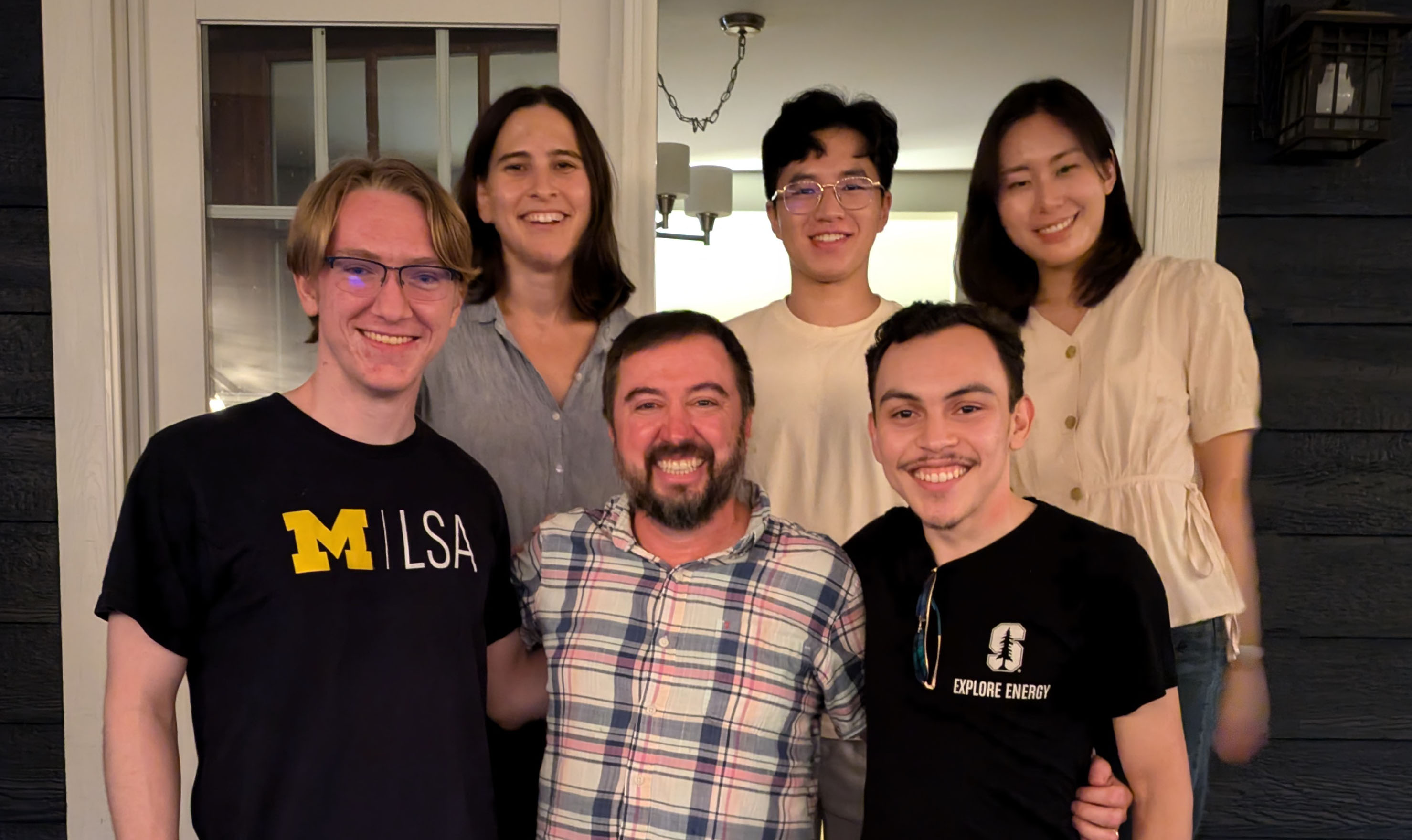
Lab Group Photos Over the Years

Ellis Research Group, Fall 2018
Fall 2018 — Ellis Research Group
Ellis Research Group, Fall 2025
Fall 2025 — Ellis Research Group
Ellis Research Group BBQ, 2017
2017 — Group BBQ
Ellis Research Group, Winter 2023
Winter 2023 — Ellis Research Group

Press & Invited Talks

Press & Media

📰

CEE Spotlight: Carbon-Negative Subsurface Energy Research

Michigan College of Engineering · December 2025

📺

Pilot-scale CO₂ concrete curing covered by clean energy press

Coverage of Journal of Cleaner Production paper · 2025

📰

Flint Water Crisis lead contamination research cited in national policy

Widely covered in national media & cited in EPA rulemaking · 2017

🌐

University of Michigan MI Hydrogen Initiative Launch

U-M Research News · Ongoing

Selected Invited Lectures & Panels

🏛

US Frontiers of Engineering Symposium

National Academy of Engineering · 2018

🌍

Arab American Frontiers Symposium (Invited Speaker)

National Academies of Science · 2014

🎓

ASCE ExCEED Teaching Fellowship

American Society of Civil Engineers · 2015

📋

For a complete list of presentations and invited talks, see the full CV

Download CV (PDF) →

Contact & CV

I welcome inquiries from prospective graduate students, postdoctoral researchers, and collaborators interested in subsurface energy systems, carbon management, or environmental engineering. The best way to reach me is by email — please include a brief description of your background and research interests.

🏛
Department of Civil & Environmental Engineering
2350 Hayward St., Ann Arbor, MI 48109

Curriculum Vitae

Full details on education, appointments, funded research, teaching, and student mentoring.

Ph.D., Princeton University (2012)  ·  B.S., University of Michigan (2006)
$6M+ in research funding  ·  52 peer-reviewed publications