Chapter 13: Unsteady State Nonisothermal Reactor Design
Topics
Batch Systems with Heat Effects summary-example
TopBalance on a system volume that is well-mixed:
\( \dot{Q} - W_S + \dot{i}_A V | \Delta H_R | T_i | = \sum_{i,o} i H_i - H_{i,o} + \sum_{N_i} C_{P_i} \frac{dT}{dt} \)
\( \dot{Q} - W_S - F_{A0} \sum \theta_i C_{P_i} | T - T_o | + \dot{i}_A V | \Delta H_R | T_i | = \sum_{N_i} C_{P_i} \frac{dT}{dt} \)
Adiabatic batch reactor with no work: \( T = T_o + \frac{X | \Delta H_R | T_o |}{\sum \theta_i
C_{P_i} + X \Delta C_P} \)
Polymath
The following reaction occurs in a batch reactor:
\( A + B \rightleftharpoons 2C \)
1) \( \frac{dT}{dt} = \frac{(r_A V)(\Delta H_E(T)) + U A (T_1 - T)}{N_{Ao} \left( \sum \theta_i C_i^n + \Delta C_P X \right)} \)
2) \( \frac{dX}{dt} = \frac{-r_A V}{N_{Ao}} \)
3) \( -r_A = -k \left[ C_A C_B - \frac{C_C^2}{K_C} \right] \)
4) \( k = k_1 \exp \left( \frac{E}{R} \left( \frac{1}{T_1} - \frac{1}{T} \right) \right) \)
5) \( K_C = K_{C2} \exp \left( \frac{\Delta H_E}{R} \left( \frac{1}{T_2} - \frac{1}{T} \right) \right) \)
6) \( C_A = C_{A0} (1 - X) \)
\( C_B = C_{A0} (1 - X) \)
\( C_C = 2 C_{A0} X \)
7) Parameter Values \( \Delta H_Rx, E, C_{A0}, E, \text{etc.} \)
Adiabatic Reaction
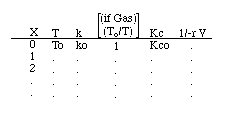
\( X = \frac{(C_{P_A} + C_{P_B}) (T - T_0)}{-\Delta H_{RX}} \) \( -r_A = k(t) F_{A0} \left[ (1 - x)^2 - \frac{2 x^2}{K_c(T)} \right] \) |
|
|
|
|
|
|
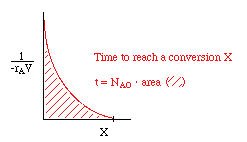
or use one of the integration formulas, e.g.: \( \int_{X_0}^{X_2} f(X) \, dX = \frac{h}{3} \left[ f(X_0) + 4 f(X_1) + f(X_2) \right] \) , to find the reaction time, t. Even better, use Polymath. |
|
 >
>
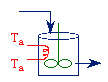
Cooling:
\( \frac{dT}{dt} = \frac{r_a V (\Delta H_{RX}) - UA (T - T_a)}{\sum N_i C_{pi}} \)
\( \frac{dT}{dt} = \frac{Q_g - Q_R}{\sum N_i C_{pi}} \)
* All chapter references are for the 1st Edition of the text Essentials of Chemical Reaction Engineering .