|
|
||||||||||||||
     |
||||||||||||||
|
||||||||||||||
|
Generic problem: To develop conceptual foundations, methodologies and tools for the comparative, analytic and quantitative descriptions of significant properties of spatial configuration, shape and form in architecture. To better understand the structure of space, shape and form and to support studies of their functional, behavioral, cognitive and cultural implications. To enhance the knowledge base that supports design formulation, design choices and design decisions. Funded research program 1995-1999: "Design Decisions Support System. Developing Second Generation Tools for the Analysis of Building Layout and Configuration". Georgia Tech Foundation Academic Initiative Grant. Principal Investigators: John Peponis and Jean Wineman. Purpose: To Establish a foundation for a enhancing the techniques of spatial analysis associated with space syntax. To provide a direct link between graphic input and output and traditional architectural drawings. To structure the computer programs so that we can incorporate emerging techniques for the analysis of shape as well as existing techniques for the syntactic analysis of permeability and visibility patterns. Result: Creation of SPATIALIST, a set of routines for the analysis of linear representations of spatial configuration, the automatic generation and analysis of convex partitions and the representation of visual fields. SPATIALIST runs on a Microstation platform. It has been licensed to 14 universities in Europe, Latin America and the USA through the Georgia Tech Research Corporation. |
||||||||||||||
|
GEOMETRIES FOR ARCHITECTURAL DESCRIPTIONS OF SHAPE AND SPATIAL CONFIGURATION |
||||||||||||||
 |
||||||||||||||
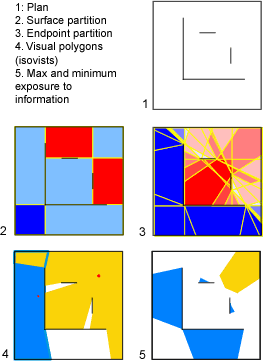
| The surface partition is produced by extending free standing wall endpoints. Partition lines are visibility thresholds for the appearance or disappearance of wall surfaces. The endpoint partition is produced by extending free standing wall endpoints and by producing all extensions of extendible visibility diagonals. Partition lines are visibility thresholds for the appearance or disappearance of edges. The resulting convex areas are informationally stable withrespect to visual information about shape. Visibility polygons (isovists) cover the area visible from a position. Areas of maximum and minimum exposure to visual information are visually linked to the greatest and to the smallest possible number of edges respectively. | ||||||||||||||
|
Main Associated Publications: Peponis J, Wineman J, Rashid M, Bafna S, Kim S H, 1998, "Describing plan configuration according to the covisibility of surfaces." Environment and Planning (B): Planning and Design, 25, 693-708 Peponis J, Wineman J, Bafna S, Rashid M, Kim S H, 1998, "On the generation of linear representations of spatial configuration." Environment and Planning (B): Planning and Design, 25, 559-57 Peponis J, Wineman J, Rashid M, Kim S H, Bafna S, 1997, "On the description of shape and spatial configuration inside buildings: convex partitions and their local properties." Environment and Planning (B): Planning and Design, 24, 761-781.
Taubman
College of Architecture & Urban Planning Phone: (734)763-1497 email: jwineman@umich.edu |
||||||||||||||
 |
|
|
|
|
|
|
|
|
|
|
|
|
|
|

 RETURN
TO TOP
RETURN
TO TOP